

Data sources: IRCC Canada • US State Department • Australia DHET • UK Home Office • ICEF Monitor • GradPilot • VisaVerge (2025–2026)
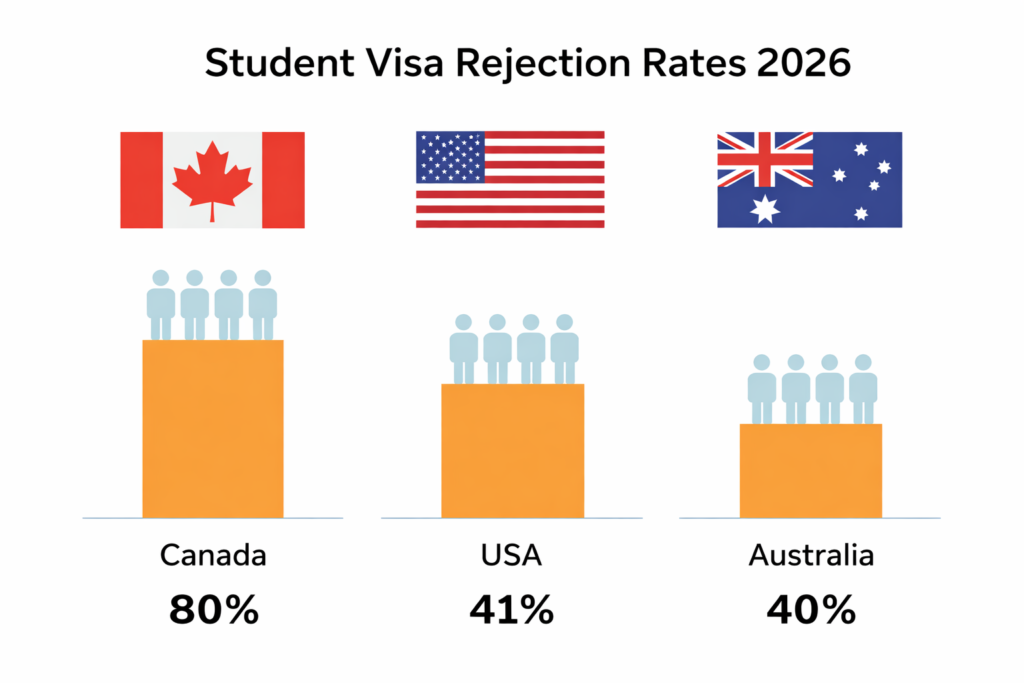
80% Indian applicants rejected by Canada (2025–26) | 41% US F-1 rejection rate — 10-year high | 40% Australia rejection rate for Indian uni applicants |
You saved ₹1–2 lakh for application fees. You got an admission letter. You studied for IELTS for months. And then — a rejection email arrived. No real explanation. No second chance. Just a flat refusal.
This is not a worst-case scenario anymore. In 2026, it is the single most common outcome for Indian students applying to study in Canada.
Student visa rejection rates in 2026 are rising rapidly, creating serious challenges for Indian students planning to study abroad.
The data is alarming, but here’s the truth most consultants won’t tell you: most rejections are completely avoidable — if you know what you’re up against. In this article we break down every number, every reason, every country, and most importantly — exactly what to do so you’re not the next rejection statistic.
Student Visa Rejection Rates 2026 (Country-wise Data)
The global visa landscape for Indian students has collapsed in two years. Let’s look at the actual data country by country.
🇨🇦 Canada — From Dream Destination to 80% Rejection
74–80% of Indian students rejected for Canada study permits in 2025–26 (IRCC Data). In 2023, it was just 32%. |
Canada issued only 408,000 study permits in 2026 — a 7% cut from 2025, itself 48% lower than 2023. For Indian applicants, the collapse is stark:
- Applications from India fell from ~20,900 per month in 2023 to just 4,515 in August 2025
- Only 1,196 out of 4,515 applications were approved in that month — the sharpest decline on record
- Canada’s financial proof requirement doubled to CAD $20,635 (~₹14.9 lakh) + full tuition
- The Student Direct Stream (SDS) fast-track was permanently shut down
- A new Provincial Attestation Letter (PAL) requirement added a third gate to the process
- Over 14,000 fraudulent admission letters flagged in 2024 — triggering blanket scrutiny on all Indian applicants
🇺🇸 USA — A 10-Year High in F-1 Rejections
The USA hit its highest F-1 student visa rejection rate in a decade — 41% in FY 2024, with 278,553 applications rejected out of 679,000. For Indian students, it got worse in 2025:
- Indian F-1 issuances dropped 61% in mid-2025 vs the previous year
- US enrollment of Indian students fell 6.9% by February 2026 (SEVIS data)
- Mandatory 5-year social media screening introduced June 2025
- No interview waivers available after October 2025 — a rejected applicant can face a 1-year ban
- 96% of US universities cite visa delays or rejections as the main reason for declining Indian enrollment
🇦🇺 Australia — Reclassified to Highest Risk Category
Australia reclassified India to Evidence Level 3 (AL3) from January 8, 2026 — the highest scrutiny tier. Earlier data shows rejection rates reached 40% for Indian university applicants and nearly 50% for vocational courses. The visa application fee was also hiked to AUD $2,000 — the highest in the world. Any rejection now costs you over ₹1 lakh just in fees.
🇬🇧 UK — The Only Good News
The UK remains the best major destination for Indian students. Approval rates for Indians remain 90–97%. The UK issued 84,739 student visas to Indians in Jan–Sep 2025 — a 13.7% increase despite global tightening. However, B2 English level and higher maintenance funds are now required from 2025.
🇩🇪 Germany — The Smart Alternative
Germany’s student visa approval rate stays above 90% for genuine applicants, and its preference among Indian students grew by 31% as Canada collapsed. With near-free tuition at public universities and a booming job market for STEM graduates, Germany is increasingly the smartest play — if you’re prepared for the language barrier.
Country-Wise Rejection Rate Comparison — April 2026
Country | Indian Rejection | Overall Rate | Key Trend (2026) | Risk Level |
🇨🇦 Canada (Indians) | 74–80% | 40% (all nations) | 2023: 32% → 80% in 2026 | 🔴 High |
🇺🇸 USA (F-1) | 41% | 41% | 10-year high (FY 2024) | 🔴 High |
🇦🇺 Australia | 40% (uni-level) | ~15% | Reclassified AL3 Jan 2026 | 🟢 Low |
🇬🇧 UK | 3–10% | 4.1% | Relatively stable | 🟢 Low |
🇩🇪 Germany | 5–10% | 5–10% | Lowest risk, growing fast | 🟢 Low |
Sources: IRCC, US State Dept, Aus DHET, UK Home Office, GradPilot, VisaVerge — updated April 2026
Why Visa Rejections Are Increasing ?
1. Visa Fraud at Massive Scale
The trigger was 2023. Canadian authorities identified 1,550 fraudulent applications tied to fake Indian admission letters. By 2024, enhanced verification flagged over 14,000 potentially fake acceptance letters globally. This caused blanket tightening on all Indian applications — even genuine ones pay the price for the bad actors.
2. Migration Reduction Targets
Every major destination — Canada, Australia, USA — is under domestic political pressure to cut migrant numbers. International students, who often use education as a PR pathway, became the first target. This isn’t personal to Indian students; it’s political math.
3. India-Canada Diplomatic Fallout
Following the 2023 Nijjar dispute, India-Canada diplomatic relations deteriorated sharply. While officials have not formally linked this to visa policy, independent analysts note that Indian applicants now face the highest refusal rate of any major nationality in Canada — including countries with lower historical approval track records.
4. Housing & Resource Pressure
Canada and Australia face housing shortages and public backlash against the pace of international student growth. Governments have responded by capping student intakes — with Indian applicants disproportionately affected due to their historically large share of applications.
Important: The crackdown is systemic — not a reflection on your merit. A fully qualified, genuine student with excellent academics can still get rejected if their documentation, SOP, or financial profile hits the wrong flags. That is why expert guidance matters more than ever in 2026. |
Top 7 Reasons Indian Students Get Their Visas Rejected in 2026
Based on IRCC decisions, Australia DHET data, and immigration tribunal case notes, these are the most common rejection triggers across all countries:
1. Weak Proof of Funds
This is the #1 reason in Canada in 2026. The requirement now stands at CAD $20,635 + tuition (roughly ₹15–20 lakh total). Officers look for funds that have been stable for 6+ months with a clear, verifiable source. Sudden large deposits, funds spread across multiple accounts, or amounts just at the minimum threshold are all red flags.
2. Generic or AI-Written SOP
Lines like “Canada has world-class universities” are an instant flag in 2026. Visa officers are now trained to detect boilerplate — including AI-generated text. Your Statement of Purpose must be hyper-specific: why this course, this university, this country, and how it connects to a clear career plan back in India.
3. Course-Profile Mismatch
Applying for a diploma in IT after a BA in History without explanation? Or your second Masters with no career rationale? Officers expect academic and professional continuity. If you’re switching fields, you must explain it convincingly — not just assert it.
4. No Demonstrated Ties to India
If you cannot show strong reasons to return home — family property, employment history, career ties — visa officers assume immigration intent. This is especially scrutinised in Canada and Australia in 2026.
5. Document Inconsistencies
Since Canada’s mandatory admission letter verification system launched in 2024, even minor discrepancies — a name spelled differently on your offer letter vs passport — can flag your file. All documents must be cross-verified, not just technically complete.
6. Failure to Satisfy the Genuine Student Test (Australia)
Australia’s new Genuine Student (GS) requirement replaced the older GTE test in 2026. You must now explain why you chose Australia specifically — ‘good universities’ is no longer accepted. Visa officers now actively use the ‘course available in home country’ clause to reject files.
7. Prior Visa Rejection (Any Country)
You must disclose prior rejections on every new application. Failing to do so is misrepresentation — a far more serious offence. A disclosed, explained rejection is manageable. A hidden one can get you permanently barred.
What Should Indian Students Do Right Now? (April 2026)
The September 2026 intake deadline is approaching. If you’re planning to apply — for Canada, UK, Australia, Germany, or USA — here’s your action plan by country:
For Canada
- Show funds 25–30% above the CAD $20,635 minimum — held stable for 6+ months in one primary account
- Secure your Provincial Attestation Letter (PAL) first — you cannot apply without it
- Apply only through IRCC-verified institutions — confirm your offer letter is in the verification portal
- Write a hyper-specific SOP: name the program, the professor, the city — and link it to your career path in India
- Consider smaller Canadian cities with higher PAL quotas — less competition, same degree value
For USA
- Make all social media accounts public — officers now audit the last 5 years of your online activity
- Prepare intensively for your visa interview — no waivers exist, and a single bad interview can trigger a 1-year ban
- Show financial proof from a single, clean, verifiable source
- Research your university and program deeply — generic answers at interview are a rejection trigger
For Australia
- Your Genuine Student statement must be personal, detailed, and clearly human-written — AI-generated content is flagged
- Explain why this specific course cannot be done in India — make the Australia case explicit
- Financial documents must be original, verifiable, and consistent with your declared sponsor
- Disclose any prior visa rejection from any country, with a clear, honest explanation
For UK or Germany (Lower Risk)
If Canada or USA rejections have set you back, the UK and Germany offer the strongest odds in 2026. The UK’s Graduate Route visa lets you stay 2 years post-study. Germany offers near-free education at public universities and among the lowest rejection rates globally. Both require strong documentation — but the approval environment is far more predictable.
GlobalEd Tip: Our visa counsellors specialise in documentation strategy — not just university shortlisting. We review your SOP, financial trail, and full application file before you submit. This single step has reversed rejections for hundreds of our students. |
Key Data Points at a Glance — April 2026
Canada: 74–80% rejection rate for Indian students (IRCC, Aug 2025). Study permits capped at 408,000 for 2026 — 7% lower than 2025. https://www.canada.ca/
|
Frequently Asked Questions (FAQs)
These are the questions we get asked most often at GlobalEd in April 2026:
Q: Is Canada’s visa rejection rate really 80% for Indian students in 2026? |
A: Yes. IRCC data confirmed a 74% rejection rate for Indian applicants in August 2025 — up from 32% in August 2023. Multiple sources including Business Standard and Business Today have reported figures reaching 80% in 2025–26. Study permit issuances dropped 70% from Jan–Jun 2024 to the same period in 2025 (125,034 to 36,417). |
Q: Can I reapply after a Canada visa rejection? |
A: Yes, but you must address the specific refusal reason. Request your GCMS notes from IRCC — these detail exactly why you were rejected. Then rebuild your application to address those specific gaps before reapplying. Do not reapply with the same documents. |
Q: Does a visa rejection in one country affect my application in another? |
A: You are legally required to disclose prior visa rejections on all new applications. Failure to disclose is misrepresentation — a far more damaging offence. A disclosed, explained rejection is manageable. A hidden one can result in permanent bans from multiple countries. |
Q: Which country has the highest student visa approval rate for Indians in 2026? |
A: The UK (90–97% approval), Germany (90%+), and Ireland (96–99%) are the safest destinations for Indian students in 2026. Poland (95%), Finland (92%), and New Zealand (85–90%) are also gaining popularity as predictable, lower-rejection alternatives to Canada and Australia. |
Q: Is September 2026 intake still a good idea given all this? |
A: Yes — but only with the right preparation. Applications from India to Canada have dropped sharply, meaning genuine, well-documented applicants face less competition within the available quota. The window is still open. The difference in 2026 is that application quality determines outcome — not just academic merit. |
Q: How much money do I need to show for a Canada student visa in 2026? |
A: Canada’s minimum proof-of-funds requirement is CAD $20,635 (approximately ₹14.9 lakh), but this is just the base. You also need to show you can cover your full tuition fees. Immigration experts recommend showing 25–30% above the minimum, stable in a single account for at least 6 months, with a clean, verifiable source of funds. |
Q: What is Australia’s Genuine Student (GS) test in 2026? |
A: The Genuine Student test replaced the older GTE requirement in Australia. It requires applicants to demonstrate why they specifically need to study in Australia — a vague answer like ‘Australia has great universities’ is no longer sufficient. Visa officers now use the ‘course available in home country’ clause actively to reject files that don’t make a compelling, specific case. |
Q: Should I use an education consultant or apply on my own in 2026? |
A: With rejection rates at historic highs, professional guidance has never been more valuable. A consultant reviews your SOP, verifies your documentation, prepares you for visa interviews, and identifies red flags before submission — not after. The cost of a rejected application ($3,000–$8,000+ in non-refundable fees) far exceeds the cost of expert guidance. |
The Bottom Line
The era of easy study abroad visas is over. Canada has gone from welcoming Indian students with open arms to rejecting 4 out of 5. The USA is at a decade-high in rejections. Australia has reclassified India to its highest risk tier. These are not temporary blips — they are structural policy shifts driven by domestic politics, fraud crackdowns, and migration targets.
But the data also shows this: well-prepared students with clean, specific, strategically built applications are still getting through. The failure isn’t in the dream of studying abroad. It’s in the preparation.
If you’re planning to apply for September 2026 intake, the window is still open — but it’s closing. The students who act now, get their documentation right, and build their applications strategically are the ones who will be boarding those flights in September.
Don’t Leave Your Study Abroad Dream to Chance |
Sources & References
• IRCC (Immigration, Refugees and Citizenship Canada) — IRCC Open Data, 2024–2026
• US State Department / Cato Institute — F-1 Visa Denial Rate FY2024
• Australian Department of Home Affairs — Student Visa Program Report, 2025–2026
• UK Home Office / British Council Student Mobility Report 2026
• GradPilot — Student Visa Rejection Rates by Country, March 2026
• VisaVerge — Indian Enrollment Drops 6.9% in SEVIS, April 2026
• ICEF Monitor — ‘Worse than COVID’ analysis of Canada student permit collapse, 2025
• Business Standard / Business Today / AngelOne — Canada 80% rejection rate reporting, Nov 2025
Published by GlobalEd Study Abroad Consultancy • Pitampura, New Delhi • globaled.co.in • April 11, 2026