

By GlobalEd Team | globaled.co.in | April 2026 | 11 min read | UK • Canada • Australia • USA • Ireland
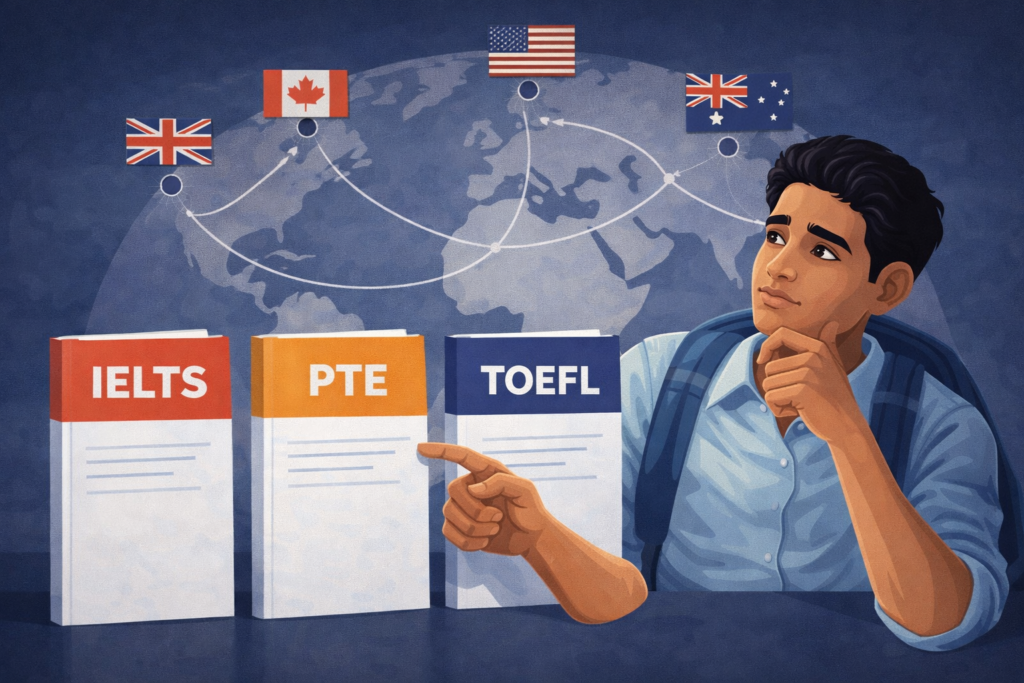
You have decided to study abroad. Your CGPA is decent. Your university shortlist is ready. But then someone asks: Have you taken your English test? And suddenly, you are confused — IELTS or PTE or TOEFL?
This is the question every Indian student faces — and it matters more than most people think. The wrong choice can delay your application, waste ₹17,000 in exam fees, or even cost you a visa.
This complete guide by the GlobalEd team breaks down IELTS vs PTE vs TOEFL specifically for Indian students in 2026 — covering format, cost, scores required, acceptance rates by country, and exactly which test you should take based on your destination and profile.
📌 Quick Answer Heading to the UK, Australia, or Canada? IELTS is the safest choice. Need fast results and are comfortable with computers? Go PTE. Applying to top US universities? TOEFL is your best bet. Read on for the full breakdown. |
Why Indian Students Must Choose Their English Test Carefully
India sends over 13 lakh students abroad every year, and every single one of them needs an English proficiency certificate — unless their last qualification was in English-medium instruction (and even then, most universities want a formal test score).
The three globally accepted tests are:
- IELTS (International English Language Testing System) — by British Council / IDP
- PTE Academic (Pearson Test of English) — by Pearson
- TOEFL iBT (Test of English as a Foreign Language, Internet-Based Test) — by ETS
Each test has its own format, scoring system, fee structure, and acceptance by universities and visa authorities. Picking the wrong one doesn’t just waste money — it can push your application deadline by months.
💡 Did You Know? Many students give IELTS and fail, then switch to PTE and clear it in 2 weeks. The tests are different in nature — not just in name. Choosing the right one for your strengths is half the battle won. |
IELTS vs PTE vs TOEFL: The Complete Comparison Table (2026)
Here is the side-by-side comparison every Indian student needs before booking their exam slot:
Feature | IELTS | PTE Academic | TOEFL iBT |
|---|---|---|---|
Exam Body | British Council / IDP | Pearson | ETS |
Full Form | IELTS | PTE Academic | TOEFL iBT |
Format | Paper + Computer | Computer-based | Computer-based |
Duration | 2 hrs 45 min | ~2 hrs | ~2 hrs |
Score Scale | 0–9 Band | 10–90 Points | 0–120 Points |
Results in | 3–13 Days | 2–5 Days (often 48 hrs) | 4–8 Days |
Exam Fee (INR) | ₹17,000 approx. | ₹16,900 approx. | ₹17,500 approx. |
Accepted by | UK, Aus, Canada, USA | UK, Aus, Canada, NZ | USA, Canada, Some EU |
Speaking | Face-to-face / Online | Recorded to AI | Recorded to AI |
Frequency | 48x/year | Daily at many centres | 50+ dates/year |
Retake Policy | Unlimited | Unlimited (5-day gap) | Unlimited (3-day gap) |
India Popularity | Most popular | Rising fast | Moderate |
Now let’s go deeper into each test, because the numbers above tell only half the story.
IELTS — Everything Indian Students Need to Know in 2026
What is IELTS?
IELTS is the world’s most popular English proficiency test, accepted by over 11,500 organisations globally. For Indian students, it is the default choice — especially those applying to the UK, Australia, Canada, and New Zealand.
IELTS comes in two versions:
- IELTS Academic — for undergraduate and postgraduate university admissions
- IELTS General Training — for migration and some vocational programs (NOT for most university applications)
If you’re applying to a university, always book IELTS Academic.
IELTS Format — 4 Sections
- Listening: 40 questions, 30 minutes + 10 min transfer (paper-based) or 30 min (computer-based)
- Reading: 40 questions, 60 minutes — academic texts from books, journals, newspapers
- Writing: 60 minutes — Task 1 (describe a graph/chart) + Task 2 (essay, 250 words)
- Speaking: 11–14 minutes — face-to-face interview with an examiner (or online via video)
IELTS Scoring
IELTS uses a Band Score from 0 to 9. Each section is scored separately and then averaged for an Overall Band Score. Most universities require 6.0 to 7.5 depending on the program. https://www.ielts.org/
Who Should Choose IELTS?
- Students applying to UK, Australia, Canada, New Zealand, or Ireland
- Those who are comfortable with human interaction in Speaking (face-to-face interview)
- Students who prefer pen-and-paper or computer-delivered tests with human evaluation
- Those applying for UK Tier 4 Student Visa or Australian Student Visa (IELTS is explicitly required by UKVI for some visa categories)
IELTS Pros and Cons for Indian Students
- ✅ Most widely accepted — zero risk of university rejection
- ✅ Human Speaking examiner — easier for confident speakers
- ✅ Paper-based option available at many centres
- ✅ Available 48 times a year across India
- ❌ Results take 3–13 days (slower vs PTE)
- ❌ Writing is evaluated by humans — can have subjective scoring
- ❌ Academic Reading passages can be very complex
PTE Academic — The Fast-Track Option for Indian Students
What is PTE Academic?
PTE Academic (Pearson Test of English) is a fully computer-based, AI-scored English test. It launched as an alternative to IELTS and has exploded in popularity among Indian students — especially those targeting Australia and Canada — because of one key reason: results in 48 hours.
PTE is accepted by thousands of universities across the UK, Australia, New Zealand, Canada, and the USA, and is approved for Australian and New Zealand visa applications.
PTE Academic Format
- Speaking & Writing: Combined — 77–93 minutes (Read Aloud, Repeat Sentence, Describe Image, Re-tell Lecture, Short Answer, Essay, Summarise Written Text)
- Reading: 32–41 minutes (Multiple Choice, Re-order Paragraphs, Fill in Blanks)
- Listening: 45–57 minutes (Summarise Spoken Text, Multiple Choice, Fill in Blanks, Highlight Correct Summary, Write From Dictation)
Total test time: approximately 2 hours.
PTE Scoring
PTE scores range from 10 to 90. Each skill (Listening, Reading, Speaking, Writing) is scored separately and an Overall Score is calculated. Many Australian university and visa requirements specify a PTE score of 50–65+.
Who Should Choose PTE?
- Students applying to Australia — PTE has a strong foothold here and is accepted for Australia Student Visa
- Those who type fast and are comfortable with computers
- Students nervous about speaking to a human — PTE Speaking is recorded, not live
- Students in a hurry — PTE results arrive in as little as 48 hours
- Those who want flexible scheduling — available daily at most centres
PTE Pros and Cons for Indian Students
- ✅ Results in 48 hours — fastest of the three tests
- ✅ AI scoring — no human bias, very consistent
- ✅ Available almost daily in major Indian cities
- ✅ Speaking is recorded (less stressful for shy students)
- ✅ Heavily favoured for Australian visa and universities
- ❌ AI scoring can penalise pronunciation and accent if not trained
- ❌ Less accepted than IELTS at some US and European institutions
- ❌ Multi-task questions can be confusing for first-time takers
TOEFL iBT — The American Standard for Global Universities
What is TOEFL iBT?
TOEFL iBT (Test of English as a Foreign Language, Internet-Based Test) is developed and administered by ETS (Educational Testing Service). It is the go-to English proficiency test for universities in the United States and is widely accepted globally, though less commonly used by Indian students than IELTS or PTE.
TOEFL iBT Format
- Reading: 35 minutes — 2 passages, 20 questions
- Listening: 36 minutes — lectures, classroom discussions
- Speaking: 16 minutes — 4 tasks (1 independent + 3 integrated)
- Writing: 29 minutes — 2 tasks (1 integrated + 1 academic discussion)
Total: approximately 2 hours. The Home Edition (TOEFL at home) is also available in India.
TOEFL Scoring
TOEFL iBT scores range from 0 to 120 (each section is scored 0–30). Most US universities require 80–100+, with Ivy League schools sometimes requiring 100–110.
Who Should Choose TOEFL?
- Students applying to universities in the USA
- Students applying to Canada’s top universities that accept TOEFL
- Those applying to European universities with English-medium programs (Germany, Netherlands)
- Students who are comfortable with integrated tasks — combining reading, listening, and writing/speaking together
TOEFL Pros and Cons for Indian Students
- ✅ Best accepted at US universities — essential for Ivy League and top-ranked programs
- ✅ Home Edition available — no need to travel to a centre
- ✅ Academic-style tasks mirror actual university work
- ❌ Less accepted in the UK for Tier 4 Student Visa (UKVI requires IELTS SELT in most cases)
- ❌ Higher complexity — integrated tasks require multitasking
- ❌ Slightly more expensive than IELTS and PTE
- ❌ Less popular in India — fewer preparation resources locally
Score Requirements by Country and Destination — 2026 Reference Table
Use this table to find out what score you need for your target country. Minimum scores vary by university; always check the specific institution’s requirement.
Country / Purpose | IELTS Band | PTE Score | TOEFL Score |
|---|---|---|---|
UK – Tier 4 Student Visa | 6.0 – 7.0 | 51 – 65 | 80 – 100 |
Canada – Study Permit | 6.0 – 7.0 | 58 – 65 | 83 – 100 |
Australia – Student Visa | 5.5 – 7.0 | 50 – 65 | 79 – 94 |
USA – Top Universities | 6.5 – 7.5 | 60 – 70 | 80 – 100 |
Germany – English Programs | 6.5+ | 62+ | 90+ |
Ireland – Visa Requirement | 6.0+ | 55+ | 79+ |
New Zealand – Student Visa | 5.5 – 6.5 | 42 – 58 | 61 – 79 |
MBA Programs (Global) | 6.5 – 7.5 | 65 – 75 | 90 – 110 |
⚠️ Important Note These are general minimum scores. Competitive universities and high-demand courses (Medicine, Law, MBA) typically require 0.5–1 band / 5–10 points higher than the visa minimum. Always verify on the specific university website or consult a GlobalEd counsellor. |
IELTS vs PTE vs TOEFL: Which Test is Best for Your Target Country?
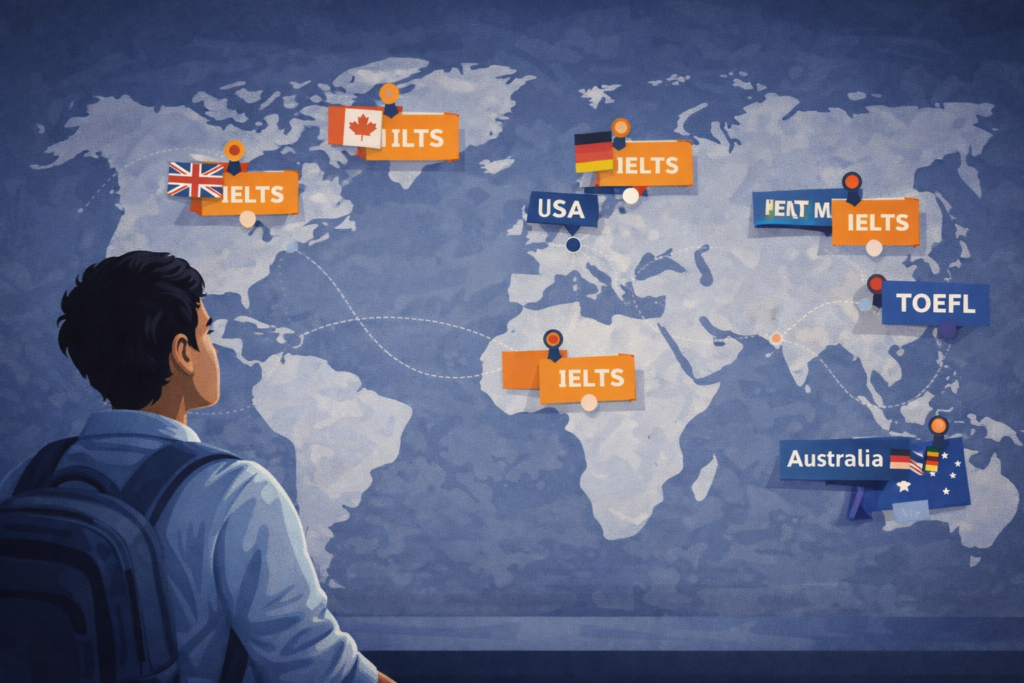
UK
IELTS is the dominant choice for UK applications. The UK Home Office recognises IELTS (both Academic and UKVI) as an approved SELT (Secure English Language Test) for the Student Route visa. PTE Academic is accepted by most UK universities for admissions but is NOT accepted by UKVI for Student Route visa purposes in all cases. TOEFL is accepted by universities but generally not for the visa application itself.
🇬🇧 Verdict for UK Go with IELTS. It’s accepted for both university admission AND the UK Student Visa. No other test matches its coverage here. |
Canada
Canada accepts all three tests — IELTS, PTE, and TOEFL — for both university admissions and the Study Permit application through IRCC (Immigration, Refugees and Citizenship Canada). IELTS is most commonly used, but PTE is growing fast especially since many students from India prefer its quick results when working against tight IRCC deadlines.
🇨🇦 Verdict for Canada IELTS or PTE — both work perfectly. If your application is time-sensitive, go PTE for 48-hour results. If you prefer human evaluation, stick with IELTS. |
Australia
Australia accepts IELTS, PTE, and TOEFL for both university and Student Visa (subclass 500). PTE has particularly strong traction in Australia — the Department of Home Affairs explicitly lists PTE Academic as an accepted test. Many Australian universities even have dedicated PTE score requirements published separately from IELTS.
🇦🇺 Verdict for Australia Both IELTS and PTE are excellent choices. PTE has a slight edge for speed and is AI-scored — consistent results even if your accent is strong Indian English. |
USA
The USA is TOEFL’s home turf. Most top US universities, including Ivy League institutions, state universities, and community colleges, prefer or exclusively accept TOEFL. Many US universities also accept IELTS (especially for graduate programs), but TOEFL is the standard. PTE acceptance in the USA is more limited.
🇺🇸 Verdict for USA TOEFL first. Check if your specific universities accept IELTS — many do. Avoid relying on PTE for US applications unless explicitly confirmed. |
Germany / Europe (English Programs)
European universities offering English-taught programs typically accept IELTS and TOEFL. PTE is gaining acceptance but is not yet universally listed by German universities. IELTS 6.5+ or TOEFL 90+ are common requirements.
🌍 Verdict for Europe IELTS is the safer bet. Check each university’s specific requirements before booking. |
Which Test Should You Choose Based on Your Profile?
Beyond destination, your personal strengths and situation matter. Here’s a quick decision guide:
If You Are… | Choose This Test |
|---|---|
Applying to UK universities + need Student Visa | IELTS Academic |
Applying to Australia — want fast results | PTE Academic |
Targeting top US universities | TOEFL iBT |
Confident speaking face-to-face with examiner | IELTS |
Shy/nervous about live speaking | PTE or TOEFL |
Need score within 48–72 hours | PTE Academic |
Targeting Canada Study Permit (time-sensitive) | PTE Academic |
Applying to 5+ countries across regions | IELTS (safest coverage) |
Strong academic writing, poor listening | IELTS |
Fast typist, good with integrated tasks | TOEFL or PTE |
Budget is a major concern | PTE (slightly cheaper, daily slots) |
Applying to Germany / EU English programs | IELTS or TOEFL |
How to Prepare for IELTS, PTE, or TOEFL in India — Practical Tips
Preparing for IELTS
- Use British Council’s official IELTS preparation materials and mock tests
- Focus on Task 2 Writing — it carries more weight and is often where Indians lose marks
- Practice Speaking aloud daily — record yourself and compare with sample Band 7–8 responses
- Read English newspapers (The Hindu, The Guardian) for Reading practice
- Cambridge IELTS books (1–18) are the gold standard for practice tests
Preparing for PTE
- Use Pearson’s official Scored Practice Tests — they use the actual AI scoring engine
- Master ‘Read Aloud’ and ‘Repeat Sentence’ — these two tasks contribute to both Speaking AND Reading scores
- Practice typing speed — PTE Writing is entirely typed
- Focus on clarity of pronunciation, not British/American accent — the AI rewards clarity
- Apps like E2Language and PTE Magic are popular among Indian test-takers
Preparing for TOEFL
- Use ETS’s official TOEFL Prep materials and the official TOEFL Practice Online (TPO) tests
- Practise Integrated Writing tasks — combine reading + listening + writing in one response
- Listen to academic podcasts (TED Talks, NPR) daily to build Listening skills
- Speaking tasks are timed — practise responding in exactly 45 or 60 seconds
- Manhattan Prep and Magoosh TOEFL are highly rated courses for Indian students
Cost Comparison: IELTS vs PTE vs TOEFL in India (2026)
Cost Factor | IELTS | PTE | TOEFL |
|---|---|---|---|
Exam Registration Fee | ~₹17,000 | ~₹16,900 | ~₹17,500 |
Score Report (university) | Free (5 reports) | Free (unlimited) | Free (4 reports) |
Rescheduling Fee | ₹3,500+ | ₹4,500+ | ₹3,500+ |
Prep Material Cost | ₹500–₹5,000 | ₹1,000–₹5,000 | ₹1,000–₹6,000 |
Coaching (optional) | ₹8,000–₹25,000 | ₹5,000–₹18,000 | ₹8,000–₹25,000 |
All three tests are roughly similar in cost. Budget-wise, PTE wins slightly because of daily availability (no need to wait weeks for the next slot, reducing urgency retake scenarios). IELTS coaching infrastructure in India is more established, which often means cheaper and more accessible preparation classes.
🎯 Not Sure Which Test to Choose? Get Free Expert Guidance from GlobalEd Our study abroad counsellors have helped hundreds of Indian students pick the right English test for their destination, profile, and timeline. Book your FREE counselling session today. 📞 Call/WhatsApp: +91 70421 72502 🌐 Visit: globaled.co.in | 📧 info@globaled.co.in |
Frequently Asked Questions: IELTS vs PTE vs TOEFL for Indian Students
Q1. Is IELTS harder than PTE for Indian students?
Neither is universally harder — it depends on your strengths. IELTS has a face-to-face Speaking round and complex Reading passages. PTE is fully computer-based with AI scoring, which rewards pronunciation clarity over accent. Most Indian students find PTE’s Repeat Sentence and Read Aloud tasks challenging, while IELTS Writing Task 1 trips up many students. Try a free practice test for both and decide.
Q2. Which English test is accepted for the UK Student Visa?
IELTS (both IELTS Academic and IELTS UKVI) is the safest option for the UK Student Route visa. While PTE and TOEFL are accepted by UK universities for admissions, UKVI (UK Visas and Immigration) requires an approved Secure English Language Test (SELT), and IELTS is the most widely listed. Always verify with the specific university and the UK Home Office website.
Q3. How many attempts does it take for Indian students to clear these tests?
On average, Indian students clear IELTS or PTE within 1–2 attempts when properly prepared. TOEFL typically requires more structured preparation. The biggest mistake students make is attempting the exam without sufficient practice. At GlobalEd, we recommend 6–8 weeks of focused preparation before your first attempt.
Q4. Can I submit IELTS for one country and PTE for another?
Yes, absolutely. Your test score report is your own. You can send your IELTS score to UK universities and your PTE score to Australian universities at the same time. Scores are valid for 2 years from the test date for all three exams.
Q5. Is PTE accepted for Canada PR and Study Permit?
Yes. IRCC (Immigration, Refugees and Citizenship Canada) accepts PTE Academic for Canadian Student Permits and some immigration streams. However, always verify the latest IRCC guidelines as immigration policies are updated regularly.
Q6. Which test has the fastest results?
PTE Academic wins — results are typically available within 48 hours of your test. TOEFL takes 4–8 days and IELTS takes 3–13 days (computer-based IELTS is faster than paper-based).
Q7. Can I give both IELTS and PTE and use whichever score is better?
Yes. Many students attempt both and submit whichever score best meets the university’s requirements. Since scores are valid for 2 years, this is a smart strategy if you have the time and budget.
Final Verdict: IELTS vs PTE vs TOEFL — Which Should You Choose?
There is no single ‘best’ English test — the right choice depends on three factors: your destination country, your personal strengths, and your application timeline.
- Choose IELTS if: you’re applying to the UK, or you want the most universally accepted test with human evaluation
- Choose PTE if: you’re targeting Australia or Canada and need fast results, or prefer AI scoring
- Choose TOEFL if: the USA is your primary destination, especially for top-ranked universities
Whichever test you choose, preparation is everything. Indian students who score 7+ bands or 65+ on PTE consistently do so with 6–10 weeks of structured practice — not talent alone.
And if you’re still unsure, the GlobalEd team is here to help you make the right call — for free.
📚 Ready to Study Abroad? GlobalEd Will Guide You — Step by Step From choosing the right English test to university shortlisting, application, and visa support — GlobalEd handles everything. Join hundreds of students who’ve made their study abroad dream a reality with our expert guidance. Book your FREE counselling session now. No fees. No obligations. 📞 Call/WhatsApp: +91 70421 72502 🌐 Visit: globaled.co.in | 📧 info@globaled.co.in |
About GlobalEd
GlobalEd (globaled.co.in) is one of India’s most trusted study abroad consultancies, based in Pitampura, New Delhi. We specialize in helping Indian students gain admission to universities in the UK, Canada, Australia, USA, Ireland, Germany, and beyond — with expert support across admissions, English test guidance, visa applications, and pre-departure orientation.
📍 Address: 2nd Floor, 2C–JD, Opposite Metro Pillar–356, Pitampura Road, Pitampura, Delhi–110034
📞 Phone/WhatsApp: +91 70421 72502
🌐 Website: globaled.co.in
📧 Email: info@globaled.co.in

