

By GlobalEd Team | April 2026 | 14 min read | Canada
The Canada student visa rejection rate 2026 has reached alarming levels for Indian applicants — and understanding why could save your study abroad dream. In August 2025, Canadian immigration authorities rejected 74% of study permit applications from India, nearly three times the refusal rate for Chinese applicants in the same period, according to IRCC Open Data. The number of Indian students who even applied that month collapsed from 19,175 to just 3,920, a drop of nearly 80%.
The Canada student visa rejection rate 2026 is a critical concern for every Indian family planning overseas education.
Riya Sharma had always dreamed of studying business analytics in Toronto. A bright student from Chandigarh with a 78% aggregate and a GIC already deposited, she was certain her Canada study permit would come through. Three weeks later, she opened her email to find a single-line refusal: “Purpose of visit not established.” She had never seen that phrase before. She had no idea what she did wrong.
She is not alone. In August 2025, Canadian immigration authorities rejected 74% of study permit applications from India — nearly three times the refusal rate for Chinese applicants in the same period, according to data from IRCC Open Data Portal and ICEF Monitor. The number of Indian students who even bothered applying that month fell from 19,175 to just 3,920, a drop of nearly 80%.
Canada has not closed its doors. But it has made them significantly harder to open. This blog explains exactly what is driving the Canada student visa rejection rate in 2026, which mistakes are costing Indian students their spots, and what you can do today to give your application the best possible chance.
KEY NUMBERS AT A GLANCE — 2026
Before we dive into the reasons, here is the reality of Canada’s student visa landscape for Indian applicants today.
Metric | Figure | Source |
|---|---|---|
Canada study permit cap (2026) | 408,000 total permits | IRCC |
New entrant slots from abroad | 155,000 only | IRCC |
India study permit refusal rate (Aug 2025 peak) | 74% | IRCC Open Data / GradPilot |
Global study permit refusal rate (2026) | ~62% | IRCC / Amir Ismail Immigration |
India approval rate for new arrivals (2026) | 25–27% only | Times of India / IRCC |
Top refusal reason — material incompleteness | 41% of refusals | IRCC Data |
Top refusal reason — unclear funding source | 36% of refusals | IRCC Data |
SDS (Student Direct Stream) status | DISCONTINUED (Nov 2024) | IRCC |
Financial proof required (from Sep 2025) | CAD $22,895 + tuition + travel | IRCC |
Why Is the Canada Student Visa Rejection Rate So High in 2026?
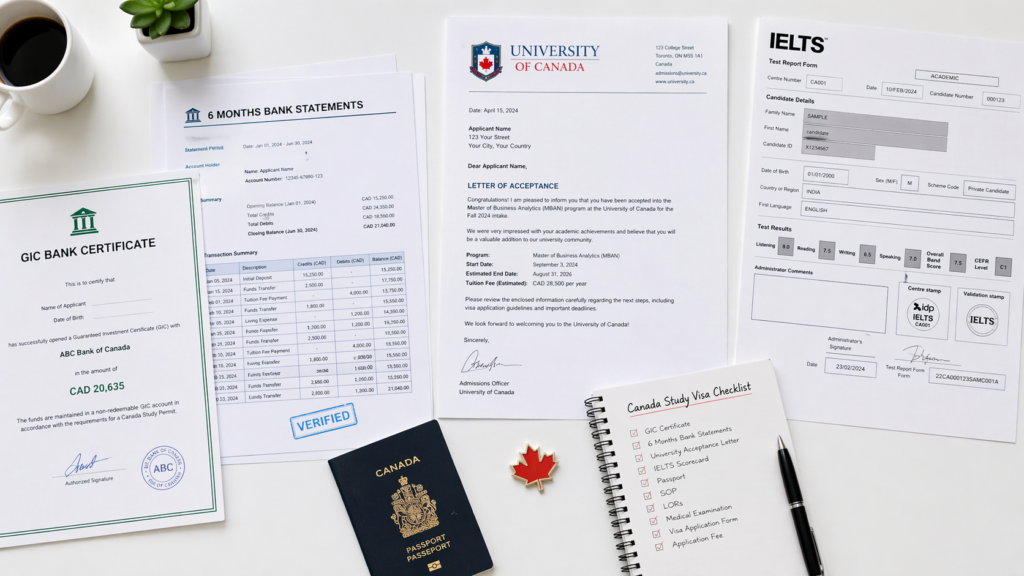
The Canada student visa rejection rate 2026 is the result of several overlapping policy changes that hit Indian applicants simultaneously.
To understand why rejections have spiked so sharply, you need to understand the policy earthquake that Canada’s immigration system went through in late 2024 and 2025. Several changes hit at once — and many Indian students were caught off guard.
1. The Student Direct Stream Is Gone
Until November 8, 2024, Indian students could apply through the Student Direct Stream (SDS) — a fast-track program that promised processing in 20 days for applicants who met strict requirements around GIC deposits, IELTS scores, and financial documentation. SDS had an exceptional approval rate, reaching 98% for Indian applicants in 2024.
Then, abruptly, IRCC discontinued SDS. All applicants — regardless of nationality — now go through the regular study permit stream, which takes 8 to 16 weeks and subjects every file to far more intensive scrutiny. The fast-track advantage Indian students had built their strategies around simply no longer exists.
2. The 408,000 Cap and the Two-Tier System
Canada has set a hard cap of 408,000 total study permits for 2026, down from 485,000 in 2024. More critically, only 155,000 of these slots are reserved for new international students arriving from abroad — a 50% reduction from previous years. The other 62% of permits are reserved for students already inside Canada (renewals and extensions), who have a statistically far better approval rate.
This means if you are applying from India, you are competing for a dramatically smaller pool than ever before.
3. The Provincial Attestation Letter (PAL) Requirement
For undergraduate and diploma students, a Provincial Attestation Letter (PAL) is now mandatory before IRCC will even process a study permit application. The PAL must come from the province where your institution is located, confirming that your institution has been allocated a slot within that province’s international student quota.
Many students were unaware of this requirement, submitted applications without a PAL, and received automatic rejections. The good news: as of January 1, 2026, Master’s and PhD students at public Designated Learning Institutions (DLIs) are fully exempt from the PAL requirement — and benefit from faster processing times as a result.
GOOD NEWS FOR POSTGRADUATE APPLICANTS
If you are applying for a Master’s or PhD program at a public Canadian DLI, you are PAL-exempt as of January 2026. You also qualify for priority processing. This is Canada’s clearest signal about which students it most wants to attract. Plan your application with this advantage in mind.
4. Raised Financial Proof Requirements
Effective September 1, 2025, IRCC significantly raised the financial bar. Applicants must now demonstrate access to at least CAD $22,895 for living expenses alone — a 34% increase from previous requirements — in addition to their full first-year tuition and travel costs. For a typical Indian student applying to an Ontario university with CAD $35,000 annual tuition, this means proving access to roughly CAD $57,895 (approximately INR 35–38 lakhs) before they board a plane.
Critically, the funds must be verifiable. Large unexplained deposits, money recently transferred just before the application window, or funds sourced from informal channels are all red flags that trigger intense scrutiny from visa officers.
The Top 8 Reasons Canadian Study Permit Applications Get Rejected
Now let us look at the specific, actionable reasons why individual applications fail. These are drawn from IRCC data, immigration lawyers’ case notes, and patterns reported by consultants across India.
Reason 1: Weak or Incomplete Financial Documentation (41% of refusals)
This is the single largest cause of refusal. Visa officers need to see that your money is real, stable, and sufficient. Common financial mistakes that trigger rejection include:
- Bank statements showing a sudden large deposit just before the application
- Funds that appear and disappear without explanation
- No source documentation for the money (property sale deed, salary slips, business income proof, etc.)
- Showing the exact minimum amount with no buffer — officers are suspicious of accounts that appear staged
- GIC certificates from non-IRCC-approved institutions
- Loan sanction letters without proper bank letterhead or NBFC registration details
WHAT OFFICERS LOOK FOR IN YOUR BANK STATEMENTS
IRCC wants to see 4–6 months of consistent financial history. Funds should look like they belong in your account. If your family recently sold a property or received a large sum, attach an affidavit explaining the source. Unexplained money is treated as suspicious money.
Reason 2: Failing to Demonstrate Genuine Intent to Study (Not Migrate)
Canada’s visa officers are trained to distinguish between students who genuinely want to study and students who are using a study permit as a backdoor into immigration. With 74% of Indian applications being refused at peak, the system defaults to scepticism for Indian applicants.
Your application — especially your Statement of Purpose (SOP) and Letter of Explanation (LOE) — must clearly answer three unspoken questions that every officer is asking:
- Why do you need to study this specific program in Canada and not in India?
- How does this program advance your career in India (or your home country)?
- What compelling ties to India will bring you back after your studies?
Ties to home country are critical. These can include family responsibilities, property ownership, a job offer waiting for you, an ongoing business, or clear career prospects in your field in India. Vague answers like “I want to gain international exposure” are almost guaranteed to get a refusal.
Reason 3: Program Choice That Does Not Make Logical Sense
If your academic background in India does not logically connect to the program you are applying to in Canada, officers question whether you are genuinely there to study. For example, a graduate with a BTech in Computer Science applying for a Diploma in Hospitality Management will raise serious red flags without a compelling explanation.
Your SOP must clearly tell the academic story — why this program, why now, and how it connects to where you have come from and where you are going professionally.
Reason 4: Missing or Invalid Provincial Attestation Letter (PAL)
For undergraduate and diploma applicants, submitting an application without a valid PAL from the relevant province is an automatic disqualifier. Even if every other part of your application is perfect, the absence of a PAL means instant refusal.
PALs are institution-specific and province-specific. Your university’s international admissions office should guide you through obtaining one. Start this process the moment you receive your Letter of Acceptance.
Reason 5: Problems with the Letter of Acceptance (LOA)
Your LOA must come from a Designated Learning Institution (DLI) that is listed on IRCC’s official registry. Submitting an LOA from a private college that is not a properly registered DLI, using an expired LOA, or submitting a fraudulent LOA (IRCC caught 9,000 fake LOAs in a five-month period in 2024–2025) will result in immediate rejection and potential bans.
Always verify your institution’s DLI status on the official IRCC website before applying.
Reason 6: Insufficient or Inconsistent Study Plan / SOP
Post-SDS, the Letter of Explanation (LOE) or Statement of Purpose is no longer optional — it is the core document that makes or breaks borderline applications. IRCC officers are now trained to evaluate eight implicit criteria when reading an LOE, including the clarity of your academic goals, the logic of your program choice, evidence that you understand the Canadian education system, and the strength of your home-country ties.
Generic, AI-generated, or copy-pasted SOPs are immediately identifiable and routinely rejected. Your SOP must be specific, personal, and evidence-based.
Reason 7: Low IELTS / Language Test Scores
Each Canadian institution sets its own minimum language requirements. Submitting test results that fall below your institution’s stated threshold — even by a fraction of a band — is grounds for immediate rejection. This is a simple, avoidable mistake.
Take your language test at least six months before your intended intake date. If you miss the minimum score, retake it. Do not apply with a score you know is borderline.
Reason 8: Prior Immigration History Issues
Prior visa refusals — whether for Canada or other countries — must be disclosed honestly in your application. Misrepresentation of any previous refusal or entry is considered fraud and can result in a multi-year ban from Canada. If you have had a prior refusal, work with an experienced consultant to address it transparently in your new application.
Which Students Still Get Approved in 2026?
Despite the alarming statistics, Canada is still approving applications. The system is selective, not closed. Based on current approval patterns, applicants with the best odds share these characteristics:
Profile Factor | Approval-Friendly | Higher Risk |
|---|---|---|
Program level | Master’s / PhD | Undergraduate / Diploma |
Institution type | Public DLI (PAL exempt) | Private college / Non-DLI |
Financial proof | 6 months clean history + 30% buffer | Exact minimum, recent deposits |
Academic continuity | Clear logical progression | Unrelated field change |
Home country ties | Strong — property, family, career | No clear ties documented |
SOP quality | Specific, personalised, evidence-based | Generic / AI-written |
IELTS / PTE score | Above institution minimum + buffer | Borderline or below minimum |
Prior refusals | None, or disclosed + addressed | Undisclosed prior refusals |
A Step-by-Step Action Plan to Avoid Canada Visa Refusal in 2026
If you are planning to apply for a Canadian study permit, here is your practical, timeline-based action plan:
8–10 Months Before Your Intended Start Date
- Choose your institution and confirm it is a registered DLI on the IRCC website
- Begin building a clean, transparent 6-month financial trail
- Book your IELTS / PTE well in advance — do not apply with a borderline score
- If applying for undergraduate/diploma: start the PAL process immediately after receiving your LOA
4–6 Months Before Start Date
- Calculate your exact financial requirement: first-year tuition + CAD $22,895 + travel. Have this fully documented
- If your funds include a large recent sum (property sale, gift), prepare a signed affidavit explaining the source
- Write your SOP / LOE. Be specific about your academic journey, why Canada, and your return plans
- Have your complete application reviewed by a qualified consultant before submission
At Application Stage
- Upload all documents in the correct IRCC category folders — misfiled documents cause delays and rejections
- Do your biometrics upfront — this alone can save 2–4 weeks of processing time
- Disclose all prior visa refusals honestly. Misrepresentation is fatal to your application
- Apply early — quota slots fill up in the first months of each application window
Worried About Your Canada Study Permit? GlobalEd’s experts review your complete profile — documents, financials, study plan — and tell you exactly what to fix before you apply. Book Your FREE Consultation at globaled.co.in | +91 9217112502 |
What to Do If Your Canada Study Permit Was Rejected
If you have already received a refusal, do not panic. A refusal is not permanent. Here is what to do:
Step 1: Understand Exactly Why You Were Refused
Your refusal letter will contain a reason code or a brief explanation. This is your starting point, but it is often not the complete picture. You can request your visa officer’s case notes (called GCMS notes) through an Access to Information request. These notes show exactly what the officer found concerning — and are essential if you are planning to reapply.
Step 2: Address Every Specific Concern Before Reapplying
Reapplying with the same documentation that caused your first refusal will almost certainly lead to a second refusal. Your new application must directly address each reason cited in the refusal. This is not about submitting more documents — it is about submitting better, more targeted documents and a stronger LOE.
Step 3: Consider Whether Canada Is Still the Right Choice
For some students — especially those targeting undergraduate programs or those with a profile that keeps triggering immigration intent concerns — it may be worth honestly evaluating whether a different destination like the UK, Ireland, or Germany offers a more straightforward path to quality education and a strong career outcome. A good consultant will help you make this assessment honestly.
IF YOUR VISA WAS REFUSED: DO NOT REAPPLY IMMEDIATELY
Wait until you have GCMS notes, fully understand the refusal reason, and have made concrete changes to your application. Rushing a second application without fixing the root cause wastes time, money, and uses up quota slots. Speak to a qualified consultant first.
Is Canada Still Worth It in 2026?
Despite all of the above, Canada remains one of the strongest destinations for Indian students — particularly at the postgraduate level. Here is an honest assessment:
Factor | Reality for Indian Students in 2026 |
|---|---|
Quality of education | World-class — QS-ranked universities, research-intensive environment |
PR pathway | Still exists via Express Entry / PNP, but harder and takes longer than 2022–2023 |
Post-study work (PGWP) | Still available — up to 3 years for programs of 2+ years |
Part-time work | 24 hours/week off-campus during academic sessions (increased from 20) |
Tuition cost | CAD $25,000–50,000/year for international students depending on program |
Scholarship availability | Good at graduate level — merit scholarships at most public universities |
Visa approval odds (Master’s, strong profile) | Significantly better than undergraduate — aim for 2026 application |
Alternative to consider | UK Graduate Route, Ireland, Germany (for tech/engineering), Australia |
Frequently Asked Questions About Canada Student Visa Rejection 2026
These are the most common questions students ask us about the Canada student visa rejection rate 2026 and what to do about it.https://www.canada.ca/
What is the Canada student visa rejection rate for Indian students in 2026?
Indian applicants saw a 74% refusal rate at the peak in August 2025, according to IRCC Open Data Portal. In 2026, the overall global refusal rate stands at approximately 62%, but India-specific rates remain significantly higher than the global average. The approval rate for new Indian arrivals in 2026 is estimated at 25–27%.
Why did Canada discontinue the Student Direct Stream (SDS)?
IRCC discontinued SDS on November 8, 2024, citing concerns about fraud, non-attendance at institutions, and rising asylum claims among students who had entered through the SDS route. All applicants — regardless of nationality — now apply through the regular study permit stream.
Do Master’s students in Canada need a PAL in 2026?
No. As of January 1, 2026, Master’s and PhD students applying to public Designated Learning Institutions are fully exempt from the Provincial Attestation Letter (PAL) requirement. This exemption also allows for faster processing. Undergraduate and diploma applicants still require a PAL.
How much money do I need to show for a Canada student visa in 2026?
Effective September 1, 2025, you must demonstrate access to CAD $22,895 in living expenses, plus your first-year tuition fees, plus estimated travel costs. For Quebec, the requirement is approximately CAD $24,617. These amounts must be demonstrated through verifiable bank statements and should reflect a stable financial history of at least 4–6 months.
Can I reapply for a Canada student visa after rejection?
Yes. A refusal is not permanent. However, you should request your GCMS case notes first, address every specific concern raised in the refusal, and significantly strengthen your financial documentation and Statement of Purpose before reapplying. Simply resubmitting the same application is unlikely to succeed.
Is Canada still a good option for Indian students in 2026?
For postgraduate (Master’s/PhD) students with strong academic profiles, solid financial documentation, and a clear career plan, Canada remains an excellent destination. For undergraduate applicants, the combination of the 155,000 new-entrant cap, mandatory PAL requirements, and high scrutiny makes alternatives like the UK or Ireland worth serious consideration alongside Canada.The Canada student visa rejection rate 2026 is high, but it is not a dead end for students who apply strategically
Final Word: The New Reality of Studying in Canada
The days of treating a Canada study permit as a relatively predictable outcome are over — at least for now. The system has changed fundamentally, and Indian students who approach it with the same assumptions they had in 2022 or 2023 are setting themselves up for refusal.
But the students who understand the new rules, build genuinely strong applications, and choose the right program level and institution type are still getting approved. Canada has not changed what it wants — it has just become more rigorous about filtering for it.
Thorough preparation, honest documentation, a compelling and specific SOP, and expert guidance are no longer optional extras. In the 2026 system, they are the difference between a visa stamp and a rejection letter.
The Canada student visa rejection rate 2026 rewards preparation — and punishes assumptions.Students who understand why the Canada student visa rejection rate 2026 is high are in a far stronger position than those who don’t.
ABOUT GLOBALED
GlobalEd is one of India’s most trusted study abroad consultancies, based in Pitampura, New Delhi. Our counsellors review your complete application profile — financial documentation, academic history, SOP, and program fit — before you submit a single document. We have helped hundreds of Indian students navigate the new Canada system successfully.

Worried About Your Canada Study Permit? We have helped hundreds of students navigate the Canada student visa rejection rate 2026 and come out with successful approvals. GlobalEd’s experts review your complete profile — documents, financials, study plan — and tell you exactly what to fix before you apply. |
Disclaimer: Immigration policies change frequently. All figures cited are based on data available as of April 2026. Always verify requirements directly on the IRCC official website (canada.ca/ircc) before applying.
Related Reads: Why Student Visa Rejected Cases Are Increasing | Study Abroad USA vs UK vs Australia | UK Graduate Route Visa Explained