

A 2-year Master’s in the UK costs ₹40–60 lakh. In the USA — up to ₹1 crore. In Germany? ₹0 in tuition fees. Zero. And you still get a world-class degree recognised globally.
If that sounds too good to be true, read on — because it is 100% real, and over 49,000 Indian students are already living this dream in Germany right now.
According to DAAD (German Academic Exchange Service) 2026 data, India is the single largest source country of international students in Germany from outside Europe. Germany’s public universities charge no tuition fees — not just for German citizens, but for every student in the world, including you.
This comprehensive guide covers everything you need to know about studying in Germany in 2026: the free education system explained honestly, top universities, the APS certificate process, blocked account requirements, scholarships, student visa steps, and — most importantly — the full PR (Permanent Residency) roadmap after graduation.
Let’s begin. And if you want expert guidance at any point, book a free counselling session with our Germany specialists at GlobalEd.
Why Germany Is the #1 Smart Choice for Indian Students in 2026
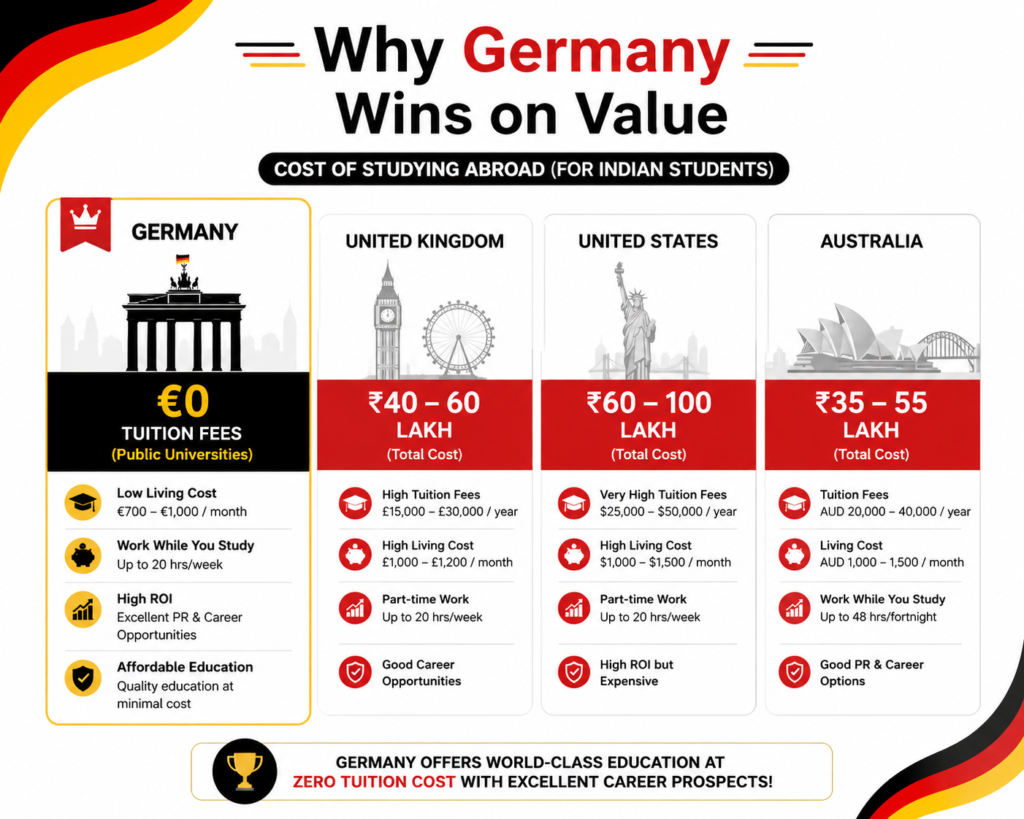
Before we go into the details, let’s answer the most important question Indian families ask: why Germany over the UK, USA, or Australia?
Feature | Germany | UK | USA | Australia |
|---|---|---|---|---|
Avg. Tuition (Masters) | €0 (most universities) | ₹30–50 lakh | ₹50–80 lakh | ₹35–55 lakh |
Post-Study Work Visa | 18 months | 2 years | OPT 3 yrs (STEM) | 2–4 years |
PR Timeline | ~5 years (21 months on Blue Card) | ~5 years | 10+ years | ~4 years |
Blocked Funds Required | €11,904/year (~₹10.8L) | £28,000+ | $10,000+ | AUD 21,041 |
Indian Student Community | 49,000+ | 1,00,000+ | 2,50,000+ | 1,30,000+ |
Language Requirement | English or German | English | English | English |
The numbers speak for themselves. Germany is the only top-destination country where you pay nothing in tuition and still receive a degree that competes with Oxford and MIT in the global job market.
Is Education in Germany Really Free? The Honest Truth
Short answer: Yes — but with important exceptions you must know.
Germany’s public universities (called Staatsuniversitäten) charge zero tuition fees for almost all Bachelor’s and Master’s programs, for every nationality including Indian students. You only pay a small administrative semester contribution of €100–€400, which typically includes a public transport pass for the entire city — effectively free daily commuting.
The 3 Exceptions Indian Students Must Know
- Baden-Württemberg State Universities (e.g., Heidelberg, Stuttgart): Non-EU students pay €1,500 per semester (€3,000/year). Still far cheaper than UK or USA.
- Technical University of Munich (TUM): Since 2024, TUM charges non-EU students €2,000–3,000/semester for Bachelor’s and €4,000–6,000/semester for Master’s. Other Bavarian universities remain free.
- All Private Universities: Fees range from €6,000–€20,000 per year. Avoid these if cost is your priority.
The Blocked Account — Your Biggest Upfront Cost
Even though tuition is free, Germany requires you to prove you can support yourself. This is done through a Blocked Account (Sperrkonto):
Requirement | Amount 2026 | INR Equivalent |
|---|---|---|
Blocked Account (Sperrkonto) | €11,904/year | ~₹10.8 lakh |
Monthly Release | €992/month | ~₹90,000/month |
Semester Contribution | €150–€400/semester | ~₹13,500–36,000 |
Health Insurance | €110–€120/month | ~₹10,000/month |
Approved blocked account providers include Expatrio, Fintiba, and Deutsche Bank. Open it at least 6–8 weeks before your visa appointment.
Top Universities in Germany for Indian Students 2026
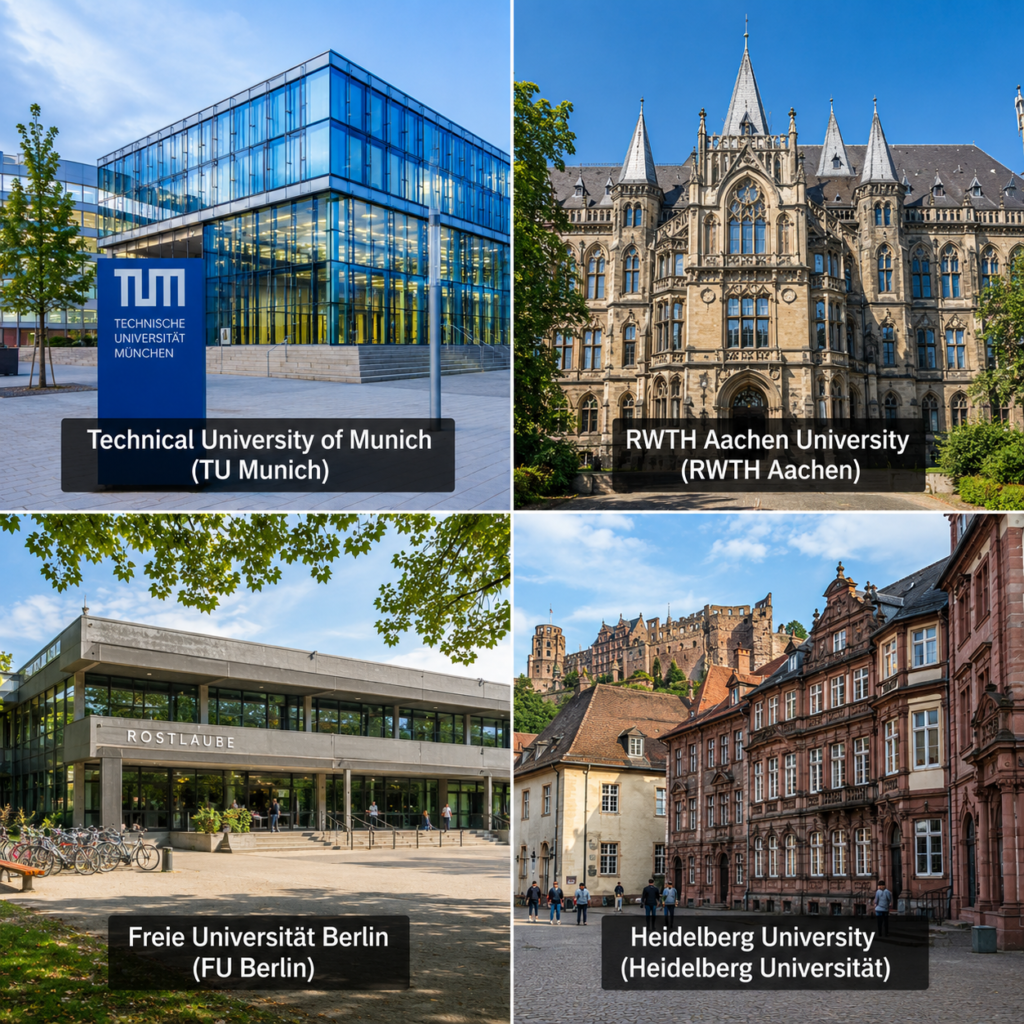
Germany has 9 universities in the QS World Rankings Top 200. Here are the top picks for Indian students, organised by strengths and fee status:
University | State | Tuition Fees (Non-EU) | Top Courses | English Programs |
|---|---|---|---|---|
RWTH Aachen University | NRW | FREE | Engineering, CS, Mech | Yes (Masters) |
TU Berlin | Berlin | FREE | Engineering, Architecture, Economics | Yes (Masters) |
Freie Universität Berlin | Berlin | FREE | Humanities, Sciences, Law | Yes (Masters) |
LMU Munich | Bavaria | FREE | Medicine, Natural Sciences, Business | Yes (Masters) |
KIT Karlsruhe | Baden-W. | €1,500/sem | CS, Physics, Environmental Sci. | Yes (Masters) |
TU Munich (TUM) | Bavaria | €4-6K/sem (Masters) | Engineering, CS, MBA, Data Sci. | Yes (Masters) |
Heidelberg University | Baden-W. | €1,500/sem | Medicine, Sciences, Law | Yes (some) |
University of Hamburg | Hamburg | FREE | Law, Business, Natural Sciences | Yes (Masters) |
FAU Erlangen-Nürnberg | Bavaria | FREE | Engineering, Medicine, Business | Yes (Masters) |
Pro Tip: For the best combination of zero fees AND top rankings, target RWTH Aachen, TU Berlin, FAU Erlangen-Nürnberg, and University of Hamburg. All are FREE and globally ranked.
Eligibility & Requirements for Indian Students — Complete 2026 Checklist
1. Academic Requirements
- Bachelor’s Programs: Class 12 (CBSE/ISC/State Board) + 1-year Studienkolleg (foundation course) to meet the German Abitur standard
- Master’s Programs: A recognised Bachelor’s degree in a relevant field from an Indian university (AIU-recognised)
- GPA: Most programs require 60–70%+ at undergraduate level
2. The APS Certificate — Non-Negotiable
This is the single most overlooked requirement. Without it, your application will be rejected outright.
The APS (Academic Evaluation Centre) Certificate validates your Indian academic documents for German universities. It is mandatory for all Indian applicants since 2023.
APS Step | Details | Timeline |
|---|---|---|
Apply to APS India | Submit Class 10, 12, UG transcripts + degree certificates | Apply: March 2026 |
APS Interview | Brief academic knowledge interview at APS office (New Delhi/Chennai) | April–May 2026 |
Receive Certificate | APS certificate issued upon verification | May–June 2026 (4–8 weeks) |
Cost | Approximately ₹18,000 | One-time fee |
APS India offices: New Delhi (German Embassy) | Chennai. Book your appointment at least 6 months before your intended intake.
3. Language Requirements
- English-taught programs (Masters): IELTS Academic 6.0–7.0 OR TOEFL iBT 90–100
- German-taught programs: C1 level — TestDaF (16+) OR DSH-2
- No English test required: Some universities accept undergraduate taught-in-English transcripts as proof
Strategic advice: Even if your program is English-taught, start German at A1 level before departure. B1 German cuts your PR timeline by 12 months and massively improves your job search success.
Step-by-Step Application Process & Timeline for Winter 2026 Intake
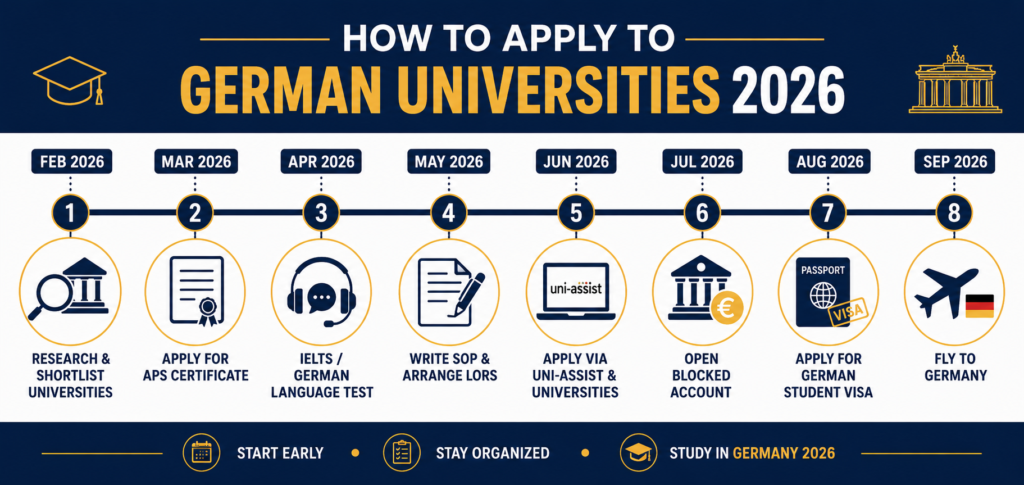
Step | Action | When (Winter 2026) |
|---|---|---|
1 | Research & shortlist 5–8 universities (check uni-assist.de + DAAD database) | Now – Feb 2026 |
2 | Apply for APS Certificate at APS India office | Feb – Mar 2026 |
3 | Take IELTS / TOEFL / TestDaF exam | Feb – Apr 2026 |
4 | Write SOP + collect LORs from professors/managers | Mar – Apr 2026 |
5 | Apply via uni-assist.de OR university portals (fee: ~€75/application) | Apr – Jul 2026 |
6 | Open Blocked Account (Expatrio / Fintiba) — deposit €11,904 | May 2026 |
7 | Apply for Student Visa at German Consulate (processing: 8–12 weeks) | Jul 2026 |
8 | Pre-departure prep: accommodation, health insurance, A1 German | Sep 2026 |
Application deadline alert: Most German universities close Winter 2026 intake applications by July 15, 2026. Some close as early as May–June. Apply early.
Need help with SOP, LOR, and university shortlisting? Connect with our Germany counsellors at GlobalEd — it’s FREE.
Top Scholarships to Study in Germany in 2026 (Cover Your Living Costs Too)
Tuition is already free — scholarships in Germany are your tool to cover living expenses. Here are the top ones for Indian students:
Scholarship | Provider | Amount | Who Should Apply | Deadline |
|---|---|---|---|---|
DAAD Scholarship | German Govt. | €934/month + health ins. | High academic achievers, research focus | Oct–Nov annually |
Deutschlandstipendium | German Universities | €300/month | Strong academics + leadership | Varies by university |
Heinrich Böll Foundation | Green Party–linked | Full living + tuition support | Environment/social justice focus | Mar & Sep annually |
Konrad Adenauer Foundation | KAS (CDU-linked) | Full living expenses | Academic excellence + civic leadership | Jan & Jul annually |
Erasmus+ | EU Programme | Travel + living allowance | Students at partner universities | Varies by institution |
DAAD–WISE Internship | DAAD | €650–750/month | Final-year B.Tech/M.Tech students | Oct–Nov annually |
Key insight: DAAD funded over 140,000 students globally in 2025. Indian applicants have a strong success rate, particularly in STEM fields. Apply 12 months before your intended intake. See the full list of available scholarships on the official DAAD India portal.
Cost of Living in Germany for Indian Students 2026 — Full INR Breakdown
Expense | Monthly Cost (€) | Monthly Cost (₹ approx.) |
|---|---|---|
Accommodation (shared flat/WG) | €300–500 | ₹27,000–45,000 |
Food & Groceries | €150–250 | ₹13,500–22,500 |
Public Transport | €0 (semester ticket) | ₹0 |
Health Insurance | €110–120 | ₹10,000–11,000 |
Mobile + Internet | €20–30 | ₹1,800–2,700 |
Books & Stationery | €20–40 | ₹1,800–3,600 |
Leisure & Misc. | €80–150 | ₹7,200–13,500 |
TOTAL | €680–1,090 | ₹61,000–98,000 |
Part-time work: Students can work 120 full days (or 240 half-days) per year on a student visa. Average part-time wage is €12–15/hour. This can comfortably cover 40–60% of your monthly living costs.
City tip: Munich and Frankfurt are the most expensive cities. Leipzig, Dresden, Dortmund, and Bielefeld offer the same quality education and job access at 30–40% lower living costs.
The Full Germany PR Roadmap for Indian Students: Study → Work → Settle
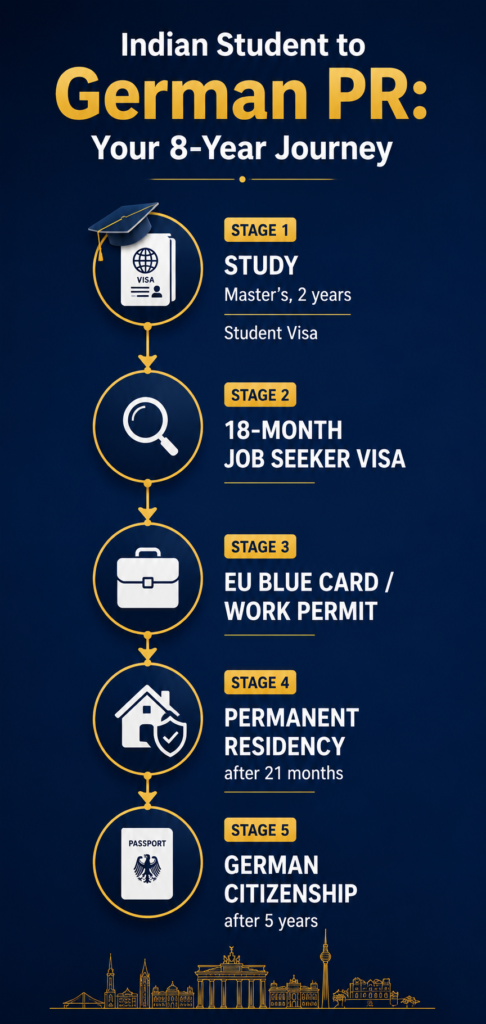
This is the section Indian families make decisions on. Germany is not just a study destination — it is one of the clearest and most achievable paths to European PR and eventual citizenship available to Indian nationals today.
Stage 1: Student Visa → Graduate (2 Years)
Complete your Master’s degree at a German public university. During this time you can work part-time 120 full days per year. Use this time to build your German language from A1 to B1. This is your highest-leverage action for accelerating PR later.
Stage 2: 18-Month Post-Study Job Seeker Visa
Upon graduation, Indian students automatically qualify for an 18-month residence permit to find a job in Germany. This is distinct from the Chancenkarte (Opportunity Card), which is for non-German graduates. Use this period to secure a full-time role matching your qualification.
Stage 3: Convert to EU Blue Card or Work Permit
Once you secure a qualifying job:
- EU Blue Card (recommended): Salary threshold in 2026 is €50,700 for standard occupations and €45,934 for shortage sectors (IT, engineering, healthcare). The Blue Card is the fastest route to PR.
- Regular Work Permit: Available for any qualified employment, but PR timeline is longer (5 years vs 21 months for Blue Card holders).
Stage 4: Permanent Residency (Niederlassungserlaubnis)
Route | Minimum Residency for PR | Language Requirement |
|---|---|---|
EU Blue Card + B1 German | 21 months | B1 German |
EU Blue Card (no German) | 33 months | A1 German (basic) |
Regular Work Permit | 5 years | B1 German + integration course |
Graduate from German university | 2–3 years work after graduation | B1 German |
Additional PR requirements: Valid work-based residence permit, financial independence (no government assistance), pension contributions for 60 months, and suitable housing proof.
Stage 5: German Citizenship
As of October 2025, Germany reduced the citizenship residency requirement from 8 years to 5 years. Requirements include B1-level German, financial independence, no criminal record, and passing the German citizenship test.
The Chancenkarte (Opportunity Card) — A Bonus Option: If you are already a working professional wanting to explore Germany without a job offer, India is the largest source country for Germany’s Chancenkarte visa. It allows you to enter Germany for 12 months, work part-time 20 hours/week, and convert to a Blue Card upon securing employment. Learn more at Make it in Germany — official portal.
7 Costly Mistakes Indian Students Make When Applying to Germany
- Not applying for APS early — Without APS, your application is auto-rejected. Apply 5–6 months before intake.
- Applying only to TUM (TU Munich) — TUM now charges non-EU fees. Many equally ranked universities remain FREE.
- Ignoring German language — Even A1 before departure dramatically improves your campus life and future PR timeline.
- Opening the blocked account too late — Expatrio/Fintiba accounts take 2–4 weeks. Don’t leave it to the week before your visa.
- Applying to only 1–2 universities — Germany is competitive. Apply to 6–8 with a smart mix of reach, target, and safe universities.
- Choosing Baden-Württemberg universities without budgeting for fees — Not all public universities are fully free. Check the state.
- Underestimating the SOP — German admissions are largely SOP-driven. A generic SOP kills strong academic profiles.
Avoid all these mistakes. Talk to our Germany specialists at GlobalEd for a personalised application review.
Frequently Asked Questions (FAQ)
1. Can I study in Germany without IELTS?
Yes. Some German universities accept proof that your undergraduate degree was taught in English as a substitute for IELTS. However, most top universities will ask for IELTS 6.5+ or TOEFL 90+. For German-taught programs, TestDaF or DSH at C1 level is required.
2. What is the APS certificate and how long does it take?
The APS (Academic Evaluation Centre) certificate verifies your Indian academic documents for German universities. It is mandatory for all Indian applicants. The process takes 4–8 weeks and costs approximately ₹18,000. Apply through the APS India office in New Delhi or Chennai.
3. How much money do I need to show for a Germany student visa?
You need to show €11,904 in a blocked account (Sperrkonto) for the year 2026 — approximately ₹10.8 lakh. This amount is updated annually by the German government.
4. Can I work while studying in Germany?
Yes. International students in Germany can work 120 full days or 240 half-days per year without requiring a work permit. Part-time wages range from €12–15/hour, which can cover a significant portion of living expenses.
5. How long does it take to get PR in Germany after a Master’s degree?
If you secure an EU Blue Card role with B1 German proficiency, you can apply for PR in as little as 21 months after starting full-time work. Without B1 German, the Blue Card PR timeline extends to 33 months. Via a regular work permit, the standard timeline is 5 years from first residence.
6. Is Germany safe for Indian students?
Germany is consistently ranked among the safest countries in the world for students. Emergency numbers: 112 (medical/fire) and 110 (police). Indian student associations operate in every major city, making the transition comfortable.
7. What is the deadline to apply for German universities in 2026?
For Winter 2026 intake (starting October): most universities close applications by July 15, 2026. Some close earlier in May–June. For Summer 2027 intake (April): applications typically close in January 2027.
Related Guides You Must Read
- IELTS vs PTE vs TOEFL 2026: Which English Test Is Best for Germany? → [Link to IELTS comparison blog]
- How to Write a Winning SOP for German Universities → [Link to SOP guide on GlobalEd]
- Top Education Loans for Studying Abroad Without Collateral 2026 → [Link to finance guide]
- Germany vs Australia 2026: Which Country Is Better for Indian Students? → [Link to comparison blog]
- Top 15 Fully Funded Scholarships for Indian Students in 2026 → [Link to scholarship roundup]
Authoritative Sources & External References
1. DAAD — German Academic Exchange Service (Official) — Germany’s official scholarship and university search portal
2. uni-assist.de — Official Application Portal for German Universities — Most German universities accept applications through uni-assist
3. APS India — Academic Evaluation Centre — Mandatory certification for all Indian students applying to Germany
4. Make it in Germany — Official German Immigration Portal — Official German government resource for skilled immigration and Chancenkarte
5. BAMF — Federal Office for Migration and Refugees — Official source for German residency, PR, and citizenship rules
6. QS World University Rankings 2026 — Germany — University ranking reference
Conclusion: Is Germany Right for You in 2026?
Germany is not just a study destination — it is a life decision. It is the only country in the world where you can earn a globally respected Master’s degree for zero tuition, work part-time to cover your living costs, stay on after graduation to find a high-paying job, get Permanent Residency in as little as 21 months on the EU Blue Card, and build a life in Europe’s strongest economy.
But Germany rewards those who plan early. The APS certificate, blocked account, and visa process require at least 6–9 months of lead time. The Winter 2026 intake clock is ticking right now.
Do not navigate this alone. GlobalEd has successfully placed hundreds of Indian students in top German universities. Our Germany counsellors know every step of this process — from APS to blocked account to SOP to visa — and our consultation is 100% free.