


Is an MBA abroad worth it for Indian students in 2026? That is the single most searched question by every ambitious Indian professional staring at a ₹60–₹200 lakh price tag and wondering if it will ever pay off.
The honest answer is: it depends — but not in a vague way. It depends on exactly four things: which country you choose, which school you target, what role you want after graduation, and whether you plan to stay abroad or return to India. Get these four right, and an MBA abroad is one of the highest-ROI financial decisions of your career. Get them wrong, and you could spend a decade paying off a loan that never delivered.
This is not a blog that gives you feel-good answers. This is a data-driven ROI analysis — built specifically for Indian students in 2026 — with real cost numbers, real salary data, country-wise break-even calculations, and a clear framework to make the decision that is right for your profile and goals.
If you want personalised guidance after reading this, book a free MBA counselling session with GlobalEd’s experts. Zero pressure, 100% clarity.
Section 1: The Real Total Cost of an MBA Abroad — What Most Blogs Won’t Tell You
Most cost comparisons show only tuition. That is a dangerous half-truth. When you calculate whether an MBA abroad is worth it for Indian students in 2026, you must count every rupee of the true investment — including what you give up.
True Cost = Tuition + Living Expenses + Foregone Salary + Loan Interest
Here is the complete picture, country by country, for a 2-year full-time MBA program:
Country | Tuition (2 yrs) | Living Cost (2 yrs) | Foregone Salary (India) | Loan Interest (10% p.a.) | TRUE All-In Cost (INR) |
|---|---|---|---|---|---|
USA (Top 15) | ₹1.1–1.8 Cr | ₹40–55 lakh | ₹20–40 lakh | ₹15–25 lakh | ₹1.8–3.0 Cr |
UK (1-year) | ₹55–90 lakh | ₹20–28 lakh | ₹10–20 lakh | ₹8–12 lakh | ₹93L–1.5 Cr |
Canada (2-yr) | ₹45–75 lakh | ₹30–45 lakh | ₹20–40 lakh | ₹10–16 lakh | ₹1.05–1.75 Cr |
Australia (2-yr) | ₹35–55 lakh | ₹28–40 lakh | ₹20–40 lakh | ₹8–14 lakh | ₹91L–1.49 Cr |
Germany (public) | ₹2–8 lakh | ₹14–20 lakh | ₹20–40 lakh | ₹4–8 lakh | ₹40–76 lakh |
ISB / IIM-A (India) | ₹25–40 lakh | ₹6–10 lakh | ₹10–15 lakh | ₹4–6 lakh | ₹45–71 lakh |
Critical insight most students miss: |
Section 2: Post-MBA Salary Data for Indian Students in 2026 — Country by Country
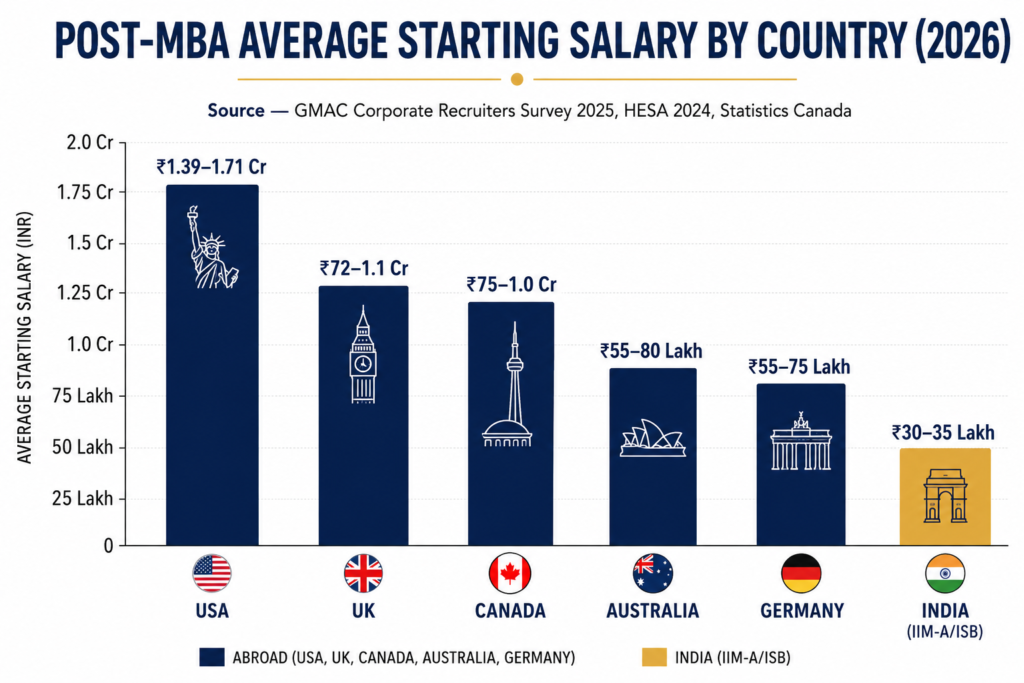
Sources: GMAC Corporate Recruiters Survey 2025 | Stanford GSB 2024 Employment Report | HESA Graduate Outcomes Survey 2024 | Statistics Canada Labour Force Survey | Bundesagentur für Arbeit (Germany Federal Employment Agency). INR conversions at ₹92.46/USD, March 2026.
Country | Avg. Starting Salary (Local) | In INR (approx.) | Top Sector Salaries | Salary Growth (3 yrs) |
|---|---|---|---|---|
USA | $150,000–175,000/yr | ₹1.39–1.62 Cr | Consulting, Finance, Tech: up to $200K+ | 60–100% over pre-MBA |
UK | £60,000–80,000/yr | ₹72–96 lakh | LBS/Oxford: £90K+ in finance & consulting | 80%+ within 3 years |
Canada | CAD 90,000–120,000/yr | ₹55–74 lakh | Finance, Healthcare, IT: CAD 130K+ | 50–75% over pre-MBA |
Australia | AUD 90,000–130,000/yr | ₹50–72 lakh | Mining, Finance, Management | 40–60% over pre-MBA |
Germany | €55,000–75,000/yr | ₹51–70 lakh | Engineering firms, Big 4, Auto sector | 35–55% over pre-MBA |
India (IIM-A/ISB) | ₹30–35 LPA | ₹30–35 lakh | Top consulting/PE roles: ₹50–80 LPA | Fastest break-even domestically |
Key data point: Per the GMAC Corporate Recruiters Survey 2025, median MBA starting salaries in the USA range from $150,000–175,000 per year — approximately ₹1.39–1.62 Cr — making the USA the highest absolute salary destination for MBA graduates globally.
The UK advantage on speed: A 1-year MBA at London Business School or Oxford Said costs roughly ₹55–90 lakh total with living costs, yet delivers starting salaries of ₹72–96 lakh. The break-even comes faster than the USA for most Indian students.
Section 3: The Break-Even Analysis — When Does an MBA Abroad Actually Pay Off?
This is the section that answers the core question: is an MBA abroad worth it for Indian students in 2026? The break-even point is when your total cumulative post-MBA earnings exceed your total all-in investment.
Break-Even Formula
Break-Even Period (years) = True All-In Cost ÷ Annual Salary Premium
Annual Salary Premium = Post-MBA salary abroad MINUS what you would have earned without the MBA (adjusted for currency and taxes).
Scenario | True All-In Cost | Post-MBA Salary | Pre-MBA Earning (est.) | Annual Premium | Break-Even |
|---|---|---|---|---|---|
USA — Top 15 MBA, stay in USA | ₹2.2 Cr | ₹1.45 Cr/yr | ₹20 lakh/yr (in India) | ₹1.25 Cr/yr | 1.8 years |
USA — Top 15 MBA, return to India | ₹2.2 Cr | ₹35–50 lakh/yr | ₹20 lakh/yr | ₹15–30 lakh/yr | 7–14 years |
UK — Top 10 MBA (1-yr) | ₹1.1 Cr | ₹85 lakh/yr | ₹20 lakh/yr | ₹65 lakh/yr | 1.7 years |
Canada — Top MBA, stay in Canada | ₹1.4 Cr | ₹65 lakh/yr | ₹20 lakh/yr | ₹45 lakh/yr | 3.1 years |
Germany — Public MBA, stay in Germany | ₹55 lakh | ₹60 lakh/yr | ₹20 lakh/yr | ₹40 lakh/yr | 1.4 years |
ISB / IIM-A — India | ₹55 lakh | ₹32 lakh/yr | ₹15 lakh/yr | ₹17 lakh/yr | 3.2 years |
The single biggest ROI insight from this data: A US MBA that returns to India and earns ₹40 lakh/yr takes 7–14 years to break even — by which time IIM-A graduates are already ahead. The UK 1-year MBA has the fastest break-even for students who want to go abroad — just 1.7 years. Germany is the hidden ROI champion — lowest all-in cost, solid European salary, and fastest break-even at 1.4 years. Canada is the most balanced option — manageable cost, clear PR pathway, and break-even in ~3 years. |
Section 4: Country-by-Country MBA ROI Analysis for Indian Students 2026
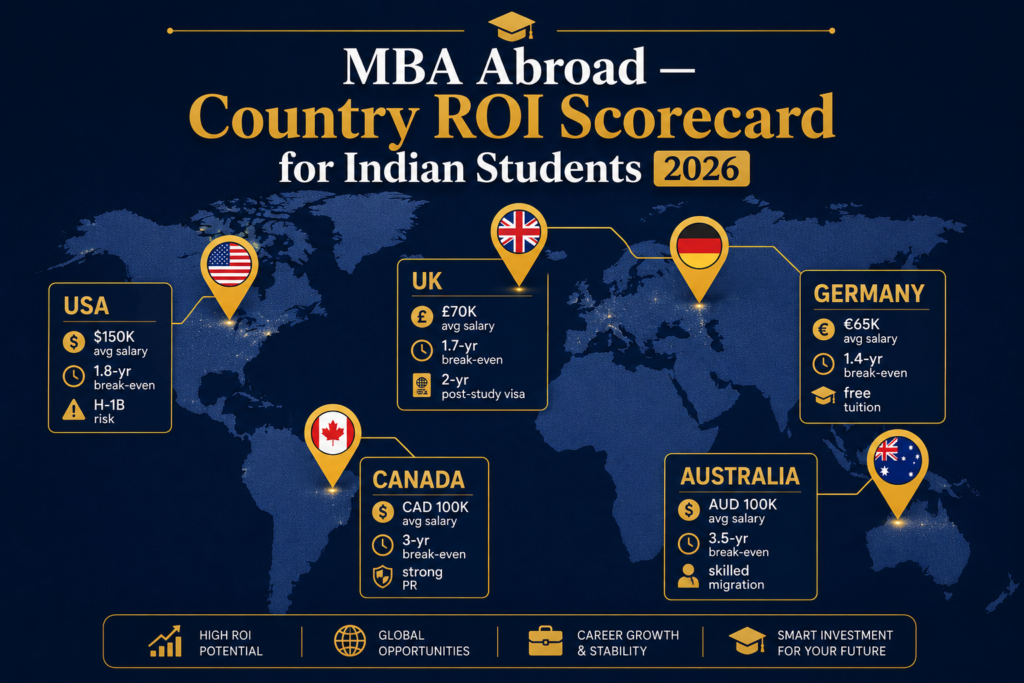
USA — Highest Salary, Highest Risk, Slowest PR
Factor | Details |
|---|---|
Best schools | Harvard, Wharton, Stanford GSB, Booth, Kellogg (M7), Top-15 |
Total cost (2-yr, top school) | ₹1.8–3.0 Cr (all-in including living + foregone salary) |
Starting salary | $150,000–175,000/yr (₹1.39–1.62 Cr) | Stanford median: $185,000 |
Post-study visa | OPT 12 months + STEM OPT 24 months extension = 3 years work authorization |
H-1B reality (2026) | Lottery-based, roughly 1-in-3 selection odds. Graduates in 2028 have OPT until 2031 before needing H-1B |
PR / Green Card | 10+ years typical for Indian nationals due to per-country cap backlog |
ROI verdict | BEST if you stay in the USA and land a top consulting/finance role. POOR ROI if you return to India. |
2026 H-1B note: A new $5,000 H-1B employer fee (per Trump administration, effective until Sep 2026) may deter some small employers. However, top MBA employers — McKinsey, Goldman Sachs, Amazon — are expected to absorb this cost. STEM MBA OPT extension gives graduates until 2031 before needing H-1B, well into any new administration.
UK — Best ROI for Speed-Conscious Indian Students
Factor | Details |
|---|---|
Best schools | London Business School, Oxford Said, Cambridge Judge, Imperial, Warwick, Manchester |
Total cost (1-yr) | ₹75–1.15 Cr (tuition + living) — one year saves you ₹25–40 lakh vs 2-yr programs |
Starting salary | £60,000–80,000/yr (₹72–96 lakh) | LBS finance roles: £90,000–120,000 |
Post-study visa | 2-year Graduate Route visa — applies to ALL graduates, no employer required |
PR timeline | 5 years legal residency. Less structured than Canada but achievable |
ROI verdict | EXCELLENT for India UK FTA tailwinds, tech, consulting, and finance graduates. 1-year format = faster break-even. |
Canada — Best for PR-Focused Indian Students
Factor | Details |
|---|---|
Best schools | Rotman (U of T), Ivey (Western), Desautels (McGill), Schulich (York), Smith (Queen’s) |
Total cost (2-yr) | ₹1.05–1.75 Cr | Co-op programs: students earn CAD salary during internship, reducing net cost |
Starting salary | CAD 90,000–120,000/yr (₹55–74 lakh) |
Post-study work permit | PGWP up to 3 years — the longest of any country. Directly usable for Express Entry PR. |
PR timeline | Express Entry: 1–2 years of skilled work experience qualifies most MBA graduates |
ROI verdict | BEST for Indian students who want a clear, predictable PR pathway alongside a solid MBA ROI. |
Germany — The Hidden ROI Champion
Factor | Details |
|---|---|
Best schools (English MBA) | ESMT Berlin, HHL Leipzig, Mannheim Business School, Frankfurt School of Finance |
Public university MBA | €0 tuition (German-taught) — total all-in cost as low as ₹40–55 lakh for 2 years |
Starting salary | €55,000–75,000/yr (₹51–70 lakh) — engineering/auto/consulting sectors pay higher |
Post-study visa | 18-month job seeker visa after graduation. Convert to EU Blue Card upon employment. |
PR timeline | EU Blue Card + B1 German = PR in 21 months. Fastest PR of any country in this list. |
ROI verdict | BEST value for Indian students who can learn German and want European settlement. Lowest cost, fastest PR. |
Australia — Best for Asia-Pacific Career Goals
Factor | Details |
|---|---|
Best schools | Melbourne Business School, UNSW AGSM, Macquarie, UQ Business School, Monash |
Total cost (2-yr) | ₹91 lakh–1.49 Cr |
Starting salary | AUD 90,000–130,000/yr (₹50–72 lakh) |
Post-study visa | Temporary Graduate Visa (subclass 485): 2–4 years depending on location and program |
PR timeline | Skilled migration pathway: General Skilled Migration points test. Typically 3–5 years. |
ROI verdict | GOOD for students targeting resource, healthcare, and finance sectors. Strong PR pathway but longer break-even than UK. |
Section 5: MBA Abroad vs IIM-A/ISB — The Decision That Actually Matters
For most Indian MBA aspirants, this is the real choice. Not USA vs UK — but MBA abroad vs a top Indian B-school. Here is the honest, data-driven comparison:
Factor | Top MBA Abroad (USA/UK) | IIM-A / ISB India |
|---|---|---|
Total cost | ₹1.0 Cr – 3.0 Cr | ₹25–40 lakh |
Starting salary (stay in that market) | ₹85 lakh – 1.62 Cr/yr | ₹30–35 LPA |
Break-even (stay abroad) | 1.7–3.5 years | 1.5–2.5 years |
Break-even (return to India) | 7–15 years | 1.5–2.5 years |
Alumni network (India) | Weak to moderate | Extremely strong |
Alumni network (Global) | Very strong | Moderate |
H-1B / PR risk | High (USA) / Moderate (UK, Canada) | N/A |
Career pivot potential | Excellent — cohort diversity, brand name | Good — but limited abroad |
Best for | Global roles, career pivot, long-term settlement abroad | India-focused leadership, fastest domestic ROI |
The verdict: If your goal is to build a career in India — at an MNC, consulting firm, or Indian startup — an IIM-A or ISB gives you a faster financial return and a stronger domestic network. The MBA abroad delivers something Indian programs structurally cannot: a global cohort, summer internships in international firms, and the work visa runway to pivot your career in a new market.
The one scenario where MBA abroad wins decisively: If you need a career pivot — from engineering to consulting, from finance to product management — a foreign MBA’s summer internship is the pivot mechanism that Indian programs do not have.
Section 6: Is an MBA Abroad Worth It for You? Answer These 5 Questions
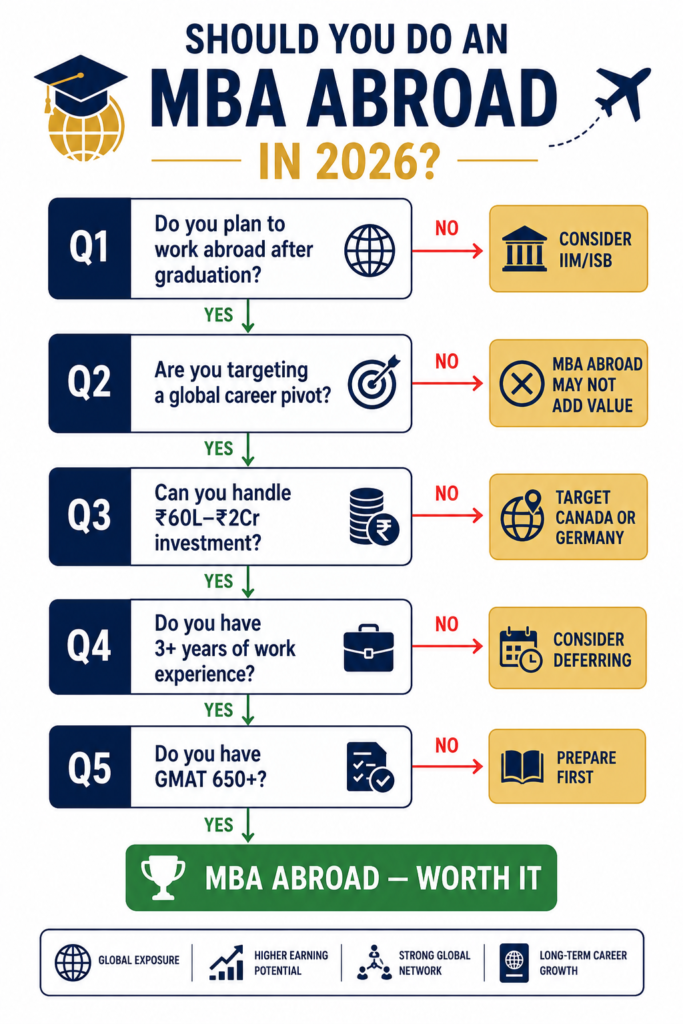
MBA Abroad IS Worth It in 2026 if You:
- Plan to work and stay in that country for at least 3–5 years after graduation
- Are targeting a career pivot that requires international exposure or summer internships abroad
- Are aiming for global roles at McKinsey, Goldman Sachs, Google, or similar firms where the foreign MBA brand opens doors
- Have a GMAT of 650+ and 3+ years of work experience — the minimum for a program that pays off
- Are targeting Canada or Germany where the PR pathway is clear and the cost is more manageable
- Have partial scholarship coverage — even 30% off tuition collapses the break-even from 3 years to under 2
MBA Abroad is NOT Worth It in 2026 if You:
- Plan to return to India within 2 years of graduating — the salary delta against IIM-A won’t justify the cost
- Are applying to unranked or regional foreign universities — the brand premium evaporates and ROI is negative
- Are not willing or able to secure H-1B / work visa sponsorship in the USA — OPT ends and you are left with a ₹2 Cr loan
- Already earn ₹30+ LPA in India and are targeting only modest salary growth — IIM or ISB executive programs cost less and deliver comparable results
- Have a GMAT below 600 — low-ranked programs deliver little ROI regardless of country
Section 7: How Scholarships Change the MBA ROI Equation Dramatically
A 50% scholarship on a ₹90 lakh UK MBA reduces your all-in cost to roughly ₹65 lakh and collapses the break-even to under 1 year at a £70,000 post-MBA salary. Here are the top scholarships Indian MBA students consistently win:
Scholarship | Country | Value | Eligibility | Deadline |
|---|---|---|---|---|
Chevening Scholarship | UK | Full tuition + living (£18,000–20,000) | Leadership potential, 2+ yrs work exp. | Nov annually |
Commonwealth Scholarship | UK | Full tuition + stipend | Commonwealth nations, academic merit | Dec annually |
DAAD Scholarship | Germany | Full funding + €934/month stipend | Academic excellence, research focus | Oct–Nov annually |
Fulbright-Nehru MBA Fellowship | USA | Partial tuition + stipend | Indian citizens, 3+ yrs work exp, GMAT | Jul annually |
Wharton Fellowship | USA | Up to $40,000 | Exceptional GMAT, leadership profile | R1/R2 deadlines |
LBS MBA Scholarship | UK | Up to £15,000 | Merit + nationality diversity | Rolling by round |
Rotman MBA Award | Canada | CAD 10,000–30,000 | Academic + professional merit | Rolling |
Australia Awards | Australia | Full tuition + stipend | Development-sector focus | Apr–Jun annually |
Pro tip: Apply to scholarships a full 12 months before your intake date. Most top scholarship deadlines close 6–9 months before the program starts. Missing R1 (Round 1) for GMAT-based programs means missing most scholarship money — not just admission seats.
Section 8: GMAT, Work Experience & Eligibility — What Indian Students Actually Need
Destination | GMAT Score Required | Work Experience | Other Requirements |
|---|---|---|---|
USA (M7/Top-15) | 720–760 avg | 5+ years preferred (avg ISB: 4+ yrs) | TOEFL 100+ / IELTS 7.0, Essays, Reco letters |
USA (Top 25–50) | 650–720 | 3–5 years | TOEFL 90+ / IELTS 6.5 |
UK (LBS, Oxford, Cambridge) | 680–720 | 3–5 years preferred | IELTS 7.0+ / TOEFL 110+ |
UK (Top 10–20) | 600–680 | 2–4 years (some accept 0 exp) | IELTS 6.5+ |
Canada (Rotman, Ivey) | 620–680 | 3–5 years | TOEFL 100+ / IELTS 6.5 |
Canada (Schulich, Smith) | 580–650 | 2–4 years | TOEFL 93+ / IELTS 6.5 |
Germany (ESMT, Mannheim) | 600–680 | 2–4 years | IELTS 6.5 / TOEFL 90+ |
Australia (MBS, UNSW AGSM) | 580–660 | 3+ years | IELTS 6.5+ / PTE 58+ |
Strategy for Indian students with GMAT below 680: Target Canada and Australia, which have lower GMAT thresholds, strong post-study work permits, and clear PR pathways. A GMAT of 620–660 with a clear career narrative is competitive at Rotman, Schulich, and UNSW AGSM.
Section 9: 6 Costly Mistakes Indian Students Make in Their MBA ROI Calculation
- Counting only tuition and ignoring living costs, foregone salary, and loan interest. The true all-in cost can be 60–80% higher than the headline tuition figure.
- Choosing a country based on rankings without considering where you will actually work. A Harvard MBA that returns to India has the ROI of an IIM program at 5x the cost.
- Underestimating the H-1B lottery risk. In 2026, the US H-1B has roughly 1-in-3 selection odds. STEM OPT extends your runway to 2031, but beyond that, visa dependency is a real career risk.
- Applying to unranked foreign programs thinking the abroad brand will impress Indian employers. For India-based hiring, IIM, ISB, and XLRI outrank most foreign programs outside the global top 50.
- Missing Round 1 deadlines. Most scholarships and competitive seats at top MBA programs are allocated in R1. Indian students who miss R1 are almost always behind on both admission and scholarship outcomes.
- Ignoring the co-op advantage in Canada. Many Canadian MBA programs include mandatory paid co-op terms where students earn Canadian salaries, directly reducing the net cost of the program by ₹8–15 lakh.
Frequently Asked Questions — MBA Abroad for Indian Students 2026
1. Is an MBA abroad worth it for Indian students in 2026?
Yes — if you plan to stay and work in the destination country for at least 3–5 years after graduation, and if you target a school ranked in the global top 50. The highest ROI scenarios are: UK 1-year MBA (break-even under 2 years), Canada MBA with PR pathway (break-even ~3 years), and Germany MBA with EU Blue Card (break-even ~1.4 years). It is NOT worth it if you plan to return to India immediately after graduation.
2. Which country has the best MBA ROI for Indian students in 2026?
Germany has the lowest all-in cost (₹40–76 lakh) and a clear EU Blue Card to PR pathway in 21 months, giving the fastest break-even. The UK wins on speed of ROI for students who want an internationally recognised brand name at a mid-range cost. Canada is best for those prioritising a clear PR pathway alongside a solid MBA. The USA has the highest absolute salaries but also the highest cost and visa uncertainty.
3. How much does an MBA abroad cost for Indian students in 2026?
Total all-in costs range from ₹40–76 lakh (Germany public university) to ₹1.8–3.0 Cr (US top-15 MBA). UK 1-year MBA total runs ₹93 lakh–1.5 Cr. Canada 2-year MBA runs ₹1.05–1.75 Cr. Australia 2-year MBA runs ₹91 lakh–1.49 Cr. These figures include tuition, living expenses, foregone salary, and loan interest — not just tuition alone.
4. Is IIM better than an MBA abroad?
For India-focused careers: yes. An IIM-A or ISB MBA breaks even in 1.5–2.5 years, has the strongest domestic alumni network, and costs ₹45–71 lakh all-in. For global careers, career pivots, or long-term settlement abroad: a foreign MBA wins. The IIM vs abroad decision is fundamentally a geography decision — where do you want to work in 5 years?
5. What GMAT score is needed for an MBA abroad in 2026?
M7 US programs average 720–760. Top UK programs like LBS and Oxford require 680–720. Canadian programs like Rotman and Ivey target 620–680. Australian and some UK programs accept 580–650. If your GMAT is below 620, focus on Canada and Australia while building your profile. Do not waste application fees on M7 programs with a sub-650 GMAT.
6. Can I get a scholarship for an MBA abroad as an Indian student?
Yes. The Chevening Scholarship covers full UK MBA tuition and living costs. DAAD covers Germany programs fully. The Fulbright-Nehru Fellowship covers US programs partially. Most top business schools offer merit scholarships of £10,000–30,000. Even a 30% scholarship on a ₹90 lakh MBA collapses the break-even from 3 years to under 1.5 years.
7. What is the best MBA abroad country for Indian students who want PR?
Canada is the top choice for PR — the 3-year PGWP (Post-Graduate Work Permit) feeds directly into Express Entry, and most MBA graduates qualify for PR within 1–2 years of working. Germany’s EU Blue Card grants PR in 21 months with B1 German proficiency. Australia’s skilled migration pathway is also strong but requires 3–5 years. The USA’s Green Card wait for Indian nationals is 10+ years due to the per-country cap backlog.
Related Guides on GlobalEd — Read These Before Deciding
- Study in Germany 2026: Free Education, PR Pathways & Top Universities for Indian Students → [Link to Germany blog]
- Australia vs Canada 2026: Which Country Is Better for Indian Students? → [Link to comparison blog]
- GMAT vs GRE 2026: Which Exam Should You Take for an MBA Abroad? → [Link to GMAT/GRE blog]
- Education Loan for Studying Abroad Without Collateral: Best Banks & NBFCs in India 2026 → [Link to finance blog]
- Top 15 Fully Funded Scholarships for Indian Students in 2026 → [Link to scholarship blog]
Authoritative Sources & References
1. GMAC Corporate Recruiters Survey 2025 — Official MBA salary benchmark — Primary source for global MBA salary data
2. Stanford GSB 2024 MBA Employment Report — Median salary $185,000 for Stanford MBA graduates
3. HESA Graduate Outcomes Survey 2024 — UK — Official UK graduate salary outcomes data
4. DAAD — German Academic Exchange Service (Official) — Germany scholarship and MBA program database
5. IRCC — Canada Post-Graduate Work Permit Guide — Official Canada PGWP and PR pathway information
6. Make it in Germany — EU Blue Card Official Portal — Germany EU Blue Card salary thresholds and PR timelines
Conclusion: Is an MBA Abroad Worth It for Indian Students in 2026?
Let us bring all the data together with a direct, honest answer.
An MBA abroad is worth it for Indian students in 2026 if: you stay in the destination country, target a globally ranked school, choose a country with a clear visa-to-PR pathway (Canada, Germany, or UK), and have realistic salary expectations based on the actual job market — not the best-case scenario.
An MBA abroad is not worth it if: you plan to return to India within 2 years, you are targeting unranked programs for the abroad label, or you have not thought through the visa and PR path beyond graduation.
The decision matrix is simple: where do you want to live and work in 5 years? If it is India — go to IIM or ISB, protect your savings, and accelerate your career domestically. If it is abroad — calculate your true all-in cost, identify your target country’s visa pathway, and choose a school where the alumni network actually places into your target role.
GlobalEd’s MBA counsellors have helped hundreds of Indian students make this exact decision — with data, not emotion. Our consultation is free and personalised to your profile, GMAT score, work experience, and career goals.
→ Book Your Free MBA Abroad Counselling Session https://globaled.co.in/
→ Download the Free MBA ROI Calculator for Indian Students 2026
3

