
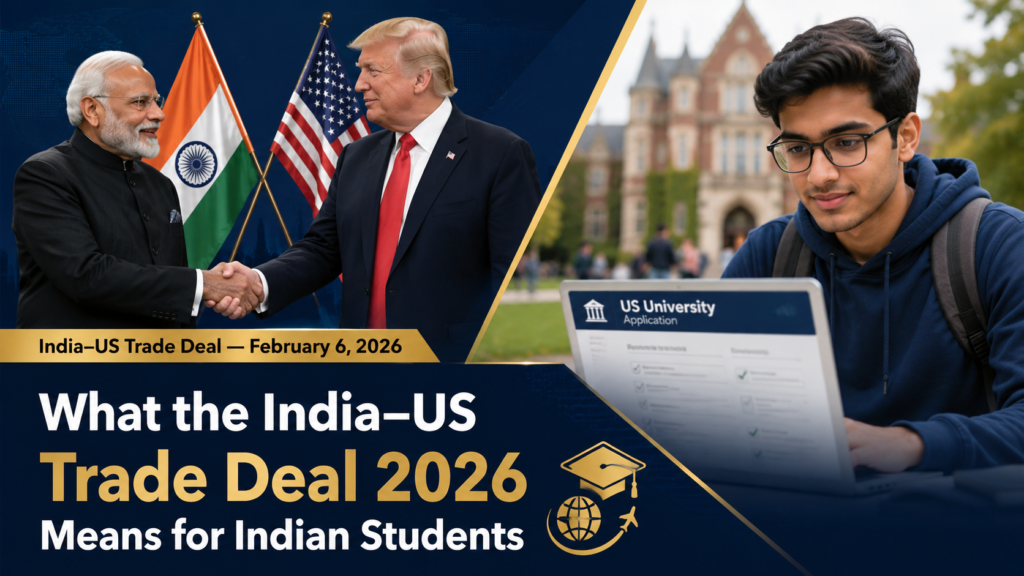
The India–US Trade Deal 2026 has generated enormous excitement — and enormous confusion — for the 330,000 Indian students currently enrolled in American universities and the hundreds of thousands more planning to apply.
On February 6, 2026, President Donald Trump and Prime Minister Narendra Modi announced a historic framework for a Bilateral Trade Agreement (BTA) that reduces US tariffs on Indian exports from 50 percent to 18 percent, commits to a ‘Mission 500’ target of $500 billion in bilateral trade by 2030, and signals a fundamental reset in the India-US economic relationship.
Indian families immediately started asking: does this deal make studying in the USA easier? Will it help with F-1 visa approvals? Will H-1B and OPT rules improve? Will there be new scholarship opportunities?
The honest answer is nuanced — and this guide gives you all of it. The trade deal itself does not change student visa rules, OPT regulations, or H-1B quotas. But it creates a geopolitical environment and bilateral goodwill that has real, indirect implications for Indian students — both positive and cautionary. Meanwhile, several US immigration policy changes in 2026 are affecting Indian students right now, independently of the trade deal. You need to know about both.
Confused about whether the USA is still the right destination for you given 2026 immigration changes? Book a free USA vs alternatives counselling session with GlobalEd.
Section 1: What the India–US Trade Deal 2026 Actually Is — The Facts
Before analysing its impact on Indian students, let us be precise about what the deal actually contains — because most of the excitement is based on misunderstandings about its scope.
Deal Component | What It Says | What It Does NOT Include |
|---|---|---|
Date announced | February 6, 2026 — Joint Statement by President Trump and PM Modi | This is a framework for an Interim Agreement — the full BTA text has not yet been published |
Tariff reduction | US reciprocal tariff on Indian goods reduced from 50% (including punitive duties) to 18% | Does not address services trade, intellectual property, or education explicitly |
Mission 500 | Bilateral trade target of $500 billion by 2030 (current: ~$149 billion in 2025) | Timeline is aspirational — no binding mechanism yet confirmed |
iCET technology cooperation | India-US Initiative on Critical and Emerging Technology: AI, semiconductors, critical minerals | Does not include any provision on student visas or work authorisation |
Energy commitment | India agreed to reduce purchases of Russian crude oil; US removed associated 25% punitive tariff | Does not affect education or immigration policy |
Education & visas | NOT mentioned in the official Joint Statement or the White House announcement | Visa policy, OPT, H-1B, and student mobility are NOT part of the BTA framework as announced |
The most important thing to understand first: Education and immigration were explicitly NOT included in the BTA framework announced in February 2026. Any article claiming the trade deal will directly make it ‘easier to get a US student visa’ or ‘improve H-1B chances’ is misleading. The deal is a trade framework — not an immigration reform. What the deal DOES do is create a bilateral diplomatic climate that INDIRECTLY benefits Indian students over time — through institutional partnerships, research funding, and geopolitical goodwill. This guide explains exactly how. |
Source: United States–India Joint Statement, The White House, February 9, 2026. ESCAP India–US BTA Analysis, February 2026.
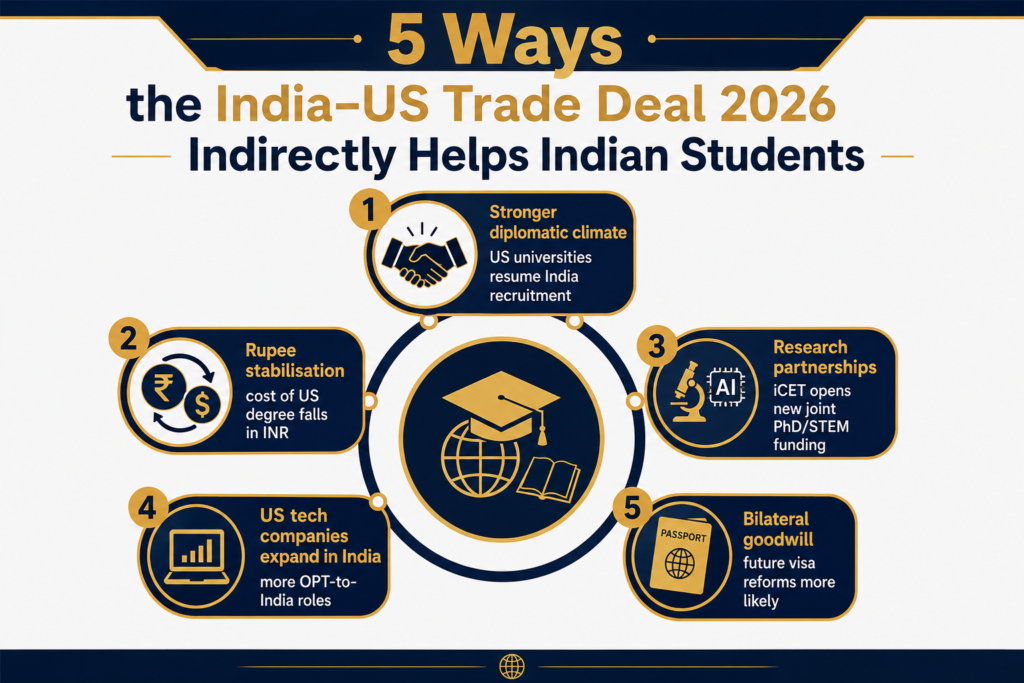
Section 2: The 5 Real — But Indirect — Ways the Trade Deal Benefits Indian Students
While the trade deal does not directly reform immigration, its second and third-order effects on the India-US educational relationship are meaningful. Here is what Indian students and families can realistically expect:
Benefit 1: Stronger Diplomatic Climate Leads US Universities to Resume India Recruitment
The US saw F-1 student visa issuances to Indian students fall by 36 percent in summer 2025, driven by heightened geopolitical tensions and the Trump administration’s immigration enforcement actions. When bilateral relations deteriorate, universities reduce India-facing recruitment drives, institutional partnerships stall, and joint research collaborations pause. The February 2026 trade deal is a structural reset of that relationship.
US State Department official Peggy Morrison said directly in June 2026: ‘The US-India relationship is sustained by one of the most remarkable people-to-people connections in the world’ — specifically noting that over 330,000 Indian students are enrolled in US institutions. This is diplomatic language signalling that Indian students are a priority, not a threat, in the renewed bilateral relationship.
In practical terms: expect more US university recruitment events in Indian cities in 2026-27, more institutional partnerships between Indian IITs/NITs and US research universities, and more joint dual-degree and articulation agreements.
Benefit 2: Rupee Stabilisation Makes a US Degree Cheaper in Real Terms
Indian equity markets responded positively to the trade deal announcement, and the Indian rupee strengthened relative to its 2025 trajectory. A stronger rupee directly reduces the real INR cost of a US degree. Consider:
Scenario | USD Cost (2-yr MS) | INR at ₹86/USD (2025 high) | INR at ₹92/USD (2026) | Difference |
|---|---|---|---|---|
State university MS (tuition only) | $35,000 | ₹30.1 lakh | ₹32.2 lakh | Higher by ₹2.1L |
Private university MS (tuition only) | $70,000 | ₹60.2 lakh | ₹64.4 lakh | Higher by ₹4.2L |
Scenario: Rupee at ₹88 (trade deal confidence) | $70,000 | ₹61.6 lakh vs ₹64.4L at ₹92 | ₹2.8 lakh saving | For every ₹1 the rupee strengthens vs dollar, a $70K degree saves ~₹70,000 |
The trade deal removes the uncertainty of a trade war — and market certainty itself is valuable. Historically, outbound student mobility from India rises when currency volatility reduces and international relations stabilise. Both conditions are now improving.
Benefit 3: iCET Technology Partnership Opens New STEM Research Funding Channels
The India-US Initiative on Critical and Emerging Technology (iCET) — which predates the trade deal but is explicitly reaffirmed in it — focuses on AI, semiconductors, quantum computing, space technology, and critical minerals. This has direct implications for Indian STEM graduate students:
- Joint research grants between Indian and US universities in AI and semiconductor fields are expanding under iCET — creating new funding opportunities for Indian PhD students
- US companies like Qualcomm, Intel, and Google — investing in India under iCET — are creating internship and research partnership pipelines that connect Indian STEM students to US job markets
- The SHANTI Act (2025), reaffirmed in the 2026 deal, opens India’s nuclear technology sector to US companies — creating research collaboration opportunities for Indian nuclear engineering students at US universities
- US university India liaison offices are being re-established at IITs, IISc, and NITs as part of the renewed partnership — creating direct application support channels
Benefit 4: US Tech Company Expansion in India Creates Post-OPT Return Options
One of the most underappreciated benefits of the trade deal for Indian students is its effect on their post-graduation options when OPT expires or H-1B lottery fails. Under the 2026 deal:
- US technology companies are expanding Indian operations significantly — Google, Microsoft, Amazon, and Meta are all growing their India development centres
- Students who complete OPT and cannot secure H-1B can increasingly return to India to work for the same US company’s Indian subsidiary — maintaining career continuity
- India’s ICT sector liberalisation (removing restrictive import licensing for US ICT goods under the BTA) accelerates the integration of India into US tech company supply chains — meaning more India-based roles that value US education
- For Indian students who choose to return to India after graduation, a US STEM degree now has stronger domestic market value in a more US-integrated Indian technology ecosystem
Benefit 5: The Diplomatic Goodwill Creates a Foundation for Future Visa Reforms
This is the most speculative benefit — but historically the most significant. When India-US relations deteriorated in 2025, H-1B employer fees increased, SEVIS monitoring intensified, and F-1 rejection rates climbed to 61 percent. When relations improve, these pressures typically ease.
The 2026 trade deal does not change any immigration rule. But it creates political goodwill that makes advocacy for Indian student-friendly reforms more viable — including potential bilateral provisions on professional mobility that could be added to subsequent BTA negotiations. The full BTA text has not been finalised; future phases of the agreement could include education and mobility provisions.
Section 3: What the Trade Deal Changes Nothing About — The Hard Realities in 2026
This is the most critical section for Indian students making decisions right now. The trade deal does NOT change any of the following — and every Indian student must understand these facts before applying to US universities in 2026.
Hard Reality 1: F-1 Visa Rejection Rate for Indian Students Is 61 Percent in 2026
US F-1 visa rejection rates for Indian students have climbed from 36 percent in 2023 to 61 percent in 2025-26 — the highest in over a decade. The Trump administration’s suspension of visa interviews in May 2025, mass revocation of student statuses, and enhanced SEVIS monitoring have compounded the problem. The trade deal does not change US consular visa adjudication policy.
F-1 Visa Metric | 2023 | 2024 | 2025-26 | Change |
|---|---|---|---|---|
F-1 rejection rate for Indian students | 36% | 48% | 61% | ↑ 25 percentage points in 3 years |
F-1 issuances globally | Stable | Declining | Down 36% in summer 2025 | Significant structural decline |
Average processing time | 3–5 weeks | 6–8 weeks | 10–14 weeks in some cities | Nearly tripled |
SEVIS revocations | Low | Moderate | Mass revocations reported May 2025 | Unprecedented level |
H-1B cap hit date (FY2027) | ~April 30 | ~April 15 | March 31, 2026 — only 25 days open | Window shrinking rapidly |
Source: Collegedunia Indian Student Visa Approval Rates 2026, April 2026; ICEF Monitor Visa Rejections 2026, April 2026; Brookings Institution Immigration Analysis, June 2026.
Hard Reality 2: DHS Proposed Rule Would Cap F-1 Status at 4 Years
On May 5, 2026, the Department of Homeland Security submitted a final rule to the Office of Management and Budget that would eliminate Duration of Status for F-1 and J-1 visa holders and replace it with a fixed 4-year admission cap. If finalised as proposed, the rule could take effect as early as September 2026.
This is described by immigration attorneys as ‘the most consequential change to student visas in three decades.’ For Indian students:
- PhD students and long master’s programs (5+ year programs) would face mandatory USCIS extension filings — each adding cost, delay, and uncertainty
- USCIS already faces an 11.3 million case backlog. DHS estimates the rule would generate 414,000 additional extension filings per year — making delays near-certain for affected students
- Indian students, who make up roughly half of all OPT and STEM OPT participants, would be disproportionately affected
- Legal challenges are expected — but until courts rule, students must plan around the proposed rule
Action required for Indian students planning F-1 applications: Target programs of 2 years or less to minimise exposure to the 4-year cap rule if finalised. Confirm your program end-date with your DSO (Designated School Official) and keep meticulous records of academic progress. Consult an immigration attorney about contingency options including O-1, H-1B cap-exempt employers, and EB-2 NIW early in your program. Have a backup country in your application plan — Germany, Canada, or Australia — in case F-1 conditions deteriorate further. |
Hard Reality 3: OPT and STEM OPT Face Proposed Restrictions
USCIS Director Joseph Edlow has publicly stated his intention to limit work authorisation for F-1 students beyond their enrolment — signalling that OPT itself may face restrictions. Indian nationals make up roughly half of all OPT and STEM OPT participants and would be disproportionately affected by any changes.
OPT/STEM OPT Status | Current Rules (as of June 2026) | Proposed Changes / Risk |
|---|---|---|
OPT duration | 12 months post-graduation work authorisation | No formal rule change yet — but USCIS Director statements signal intent to restrict |
STEM OPT extension | Additional 24 months for STEM fields = 3 years total | At risk under USCIS Director’s stated priorities; legal challenge expected if changed |
Who is affected | ~50% of OPT/STEM OPT participants are Indian nationals | Any restriction disproportionately impacts Indian STEM graduates |
H-1B lottery cap (FY2027) | 85,000 visas (20,000 US master’s cap) | Cap hit March 31, 2026 — only 25 days after FY2027 registration opened |
H-1B weighted lottery | New rule: favours higher-skilled, higher-paid workers (effective Feb 27, 2026) | Potentially benefits high-CGPA Indian STEM graduates but disadvantages early-career applicants |
H-1B prevailing wage proposal | Proposed March 2026: raise prevailing wage thresholds for H-1B sponsors | If finalised, makes some employers reluctant to sponsor — comment period closed May 26, 2026 |
The strategic implication: Indian students who apply to US universities in 2026-27 must plan their entire post-graduation strategy WITHOUT assuming OPT or STEM OPT will be available in its current form when they graduate in 2028-2030. This is not pessimism — it is the advice immigration attorneys are giving right now.
Hard Reality 4: The Green Card Wait for Indian Nationals Is Now Over 100 Years
The EB-2 India priority date in June 2026 is February 2013 — meaning Indian nationals who filed their Green Card petitions in February 2013 are only now being processed. For Indian students entering the US STEM workforce today:
- Realistic Green Card timeline for Indian STEM professionals entering the EB-2 queue today: 50–100+ years
- The per-country cap limits India to 7% of annual Green Card allocations — regardless of the absolute number of Indian applicants
- This has NOT been addressed in the 2026 trade deal, and no legislative fix is currently advancing in Congress
- Students who choose the USA with permanent residency as a goal must understand this reality before investing ₹1.5–3 crore in a US degree
Section 4: The Full Impact Matrix — What Changes, What Doesn’t, What Might
Area | Trade Deal Impact | Current 2026 Status | Outlook for 2027 |
|---|---|---|---|
F-1 visa approval rates | NO direct impact | 61% rejection rate for Indian students | Uncertain — depends on consular policy, not trade deal |
US university recruitment in India | POSITIVE — diplomatic reset encourages institutions to resume India drives | Increasing after 2025 slowdown | Likely to improve as BTA strengthens relations |
Rupee vs dollar (cost of US degree) | POSITIVE — rupee stabilisation expected | Rupee strengthened post-deal announcement | Positive if BTA confidence holds |
iCET research grants for Indian STEM PhD | POSITIVE — expanded joint research funding | Growing AI/semiconductor collaborative programs | Further expansion expected under full BTA |
OPT / STEM OPT rules | NO impact — trade deal separate from immigration | Proposed restrictions under USCIS Director review | At risk — monitor USCIS Federal Register |
H-1B lottery odds | NO impact | ~1 in 3 selection odds; FY2027 cap hit in 25 days | No improvement expected from trade deal alone |
Duration of Status 4-year cap | NO impact — trade deal separate from DHS rulemaking | Proposed rule submitted to OMB May 5, 2026 | May take effect September 2026 if not blocked by courts |
Green Card wait (EB-2 India) | NO impact — per-country cap unchanged | 50–100+ year wait for Indian nationals filing today | No Congressional fix currently advancing |
US tech company jobs in India | POSITIVE — ICT liberalisation and FDI expansion | Growing rapidly — Google, Microsoft, Amazon expanding India presence | Strong positive trend continuing |
Future BTA provisions on mobility | POSSIBLE — full BTA text not yet finalised | Education/visas not in current framework | Could be added in subsequent BTA phases — watch for 2026-27 negotiations |
Section 5: What Indian Students Should Actually Do Right Now — A 7-Point Action Plan
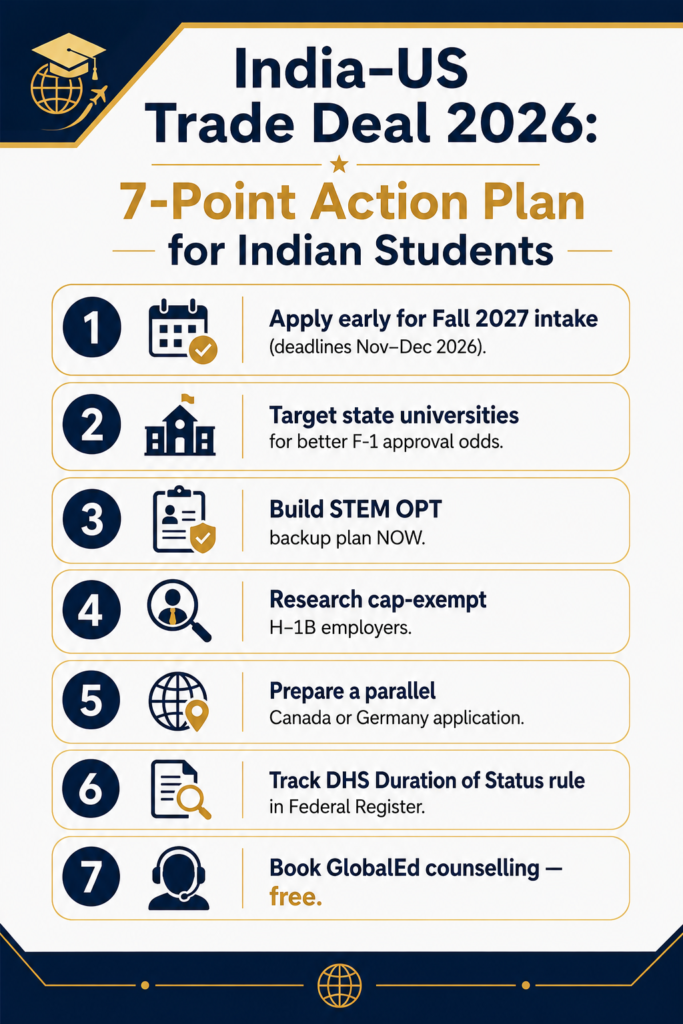
Action 1: Apply Early for Fall 2027 Intake — Deadlines Open November 2026
Given the 61 percent F-1 rejection rate, applying early gives you maximum time for reapplication if needed. Fall 2027 applications at most US universities open in September-October 2026 and close November-December 2026. Do not wait until January.
Action 2: Build the Strongest Possible F-1 Visa Application
A 61 percent rejection rate does not mean 61 percent of well-prepared applications are rejected. It means the average is 61 percent — driven by incomplete documentation, weak financial proof, and inadequate interview preparation. Here is what a visa-ready application looks like in 2026:
- Financial proof: Show minimum $40,000–50,000 in your sponsoring bank account for a 2-year MS (not just the first-year tuition)
- Strong ties to India: Proof of family property, parents’ employment, or your own career plans post-graduation — demonstrate you have reasons to return
- Clear study plan: Be able to articulate in 60 seconds exactly why you chose this specific program at this specific university
- Consulate choice: Apply at the consulate with the shortest waitlist and highest approval rate for your city — rates differ significantly across New Delhi, Mumbai, Chennai, and Hyderabad
- Apply with a counsellor: Students who prepare with experienced advisors consistently achieve higher F-1 approval rates
Action 3: Research STEM OPT Backup Plans Before You Enroll
Do not commit to a 2-year, ₹1.5-crore US investment without a clear answer to this question: what is your plan if STEM OPT is restricted or eliminated before you graduate in 2028?
- Cap-exempt H-1B employers: Universities, non-profit research institutions, and government research labs can sponsor H-1B year-round without the lottery. Research these employers in your target field before choosing your university.
- O-1 visa: Build an extraordinary ability case during your OPT period — publications, patents, and high-impact projects strengthen your O-1 eligibility
- EB-2 NIW (National Interest Waiver): STEM researchers with a clear US national interest argument can self-petition for a Green Card without employer sponsorship — begin building your case from year 1
- Parallel country application: Apply to a Canadian or German program in the same intake cycle — not as a fallback, but as a genuine alternative if US conditions deteriorate
Action 4: Target Universities That Maximise H-1B and OPT Outcomes
University Type | H-1B Sponsorship Rate | Why It Matters | Examples |
|---|---|---|---|
R1 Research Universities (top 50) | High — major tech employers recruit heavily | Research exposure + brand name = higher OPT offer rate | CMU, Purdue, UT Austin, Georgia Tech, UIUC |
Co-op universities | High — employers hire co-op students first | Work experience during degree = pre-OPT employment relationship | Northeastern, Drexel, WPI |
Universities near tech hubs | Higher — proximity to employers in tech clusters | San Jose, Seattle, Boston, Austin, NYC have highest density of H-1B sponsors | UC Berkeley, UW Seattle, BU, UT Austin |
Non-profit research institutions | Year-round, cap-exempt H-1B | No lottery risk — sponsor anytime | MIT, Stanford, Johns Hopkins (university roles) |
State universities in low-cost states | Moderate — lower tuition improves ROI | Lower ₹ investment = better ROI even with H-1B uncertainty | Purdue, Ohio State, Arizona State, NC State |
Action 5: Track the DHS Duration of Status Rule — Your Program Timeline May Be Affected
The proposed DHS rule capping F-1 status at 4 years was submitted to the OMB on May 5, 2026 and may take effect as early as September 2026. If you are applying to a PhD program or an MS program that runs longer than 4 years:
- Confirm your exact program completion timeline with your prospective DSO before enrolling
- Ask specifically: ‘If Duration of Status is eliminated, will my program be affected and what extension process will I need to follow?’
- Budget for potential USCIS extension filing fees ($370 per I-539 application) and an additional 6–12 months of processing time if the rule takes effect
- Follow the Federal Register at federalregister.gov for publication of the final rule — once published, it typically takes 60 days to take effect
Action 6: Consider a Parallel Canada or Germany Application
The single most impactful decision an Indian student can make in 2026 is to apply to US universities AND to one alternative destination simultaneously. The reasons:
- F-1 rejection rate is 61 percent — even a 50th-percentile applicant has significant risk. A parallel Canadian or German application ensures you have a confirmed offer rather than a gap year.
- Canada’s PGWP and Express Entry give PR in 3-4 years. Germany’s EU Blue Card gives PR in 21 months. Both offer structured timelines that the USA cannot match for Indian nationals.
- A Canadian or German offer in hand also strengthens your US visa interview — showing you have genuine multiple options makes you a lower-risk applicant in consular officers’ assessments.
- The incremental cost of a parallel application (₹20,000–50,000 in fees and time) is trivial compared to the cost of a gap year if your US application is rejected.
Action 7: Understand the Long Game — What BTA Phase 2 Could Mean
The Interim Agreement announced in February 2026 is explicitly the first phase of a broader BTA. Both governments have committed to ‘additional market access commitments’ in subsequent negotiations. Watch for:
- Professional services and qualifications recognition provisions in BTA Phase 2 — could streamline Indian credential evaluation for US employment
- Education services trade liberalisation — could lead to US universities establishing formal campuses or academic partnerships in India that create dual-qualification pathways
- Bilateral mobility frameworks — the State Department’s explicit mention of people-to-people connections suggests future visa-related provisions are under consideration
- Mission 500 sectoral agreements — technology, defence, and pharma expansion under the deal will create new employment pathways for Indian STEM graduates returning to India after US degrees
Section 6: Should You Still Apply to the USA? — An Honest 2026 Decision Framework
The India-US Trade Deal improves the geopolitical environment — but it does not change the immigration risk landscape that Indian students face in 2026. Here is a clean decision framework:
Apply to USA if: | Reconsider USA (or apply in parallel) if: |
|---|---|
You are targeting a specific program that only top US universities offer — Stanford CS, Wharton MBA, MIT Engineering | Your primary goal is permanent residency within 5 years — Canada or Germany deliver this faster and more reliably |
You have strong financial backing (₹1.5-3 crore) and can absorb the risk of F-1 rejection or OPT restriction | You are depending on STEM OPT to justify the ROI of the US degree — this is currently under legislative threat |
You are applying to cap-exempt research institutions where H-1B is available year-round without lottery | Your CGPA is below 8.0 or your profile is not exceptionally strong — F-1 rejection risk is even higher for borderline profiles |
You have a clear backup plan for the post-graduation visa pathway (O-1, EB-2 NIW, cap-exempt employer) | Your budget is under ₹80 lakh — Germany or Canada offer comparable STEM education at lower total cost with better post-study outcomes |
You are applying specifically for iCET-related research (AI, semiconductors) where US university-industry pipelines are strongest | You are a family person who needs certainty — the H-1B lottery and 100-year Green Card backlog create planning uncertainty that affects families more than individuals |
Section 7: What a US Degree Actually Costs Indian Students in 2026 — Full INR Breakdown
One thing the trade deal may improve is the cost in INR terms, if it leads to rupee appreciation. Here are the current figures:
Cost Component | State University (2-yr MS) | Private University (2-yr MS) | INR at ₹92/USD |
|---|---|---|---|
Tuition (2 years) | $28,000–55,000 | $55,000–90,000 | ₹25.8–50.6L / ₹50.6–82.8L |
Living expenses (2 years) | $24,000–36,000 | $30,000–48,000 | ₹22.1–33.1L / ₹27.6–44.2L |
Health insurance (2 years) | $3,000–5,000 | $3,000–5,000 | ₹2.8–4.6L |
Travel (round-trip x2) | $2,000–3,000 | $2,000–3,000 | ₹1.8–2.8L |
Miscellaneous | $3,000–5,000 | $4,000–7,000 | ₹2.8–4.6L / ₹3.7–6.4L |
TOTAL all-in (2 years) | $60,000–104,000 | $94,000–153,000 | ₹55.2–95.7L / ₹86.5–140.8L |
STEM OPT earnings (3 years, $80K salary) | −$240,000 | −$240,000 | −₹220.8L (offsets investment) |
The ROI calculus: A US STEM degree delivers its ROI ONLY if you stay in the USA and earn in USD for at least 3-5 years. The average starting salary for Indian STEM graduates on OPT is $85,000–120,000 per year (~₹78–110 lakh) — making the math work clearly IF you secure employment and work authorisation. The risk is that OPT or H-1B restrictions in 2028-2030 may prevent you from earning those dollars long enough to recover the investment.
Section 8: Best US Universities for Indian Students in 2026 — Balancing Rankings, ROI & Visa Outcomes
University | State | Strengths for Indians | Avg. MS Tuition (2 yrs) | OPT Employment Rate |
|---|---|---|---|---|
Carnegie Mellon University | Pennsylvania | CS, AI, ML, Robotics — #1 globally | $95,000 | 92% within 3 months |
Georgia Institute of Technology | Georgia | CS, Engineering — exceptional value | $35,000 (in-state rate for some programs) | 90%+ |
Purdue University | Indiana | CS, Engineering, Agriculture — strong OPT record | $30,000–40,000 | 88%+ |
University of Illinois Urbana-Champaign | Illinois | CS, Engineering — strong Indian alumni network | $40,000–55,000 | 90%+ |
Arizona State University | Arizona | Engineering, Business — strong international student support | $28,000–38,000 | 85%+ |
Northeastern University | Massachusetts | Co-op model — highest employment rate in USA | $55,000–65,000 | 94%+ (co-op) |
University of Texas Austin | Texas | CS, Engineering — tech hub proximity (Austin) | $30,000–45,000 | 88%+ |
University of Washington | Washington | CS, AI — Seattle tech hub (Amazon, Microsoft) | $35,000–50,000 | 92%+ |
Note: OPT employment rates are approximations based on university employment reports and OPT SEVIS data. Rates may change based on employer demand and US immigration policy in 2028-2030 when current applicants graduate.
Frequently Asked Questions — India–US Trade Deal 2026 and Indian Students
1. Does the India–US Trade Deal 2026 make it easier to get a US student visa?
No — not directly. The trade deal announced on February 6, 2026 is a trade framework focused on tariffs, market access, and technology cooperation. It does not include any provisions on student visas, F-1 rules, or immigration policy. The F-1 visa rejection rate for Indian students remained at 61 percent in 2026. The indirect benefit is a warmer diplomatic environment that may eventually lead to more US university recruitment in India and, in future BTA phases, potentially some professional mobility provisions.
2. Will H-1B rules improve for Indian students because of the trade deal?
The trade deal does not include any H-1B provisions. H-1B visa rules, the lottery system, and the annual 85,000 visa cap are determined by US immigration law — not trade agreements. In fact, 2026 has seen H-1B conditions worsen for early-career applicants, with a new weighted lottery that favours higher-salary positions (effective February 27, 2026 for the FY2027 lottery) and proposed prevailing wage increases. The trade deal creates no direct benefit to H-1B or OPT rules.
3. What is the DHS Duration of Status rule change and how does it affect Indian students?
On May 5, 2026, DHS submitted a proposed rule to eliminate Duration of Status for F-1 and J-1 visa holders and replace it with a 4-year fixed admission period. If finalised, Indian students in programs longer than 4 years (PhD, some professional programs) would need to file USCIS extension applications to remain in the US. USCIS faces an 11.3 million case backlog and estimates an additional 414,000 annual filings from this rule — making processing delays near-certain. Legal challenges are expected. Students should monitor the Federal Register for the final rule publication date.
4. Should Indian students still apply to US universities in 2026?
Yes — but with clear eyes about the risks and a backup plan. The USA offers the highest post-graduation STEM salaries in the world ($85,000–120,000 for MS STEM graduates), the strongest AI and technology research ecosystem, and institutional brands that open doors globally. But the F-1 rejection rate of 61 percent, proposed OPT restrictions, H-1B lottery uncertainty, and the 50–100 year Green Card backlog for Indian nationals mean that a US application should never be your only plan. Apply to the USA and simultaneously apply to Canada, Germany, or the UK as a genuine alternative.
5. What does ‘Mission 500’ mean for Indian students applying to US universities?
Mission 500 is the bilateral target to increase India-US trade from $149 billion (2025) to $500 billion by 2030. For Indian students, it means US companies are expanding their India operations significantly — which creates more India-based roles that value US education and provides a post-OPT return option for students who cannot secure H-1B in the USA. The iCET technology partnership under this mission is also expanding joint research funding in AI and semiconductors — benefiting Indian STEM PhD students at US universities.
6. Are there new scholarships for Indian students at US universities because of the trade deal?
No new scholarship programs have been announced as a direct result of the trade deal. However, the renewed India-US relationship typically leads to increased institutional partnerships — and universities that establish new formal partnerships with Indian institutions often provide joint funding, tuition waivers, or research fellowships. Watch for new partnerships announced between US R1 universities and IITs, IISc, and NITs in the 2026-27 academic year.
7. How does the trade deal compare to what Canada and Germany offer Indian students in 2026?
The trade deal creates goodwill but no structural improvement to US immigration pathways. Canada’s PGWP (3-year post-study work permit) feeds directly into Express Entry for PR in 2-3 years — no lottery, no per-country cap, no decades-long backlog. Germany’s EU Blue Card gives PR in 21 months with B1 German. Both offer predictable, achievable settlement pathways that the USA cannot offer Indian nationals under current immigration law. The trade deal’s indirect benefits do not change this structural comparison.
Related Guides on GlobalEd — Read These Before Making Your Decision
- PR After Masters Abroad 2026: Which Country Gives Permanent Residency Fastest for Indian Students?
- Is an MBA Abroad Worth It in 2026? ROI Analysis for Indian Students
- Study in Germany 2026: Free Education, PR Pathways & Top Universities for Indian Students
- Part-Time Work for Indian Students Abroad 2026: Real Earnings Guide
- IELTS vs PTE vs TOEFL 2026: Which English Test Should You Take
https://globaled.co.in/blog-2/
Authoritative Sources & External References
1. White House — United States–India Joint Statement, February 9, 2026 — Official joint statement announcing the India–US BTA framework
2. ESCAP — India–US Bilateral Trade Agreement and Implications for South Asia — Expert analysis of the BTA’s economic implications from UN ESCAP
3. Reddy Neumann Brown PC — DHS Moves to End Duration of Status for F-1 Visa Holders — Immigration law firm analysis of the proposed 4-year cap rule, May 2026
4. Brookings Institution — How the Trump Administration Is Eroding the Immigrant Talent Pipeline — Data on F-1, OPT, H-1B changes and their impact on Indian students, June 2026
5. ICEF Monitor — Visa Rejections Climb in the US for International Students from Key Markets Including India — April 2026 data on F-1 rejection rates and international student mobility shifts
6. Collegedunia — Indian Student Visa Approval Rates 2026 — Comprehensive 2026 visa approval rate comparison across all major destinations for Indian students
7. UC Davis SISS — Federal Government Updates for International Students and Scholars — University of California Davis compilation of all 2026 US federal immigration changes affecting F-1 students
Conclusion: The Trade Deal Changes the Climate — Not the Rules
The India–US Trade Deal 2026 is genuinely significant. The February 6 announcement marked a historic reset in bilateral relations — reducing tariffs, expanding technology cooperation, and signalling that the USA views India as its most important long-term partner in the Indo-Pacific.
But for Indian students applying to American universities in 2026, the deal changes the climate — not the rules.
The F-1 rejection rate is still 61 percent. The DHS is still proposing a 4-year cap on Duration of Status. OPT still faces potential restrictions. The H-1B lottery still has 1-in-3 odds. The Green Card wait for Indian nationals is still measured in decades, not years.
The trade deal creates the conditions for future improvements — in diplomatic goodwill, in institutional partnerships, in potential future BTA phases that could include professional mobility provisions. But ‘conditions for future improvements’ is not the same as ‘better conditions today.’
Indian students in 2026 need to make decisions based on today’s rules, not optimistic future projections. That means applying to the USA with a clear-eyed understanding of the risks, a backup country in your application plan, and a post-graduation strategy that does not depend on STEM OPT or H-1B working exactly as they did in 2022.
At GlobalEd, we have guided hundreds of Indian students through exactly this kind of complex, multi-country decision. We help you build an application strategy that maximises your chances across the USA, Canada, Germany, and the UK simultaneously — so that regardless of what happens to any one country’s immigration rules, you have a confirmed path forward.
→ Book Your Free USA vs Alternatives Counselling Session with GlobalEd
→ Download the Free India–US Trade Deal Impact Checklist for Students 2026