
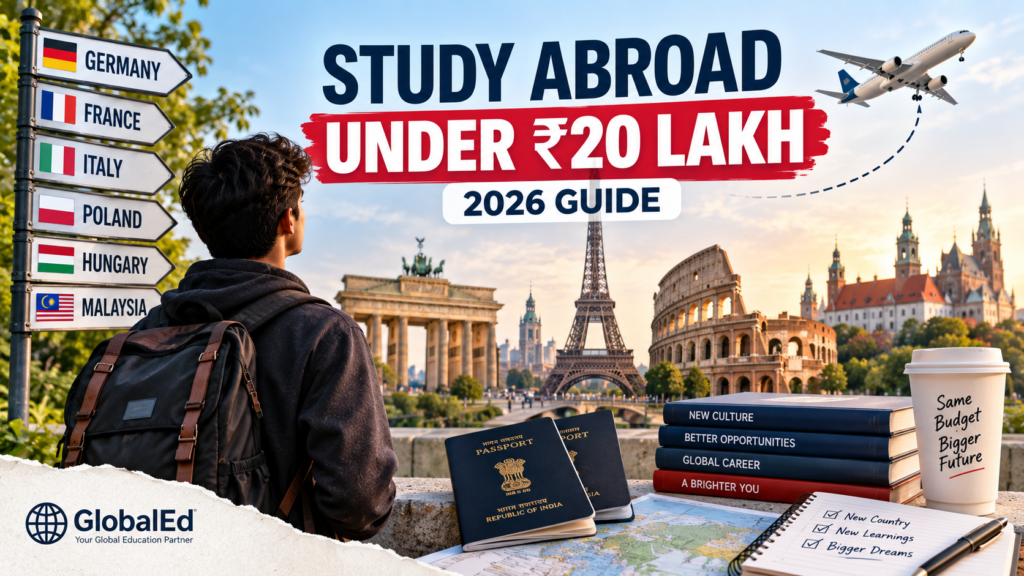
Think studying abroad requires ₹40–50 lakh? For some countries and programmes in 2026, that isn’t necessarily true. A ₹20 lakh budget can realistically open the door to an international degree — but only if you pick the right country, the right city, and the right programme, and only once you understand what ₹20 lakh actually covers.
Low tuition does not automatically mean low total cost. This guide compares real 2026 tuition fees, living costs, and visa financial requirements across the most realistic destinations for Indian students on a ₹20 lakh budget — Germany, France, Italy, Poland, Hungary, Czech Republic, and Malaysia — so you can compare total cost, not just the headline number.
In this guide:
- What “study abroad under ₹20 lakh” actually means
- Country-by-country tuition, living cost, and visa fund breakdown
- Germany, France, Italy, Poland, Hungary, Czechia & Malaysia in detail
- Bachelor’s vs Master’s affordability
- How to cut costs, and where scholarships fit in
- Budget scenarios, hidden costs, and a pre-departure checklist
- 12 FAQs on studying abroad within ₹20 lakh
Quick Answer: Can You Study Abroad Under ₹20 Lakh?
Yes — some students can study abroad within or close to a ₹20 lakh budget, particularly in lower-tuition destinations like Germany, Poland, Hungary, and Malaysia. But whether ₹20 lakh covers your entire degree or only the first year depends heavily on the country, programme, university, city, scholarships, and living costs. In Poland, Hungary, and Malaysia, ₹20 lakh can often stretch across a full Master’s. In Germany and Italy, it typically covers the first year comfortably. In France, it usually covers one year of a Master’s, not two. Always verify current tuition and visa-fund requirements with the university and embassy before finalising your budget.
What Does “Study Abroad Under ₹20 Lakh” Actually Mean?
Before comparing countries, it helps to separate five different things people mean when they say “₹20 lakh budget” — because they lead to very different shortlists.
A ₹20 lakh total-degree budget is the strictest reading — tuition and living costs for the entire programme, start to finish. A ₹20 lakh first-year budget is far more common and realistic: tuition plus living costs for year one only, with year two funded separately (loan, part-time work, family savings, or scholarship). A ₹20 lakh tuition-only budget ignores living costs, which is risky since living expenses can equal or exceed tuition in several countries. ₹20 lakh plus a scholarship changes the picture substantially, since even a partial tuition waiver can convert an unrealistic country into a comfortable one. And ₹20 lakh plus an education loan simply extends what your family funds alone could reach.
| Budget Type | What It Means | Realistic? |
|---|---|---|
| ₹20 lakh total degree | Entire education + living, start to finish | Depends heavily on country and programme |
| ₹20 lakh first year | Tuition + living for year one only | Much more realistic across most countries |
| ₹20 lakh tuition only | Living costs excluded from the figure | Risky — depends on the country’s living costs |
| ₹20 lakh + scholarship | Scholarship reduces the net cost | Potentially far more flexible |
| ₹20 lakh + education loan | Family funds topped up with a loan | Opens up more university and country options |
Which Countries Are Realistically Under ₹20 Lakh?
Exchange rates fluctuate — the conversions below use approximate September 2026 rates (1 EUR ≈ ₹111, 1 USD ≈ ₹95, 1 MYR ≈ ₹22) purely for planning. Always convert at the current rate before finalising your budget.
| Country | Typical Tuition (Master’s/yr) | Living Cost (monthly) | Approx. First-Year Budget | Language | Budget Fit |
|---|---|---|---|---|---|
| Germany | €0 public (+€150–390 semester fee) | €850 – 1,100 | ₹15L – 16.5L | English/German | Strong — first year comfortable |
| France | €3,950 (differentiated, 2026–27) | €800 – 1,300 | ₹18L – 19L | French/English | Fits first year, not full 2-yr Master’s |
| Italy | €0 – 4,000 (ISEE-based) | €500 – 1,100 | ₹13L – 15L | English/Italian | Strong, scholarships help further |
| Poland | €2,000 – 6,000 | €400 – 700 | ₹10.5L – 12L | English | Very strong — often full degree fits |
| Hungary | €2,000 – 5,000 (self-funded) | €450 – 650 | ₹11L – 12.5L | English | Strong; scholarship route even better |
| Czech Republic | €2,000 – 10,000 (English programmes) | €450 – 900 | ₹12L – 15L | English/Czech | Moderate — depends on programme |
| Malaysia | RM 10,000 – 30,000 | RM 1,500 – 2,500 | ₹10L – 11.5L | English | Very strong — often full degree fits |
All figures above are indicative estimates based on 2026 published ranges — actual costs vary by university, programme, and city. Treat them as a planning starting point, not a quote.
Germany: One of the Strongest Low-Tuition Options
Germany’s reputation as “free” is a useful headline but an oversimplification. Public universities charge no tuition for Bachelor’s and most Master’s programmes, but you still pay a semester contribution (Semesterbeitrag) of roughly €150–390, which usually covers a local transport pass and student services. One state, Baden-Württemberg, charges non-EU students up to €1,500 per semester at public universities — so “free tuition” is not universal across every state or programme.
The bigger number to plan around is the blocked account (Sperrkonto), the financial proof Germany requires for a student visa. As of 2026, this is €11,904 for a 12-month visa (€992 released per month), and it is separate from tuition — it exists purely to show you can support yourself. On top of this, budget for health insurance (roughly €1,200/year for public insurance), a flight, and initial accommodation deposits.
Germany is particularly strong for Engineering, Computer Science, AI, Data Science, Automotive Engineering, and Research-focused Master’s, many taught fully in English at the postgraduate level. Part-time work is capped at 140 full days or 280 half days per year for non-EU students, and language matters: German-speaking graduates access a far wider job market than English-only graduates, even in technical roles.
- Public tuition: €0 (most states) + €150–390 semester fee, up to €1,500/semester in Baden-Württemberg
- Blocked account (visa funds): €11,904/year, released at €992/month
- Estimated first-year total: roughly ₹15–16.5 lakh including living costs, insurance, and flights
- Post-study: 18-month job-search residence permit after graduation
(Sources: DAAD · Make it in Germany)
France: Affordable Public Education With Strong Career Options
France has historically been one of Europe’s cheapest study destinations, but this changed materially for the 2026–27 intake. Non-EU students at public universities now pay differentiated tuition of approximately €2,902/year for a Bachelor’s and €3,950/year for a Master’s, compared to the near-symbolic €178–254 EU rate. Universities can currently waive these fees for up to 30% of their international student intake, a cap that narrows in future years — so ask your target university directly whether a waiver applies to your programme.
The visa financial requirement changed too: from 1 August 2026, non-EU applicants must show at least €877.50 per month (about €10,530 per year) in financial resources — up from the earlier €615/month. This is a separate requirement from tuition and should not be confused with your actual cost of living.
Paris living costs run notably higher (€1,000–1,750/month) than smaller student cities like Lille, Nantes, or Grenoble (€700–1,000/month). France is strong for Business and Management, Engineering (Grandes Écoles), Fashion, Hospitality, and Technology. Note that private institutions and Grandes Écoles can charge significantly more than the public differentiated rate — always check whether your target programme is public or private before budgeting.
- Public tuition (2026–27, non-EU): ~€2,902 (Bachelor’s) / ~€3,950 (Master’s)
- Visa financial requirement: €877.50/month (~€10,530/year) from August 1, 2026
- Estimated first-year Master’s total: roughly ₹18–19 lakh outside Paris
- A full 2-year Master’s typically exceeds ₹20 lakh once both years are combined
(Sources: Campus France · France-Visas)
Italy: Scholarships Can Make the Difference
Italian public universities set tuition using an income-based system (ISEE), which can bring fees down to €0–€4,000/year for many international Master’s programmes — the published EU average sits around €1,628/year. Regional right-to-study bodies (DSU-type scholarships) offer tuition waivers plus, for eligible students, a housing or meal contribution — but eligibility depends on your family’s declared financial circumstances and the specific region, so treat this as a possibility to apply for, not a guaranteed discount.
Living costs vary sharply by city: northern hubs like Milan, Bologna, and Turin run €700–1,100/month, while southern cities such as Naples, Bari, and Palermo can be €500–800/month. Italy is well regarded for Architecture, Design, Engineering, Business, and Fashion, with a growing number of English-taught Master’s programmes, particularly in technical and design fields.
- Tuition: €0 – €4,000/year depending on ISEE bracket and university
- Living cost: €500 – 1,100/month depending on city
- Estimated first-year total: roughly ₹13–15 lakh, lower with a DSU scholarship
- Scholarship eligibility depends on your circumstances and region — apply early, don’t assume
(Source: Universitaly)
Poland: An Affordable European Alternative
Poland is one of the most budget-friendly EU destinations for Indian students, with English-taught tuition typically in the €2,000–6,000/year range and living costs among the lowest in the EU at €400–700/month. Warsaw, Krakow, and Wroclaw are the main student hubs, each with a growing base of English-medium Engineering, IT, and Business programmes.
Poland’s job market for graduates is developing steadily, particularly in IT and shared-services/BPO roles in Warsaw and Krakow. Visa financial requirements are comparatively modest, and because both tuition and living costs are low, Poland is one of the few countries where a full two-year Master’s can realistically be completed close to, or within, a ₹20 lakh total budget — particularly outside the largest cities.
- Tuition: €2,000 – 6,000/year for English-taught programmes
- Living cost: €400 – 700/month, among the lowest in the EU
- Estimated 2-year Master’s total: roughly ₹19–23 lakh
- Best for: Engineering, IT, and Business on a tight budget
Hungary: Low-Cost Study Plus Scholarship Opportunities
Hungary offers two very different budget pictures depending on whether you’re self-funded or scholarship-funded. Self-funded, English-taught tuition typically runs €2,000–5,000/year for Business, IT, and Engineering, with living costs of €450–650/month outside Budapest (Budapest itself runs somewhat higher).
The Stipendium Hungaricum government scholarship changes this significantly for eligible applicants: it waives tuition fully and provides a monthly stipend (around €110/month for Bachelor’s/Master’s students) plus dormitory accommodation or a housing contribution. Importantly, the stipend does not fully cover real living costs — most recipients still need €370–990/month in additional personal funds, so a scholarship reduces your budget substantially but does not eliminate the need for family funding or savings.
- Self-funded tuition: €2,000 – 5,000/year
- Stipendium Hungaricum: full tuition waiver + ~€110/month stipend (competitive, merit-based)
- Estimated self-funded first-year total: roughly ₹11–12.5 lakh
- Strong for: Medicine, Business, Engineering, IT
(Source: Study in Hungary)
Czech Republic: What Indian Students Should Know
The Czech Republic offers a genuine two-track system: Czech-taught public programmes can be free or near-free, but require Czech language proficiency, while English-taught programmes are fee-based and typically range from €2,000 to €10,000/year depending on the university and field (Medicine and Data Analytics-type programmes sit at the higher end). Prague is considerably more expensive than regional cities like Brno or Olomouc, both for rent and general living costs.
Living costs nationally run €450–900/month. Popular fields for international students include Engineering, IT, Business, and Medicine (largely at English-medium private or semi-private institutions). The Czech Republic sits in the middle of this list — cheaper than France or Italy in many cases, but not automatically as inexpensive as Poland or Hungary, so compare specific universities carefully.
- English-taught tuition: €2,000 – 10,000/year (varies widely by field)
- Living cost: €450 – 900/month depending on city
- Estimated first-year total: roughly ₹12–15 lakh
Malaysia: One of Asia’s Affordable Study Abroad Options
For students who want a lower total cost while remaining in Asia — shorter flights home, familiar climate, and a large existing Indian student community — Malaysia is a strong option. Public university (IPTA) tuition runs roughly RM 10,000–30,000/year for international students, while private universities and foreign branch campuses (Monash Malaysia, Nottingham Malaysia, Heriot-Watt Malaysia, Xiamen University Malaysia) charge RM 30,000–90,000/year — still a fraction of what the same qualification costs in the UK or Australia.
Living costs are low: RM 1,500–2,500/month in Kuala Lumpur, and somewhat less in Penang or Johor Bahru. English is the medium of instruction for the vast majority of programmes, particularly Business, IT, Engineering, and Hospitality. Malaysia’s Education Malaysia Global Services (EMGS) handles the student pass process and requires proof of funds of roughly RM 2,000/month.
- Public tuition: RM 10,000 – 30,000/year; branch campuses RM 30,000 – 90,000/year
- Living cost: RM 1,500 – 2,500/month
- Estimated first-year total (public): roughly ₹10 – 11.5 lakh
- Best for: Business, IT, Engineering, Hospitality on the tightest budgets
Best Countries Under ₹20 Lakh: Side-by-Side Comparison
Costs below are indicative and vary by institution, city, programme, exchange rate, and personal lifestyle. Visa financial requirements are a separate, non-negotiable figure set by each government — they are not the same as your estimated cost of living.
| Country | Tuition/yr | Living/mo | Visa Funds | English Programmes | Part-Time Work | Post-Study Option |
|---|---|---|---|---|---|---|
| Germany | €0 – 1,500/sem | €850–1,100 | €11,904/yr | Yes (Master’s) | 140 full / 280 half days | 18-month job search |
| France | €2,902 – 3,950 | €800–1,300 | €877.50/mo | Growing | 964 hrs/year | APS 1-year search visa |
| Italy | €0 – 4,000 | €500–1,100 | Varies by region | Growing | 20 hrs/week | 1-year search permit |
| Poland | €2,000 – 6,000 | €400–700 | Moderate | Yes | Permitted (check limits) | Developing job market |
| Hungary | €2,000 – 5,000 | €450–650 | Moderate | Yes | 24 hrs/week (term-time) | Developing job market |
| Czechia | €2,000 – 10,000 | €450–900 | Moderate | Yes | Permitted (check limits) | Developing job market |
| Malaysia | RM 10k – 30k | RM 1.5k–2.5k | ~RM 2,000/mo | Yes (most programmes) | Limited, campus roles | Graduate pass options |
Best Countries Under ₹20 Lakh, By Student Profile
There is no single “best” country under ₹20 lakh — the right one depends on your course, city preference, and risk tolerance. Use this as a starting filter, not a final ranking:
- Best for Engineering: Germany, Poland, Czech Republic
- Best for Computer Science & AI: Germany, Poland, Malaysia
- Best for Business: France, Hungary, Malaysia
- Best for Design: Italy, Poland
- Best for Architecture: Italy, Germany
- Best for Healthcare-adjacent fields: Hungary, Czech Republic
- Best for lowest tuition: Poland, Hungary, Malaysia
- Best for scholarship access: Hungary (Stipendium Hungaricum), Italy (DSU)
- Best for English-only programmes: Germany (Master’s), Poland, Malaysia
- Best for the tightest budgets overall: Poland and Malaysia
Can You Study in Germany Under ₹20 Lakh?
Yes, for the first year — with careful budgeting. A realistic first-year breakdown for a public-university Master’s: semester fee (~€300–600/year), the blocked account (€11,904, though this money is released to you monthly, not spent upfront), health insurance (~€1,200/year), a flight (~₹45,000–60,000), and initial accommodation/deposit costs (~€1,500–2,500). Combined, this lands around €13,500–15,500, or roughly ₹15–17 lakh at current rates — comfortably under ₹20 lakh.
For the full two-year Master’s, add a second year of living costs (~€10,200–13,200) since tuition remains free at most public universities. That pushes the full-degree total to roughly ₹26–31 lakh — so ₹20 lakh is realistic for year one, not automatically the whole degree, unless supplemented by part-time work (permitted, capped hours), a scholarship (DAAD offers several), or a top-up loan for year two.
Can You Study Abroad Under ₹20 Lakh Without an Education Loan?
It’s possible in lower-cost destinations, but it requires deliberate planning. Realistic levers include family savings covering the full first-year cost upfront, applying for university or government scholarships before enrolling (not after), choosing genuinely low-tuition countries (Poland, Hungary, Malaysia), picking a smaller city over a capital to cut living costs by 20–30%, using student dormitories instead of private rentals, and applying to multiple universities to compare scholarship offers rather than accepting the first admit.
One important caution: do not plan to use future part-time income to satisfy a student visa’s financial requirement. Nearly every country requires you to demonstrate the required funds are already available — in a blocked account, bank statement, or sponsor letter — before the visa is issued. Part-time work can supplement your budget once you arrive, but it cannot substitute for the upfront proof of funds.
How to Reduce Your Study Abroad Cost
- Choose public universities over private institutions where quality is comparable
- Compare cities — a smaller student city can cut living costs by 20–30% versus the capital
- Apply for university and government scholarships early, not as an afterthought
- Apply to multiple universities to compare tuition and scholarship offers
- Consider shorter, accredited programmes where academically appropriate
- Use student dormitories instead of private rentals for at least year one
- Cook at home instead of eating out regularly
- Use student transport passes, often bundled into your semester fee in Germany
- Consider shared flats/apartments to split rent and utilities
- Compare student health insurance plans where the country allows a choice
- Avoid unnecessary agent fees — verify what services you’re actually paying for
- Build a realistic financial buffer (10–15%) instead of budgeting to the exact minimum
₹20 Lakh Study Abroad Budget Example
These are illustrative examples only, not guaranteed prices — always confirm current costs with your specific university and embassy.
| Expense | Scenario A: Poland (self-funded) | Scenario B: Hungary (scholarship) | Scenario C: France (Master’s, self-funded) |
|---|---|---|---|
| Tuition | ₹3.3L | ₹0 (waived) | ₹4.4L |
| Living (1 yr) | ₹6.7L | ₹5.5L (net of stipend) | ₹12L |
| Visa/financial funds* | Included above | Included above | ₹11.7L (separate proof, not spent) |
| Insurance | ₹0.3L | Included in scholarship | ₹0.5L |
| Flight + setup | ₹0.9L | ₹0.9L | ₹1L |
| Total (Year 1, approx.) | ₹11.2L | ₹6.4L | ₹18L |
Visa financial-requirement figures are proof-of-funds amounts, not additional spending — in most cases this money remains largely intact and is what a blocked account or bank statement demonstrates, not a separate cost layered on top.
What About Part-Time Jobs?
Work rules differ by country and change periodically, so always check the current government limit before you rely on them. Germany permits roughly 140 full days or 280 half days per year for non-EU students. France allows up to 964 hours per year. Other countries set their own weekly or annual caps — verify directly with the relevant immigration authority.
Typical student jobs include campus roles (library, admin, research or teaching assistantships), hospitality and retail work, customer service, and food delivery where locally permitted. Treat part-time income as a supplement to your planned budget, not the primary funding strategy — visa authorities generally require your core financial requirement to be met independently of expected part-time earnings.
What About Scholarships?
Scholarships can meaningfully change your total cost, but availability and eligibility are never guaranteed — apply broadly and early rather than assuming a specific award.
| Scholarship Type | Typical Benefit | Who Should Apply? |
|---|---|---|
| Merit-based | Tuition reduction or partial funding | Strong academic profiles, competitive test scores |
| Need-based | Financial support tied to income/circumstances | Eligible applicants who meet the country’s criteria |
| Government (e.g., Stipendium Hungaricum, DAAD) | Tuition waiver, stipend, sometimes housing | Country/programme-specific, often competitive |
| Erasmus Mundus | Potentially comprehensive funding | Highly competitive joint Master’s applicants |
| University-specific | Partial to full tuition assistance | Varies by institution — check each university’s page |
(Reference: Erasmus+)
Is ₹20 Lakh Enough for a Master’s Abroad?
It depends heavily on programme length. A 1-year Master’s (common in parts of Europe and the UK-style system) roughly halves your total living-cost exposure compared to a 2-year programme, which makes ₹20 lakh realistic in more countries. A 2-year Master’s in Germany, Poland, or Hungary can still land near or under ₹20 lakh because tuition is low or waived. A 2-year Master’s in France typically exceeds ₹20 lakh once both years are combined, since tuition and Paris-level living costs compound. Engineering and Computer Science Master’s tend to have the widest range of low-cost options; Business Master’s/MBA-style programmes are more likely to push past ₹20 lakh unless scholarship-funded.
Is ₹20 Lakh Enough for a Bachelor’s Abroad?
Bachelor’s degrees are structurally harder to fit under ₹20 lakh for the full programme, mainly because of duration — three to four years of tuition and living costs compound quickly, even in low-tuition countries. Where a Master’s student might complete an entire degree near ₹20 lakh in Poland or Hungary, a Bachelor’s student in the same country is more likely to need ₹20 lakh for roughly the first 12–18 months only. If a Bachelor’s abroad is the goal, treat ₹20 lakh explicitly as a first-year or first-two-years budget, and plan the remaining years through loans, scholarships, or family funding from the outset — not as an afterthought once already enrolled.
USA vs Canada vs Europe Under ₹20 Lakh
| Factor | USA | Canada | Affordable European Destinations |
|---|---|---|---|
| ₹20L feasibility | Not realistic for a full degree; rarely covers even one semester | Not realistic for a full degree; may stretch to one semester | Realistic for 1 year in most; full degree possible in Poland/Hungary |
| Tuition | Very high (USD 20,000–60,000/yr) | High (CAD 20,000–35,000/yr) | Low to zero at many public universities |
| Living costs | High | Moderate to high | Low to moderate, city-dependent |
| Programme duration | 1–2 years | 1–2 years | 1–2 years, more 1-year options in Europe |
| Scholarship opportunities | Available, highly competitive | Available, moderately competitive | Government-backed options in Hungary, Italy, Germany |
| Visa financial requirements | High (I-20 cost-of-attendance based) | Moderate to high (GIC + tuition proof) | Moderate (blocked account/monthly proof, country-specific) |
| Post-study opportunities | OPT/H-1B, strong but competitive | PGWP, strong and predictable | Varies — Germany and France offer structured job-search permits |
Europe is not universally “better” than North America — affordability within Europe itself varies enormously, from near-zero tuition in Germany to France’s rising 2026–27 fees. Choose based on total cost and career fit, not a blanket regional assumption.
Hidden Costs Indian Students Often Forget
| Cost Category | Typical Range |
|---|---|
| Application fees (per university) | ₹2,000 – ₹8,000 |
| Visa fees | ₹6,000 – ₹15,000 |
| Biometrics / VFS charges | ₹1,500 – ₹4,000 |
| Health insurance (annual) | ₹35,000 – ₹1,10,000 |
| Flight (one-way, India to Europe/Asia) | ₹35,000 – ₹75,000 |
| Accommodation deposit | 1–2 months’ rent |
| University registration/enrolment fee | ₹8,000 – ₹30,000 |
| Residence permit fee (post-arrival) | ₹6,000 – ₹15,000 |
| Laptop and study materials | ₹40,000 – ₹90,000 |
| Winter clothing (Europe) | ₹8,000 – ₹20,000 |
| SIM, bank charges, currency conversion | ₹5,000 – ₹15,000 |
| Emergency buffer (recommended) | 10–15% of total budget |
Biggest Mistakes Students Make With a ₹20 Lakh Budget
- Looking only at tuition and ignoring living costs entirely
- Ignoring the visa financial-requirement figure until the last month
- Choosing an expensive capital city by default
- Assuming a scholarship is guaranteed before actually applying
- Depending entirely on future part-time work to fund the visa requirement
- Ignoring exchange-rate fluctuations between planning and departure
- Forgetting accommodation deposits and setup costs
- Choosing a course without checking graduate employability in that country
- Picking a university purely because tuition is cheapest, without checking recognition/accreditation
- Ignoring language requirements for the local job market
- Assuming low tuition automatically means low total cost
- Applying with zero emergency fund built into the budget
₹20 Lakh Study Abroad Checklist
- ☐ Calculate total tuition for the full programme, not just year one
- ☐ Calculate living expenses for your target city specifically
- ☐ Check the exact visa financial requirement for your destination
- ☐ Check scholarship eligibility and application deadlines
- ☐ Compare at least two to three cities within your shortlisted country
- ☐ Compare dormitory vs private accommodation costs
- ☐ Confirm course duration (1-year vs 2-year Master’s)
- ☐ Check part-time work rules and current hour limits
- ☐ Check post-study work/residence permit rules
- ☐ Calculate flight and one-time travel costs
- ☐ Calculate annual health insurance cost
- ☐ Maintain a 10–15% emergency fund buffer
- ☐ Compare education-loan options if self-funding falls short
- ☐ Verify the university’s recognition/accreditation status
- ☐ Check the latest government tuition and visa-fund figures — these change yearly
Not sure which of these countries fits your budget? GlobalEd can build a country and university shortlist around your actual ₹20 lakh budget — not just a generic list. Get a free, personalised cost comparison before you apply. 👉 Get Your Free Study Abroad Shortlist
Frequently Asked Questions
Can I study abroad under ₹20 lakh? Yes, particularly in Germany, Poland, Hungary, and Malaysia, where low tuition and moderate living costs make a first year — and in some cases a full Master’s — achievable within ₹20 lakh. The exact answer depends on your country, city, and programme length.
Which country is cheapest to study abroad from India? Among the destinations compared here, Poland, Hungary, and Malaysia typically offer the lowest total annual cost, combining low tuition with low living expenses. Germany is close behind due to free public tuition, though its visa financial-requirement figure is higher.
Can I study in Germany under ₹20 lakh? Yes, for the first year of a Master’s — tuition is free or near-free at most public universities, and total first-year costs including the blocked account typically land around ₹15–17 lakh. A full two-year Master’s usually runs higher once a second year of living costs is added.
Is ₹20 lakh enough for a Master’s abroad? It depends on the country and programme duration. In Poland, Hungary, and Germany, ₹20 lakh can often stretch across an entire 1-year or even 2-year Master’s. In France, it typically covers one year but not the full degree at 2026–27 tuition rates.
Can I study abroad without an education loan? It’s possible in lower-cost countries with strong scholarship support, careful city selection, and family savings — but it requires early planning. Relying on future part-time income to meet visa financial requirements is not accepted by most embassies.
Which European countries are affordable for Indian students? Germany, Poland, Hungary, and the Czech Republic are generally the most budget-friendly, followed by Italy (especially with ISEE-based tuition or DSU scholarships). France has become comparatively more expensive for non-EU students from the 2026–27 intake.
Which country has the lowest tuition fees? Germany’s public universities charge €0 tuition for most programmes (only a semester fee applies), making it the lowest by tuition alone. Poland and Hungary follow closely with tuition typically in the €2,000–6,000/year range.
Is Germany free for Indian students? Tuition is free or near-free at most public universities, but Germany is not cost-free overall. Students still need to cover the blocked account (€11,904/year), health insurance, accommodation, and living costs — Baden-Württemberg also charges non-EU tuition at public universities.
Can I study abroad under ₹20 lakh including living expenses? Yes, in Germany, Poland, Hungary, and Malaysia, ₹20 lakh can typically cover tuition and living expenses for at least the first year, and sometimes the full programme in the lowest-cost countries.
Which countries offer scholarships to Indian students? Hungary’s Stipendium Hungaricum, Germany’s DAAD scholarships, Italy’s regional DSU grants, and the EU-wide Erasmus Mundus programme are among the most accessible for Indian applicants, though all are competitive and require early application.
Can part-time work pay for my study abroad expenses? Part-time work can supplement your living costs once you arrive, within each country’s legal work-hour limits, but it cannot be used to satisfy a student visa’s upfront financial-requirement proof, which must be demonstrated independently.
Which country is best for a ₹20 lakh budget? There’s no single universal winner — the right destination depends on your course, academic profile, scholarship eligibility, language comfort, career goals, and the specific visa requirements of each country. Poland, Hungary, and Malaysia tend to fit the tightest budgets; Germany offers the strongest balance of low tuition and career outcomes.
Final Conclusion
₹20 lakh does not automatically mean that studying abroad is impossible. But it requires more than picking the country with the lowest headline tuition — it requires country selection, programme selection, a scholarship strategy, city selection, and genuine financial planning working together.
Don’t choose a country solely because tuition is cheap. The best decision balances education quality, total cost, career outcomes, visa realities, and long-term ROI — not just the number on a university’s fee page.
Requirements and costs can change. Always verify the latest tuition fees, living-cost estimates, and visa financial requirements with the relevant university and government authority before making financial or visa decisions.
Planning to Study Abroad Under ₹20 Lakh?
GlobalEd can help you:
✓ Compare affordable countries ✓ Find suitable universities ✓ Compare tuition and living costs ✓ Explore scholarship opportunities ✓ Understand admission requirements ✓ Plan your study-abroad budget ✓ Prepare for your application journey
Don’t choose a country based only on tuition fees. Choose a destination that fits your budget AND your career goals.https://globaled.co.in/contact-us/
👉 Get Your Personalised Study Abroad Shortlist with GlobalEd