

By GlobalEd Team | March 2026 | 12 min read | USA • UK • Canada • Australia • Europe
Introduction: The Dilemma That Keeps Indian Students Up at Night
Riya, a final-year engineering student from Pune, had been dreaming of her Master’s abroad for three years. She had shortlisted universities in the US and Canada — but hit a wall she hadn’t expected.
Should she apply to the University of Toronto (public/government) or Northeastern University (private)? Both were great. Both were expensive. But which one was actually the smarter choice for her career, visa, and life goals?
If you’re an Indian student planning to study abroad, you’ve almost certainly faced the same confusion. And unlike choosing between colleges in India, the global landscape is far more nuanced — fees work differently, rankings mean different things, and visa outcomes can vary in ways nobody warns you about.
According to the Ministry of Education (2024), over 13 lakh Indian students went abroad for higher education — a record high. Nearly 70% of them later admitted they didn’t fully understand the government vs private university distinction in their destination country before applying.
This ultimate guide breaks down the 10 most critical differences between government university vs private university abroad — covering the USA, UK, Canada, Australia, and Europe — specifically for Indian students making this life-changing decision in 2026.
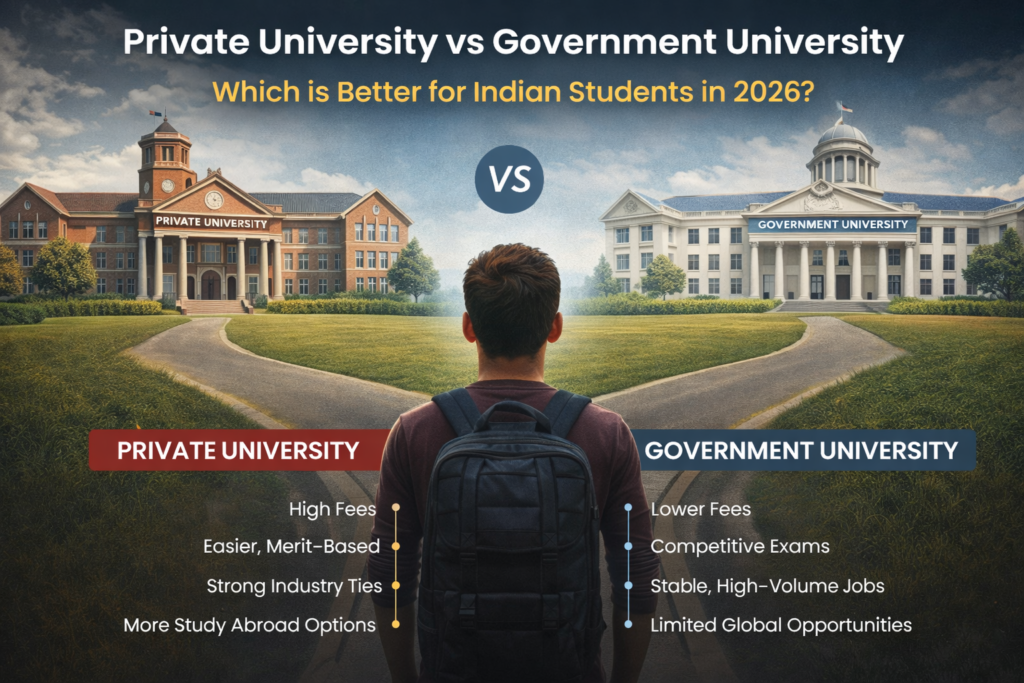
Understanding private university vs government university can help students make smarter career decisions.
Many students compare private university vs government university based on fees, placements, and global recognition.
Choosing between private university vs government university depends on your budget and career goals.
13 Lakh+ Indian students abroad (2024) | 70% Didn’t fully research govt vs private abroad | $25K–$60K Average annual cost at foreign universities |
Overview: What Do ‘Government’ and ‘Private’ Mean Abroad?
Before we dive into the differences, it’s important to understand that the terms ‘government’ and ‘private’ mean something quite different outside India.
Government (Public) Universities Abroad
In countries like the USA, Canada, Australia, and Germany, public universities are partially funded by the state or federal government. This funding subsidises the cost — primarily for domestic students. For international students like us, fees are still very high, but the institutions tend to benefit from government research grants, large endowments, and decades of infrastructure investment.
Examples: University of Michigan (USA), University of Toronto (Canada), University of Melbourne (Australia), Ludwig Maximilian University of Munich (Germany), University of Edinburgh (UK).
Private Universities Abroad
Private universities abroad are funded through tuition fees, private endowments, alumni donations, and industry partnerships. They receive little to no government funding. Yet paradoxically, some of the world’s most prestigious universities — Harvard, MIT, Oxford (semi-private), Stanford, Yale — are private.
Private doesn’t mean ‘lesser quality’ abroad. In many cases, it means the opposite. Examples: Harvard University, MIT, Stanford, New York University (NYU), University of Southern California (USC).
Key Insight for Indian Students: In India, ‘government college = better quality’ is often (though not always) true. Abroad, this assumption can completely mislead you. Some of the world’s best universities are private. Your evaluation framework must change when going global. |
10 Key Differences: Government University vs Private University Abroad
Factor | Government / Public University | Private University |
Tuition (International) | $15,000–$45,000/year | $25,000–$65,000/year |
Funding Source | State/Federal Government grants | Tuition, endowments, donations |
Class Size | Larger (50–300+ per class) | Smaller (20–60 per class) |
Research Funding | Very high (govt grants + NSF, NSERC) | High at elite schools; varies widely |
Global Rankings | Many top-ranked public unis (e.g., UCLA) | Ivy League dominates top 10 |
Industry Connections | Strong in STEM & sciences | Often stronger in business & liberal arts |
Scholarships for Intl Students | More need-blind & merit options | More generous at elite private schools |
Campus Culture | Diverse, large, state-identity focused | Tight-knit, brand-identity focused |
Flexibility of Programs | More structured, credit-based | Greater interdisciplinary flexibility |
Visa & OPT/PGWP Support | Equally strong at established unis | Equally strong; some CPT/OPT focused |
1. Tuition Fees — The Number That Changes Everything
Let’s be honest: for most Indian families, fees are the starting point of every conversation. And here the gap is real.
At a public university like the University of Illinois Urbana-Champaign (UIUC), international tuition for engineering is around $33,000/year. At a comparable private university like Northeastern, it can be $55,000+/year. Over a 2-year Master’s, that’s a $44,000 difference — roughly ₹37 lakh.
However, this doesn’t mean private is always more expensive once scholarships are factored in. Harvard’s financial aid program is so robust that the effective cost for many international students is lower than a mid-tier public university.
Smart move: Always calculate net cost (tuition minus scholarships/assistantships), not sticker price.
2. Research Opportunities — Public Universities Often Win Here
If your goal is a PhD or a research-heavy Master’s, public universities in the US, Canada, and Australia have a structural advantage: they receive massive government research grants. The NSF (National Science Foundation) in the US, NSERC in Canada, and ARC in Australia funnel billions into public university labs.
Public powerhouses like MIT of the public world — UC Berkeley, University of Michigan, University of Wisconsin — produce world-class research and offer funded PhD positions that essentially pay you to study.
Private elite schools (MIT, Stanford, Caltech) are equally research-intensive but more competitive to get into. Mid-tier private universities often have weaker research profiles than equivalent public schools.
3. Class Size & Teaching Quality
At a large public university like Ohio State (60,000+ students), your first-year classes may have 200-300 students in a lecture hall. Access to professors can be limited, especially at the undergraduate level. Graduate students often do a lot of the teaching through Teaching Assistant (TA) positions.
Private universities, especially smaller ones, pride themselves on lower student-to-faculty ratios. At Boston University or Tufts, you’re more likely to have direct access to professors, smaller seminars, and a more personalised academic experience.
4. Scholarships & Financial Aid for Indian Students
This is one of the most misunderstood areas. The common assumption is that public universities are cheaper and therefore better value. But elite private universities in the US often have billion-dollar endowments — and they use them.
Schools like Harvard, Yale, Princeton, and MIT are ‘need-blind’ for international students — meaning financial need doesn’t count against your admission. If you get in, they’ll fund you. Some even cover 100% of demonstrated financial need for international students.
Public universities, by contrast, are more generous with merit-based scholarships (like graduate assistantships and fellowships in STEM) but have less need-based aid for international students.
- Best merit aid for STEM: Public universities (UMich, UIUC, Purdue, UNC)
- Best need-based aid: Elite private universities (Harvard, Princeton, Yale)
- Best value overall: In-state public unis or fully funded PhD programs (public or private)
5. Global Rankings — Don’t Be Fooled by the Name
QS World University Rankings 2025 has both public and private universities dominating the top 100. MIT (#1 globally) is private. Oxford (#3) is technically a publicly chartered institution. UC Berkeley (#10) is public. Cambridge (#2) is similarly chartered.
The key takeaway: rankings cut across the public/private divide. Don’t assume public = lower ranked or private = prestige. Research the specific institution and program ranking.
Pro Tip for Indian Students: Program-level rankings matter more than university-wide rankings. A public university ranked #50 overall might have the #3 Computer Science program globally. Always check subject-specific rankings on QS, THE, or US News. |
6. Post-Study Work Rights — Critical for Indian Students
This is a huge practical factor that often gets overlooked. Here’s the breakdown by country:
Country | Post-Study Work (Public) | Post-Study Work (Private) | Key Rule |
USA | OPT: 1 yr (3 yrs STEM) | OPT: 1 yr (3 yrs STEM) | Same for both; SEVP-certified |
Canada | PGWP: up to 3 years | PGWP: up to 3 years | DLI-listed institution required |
Australia | Graduate Visa: 2–4 years | Graduate Visa: 2–4 years | CRICOS-registered only |
UK | Graduate Route: 2 years | Graduate Route: 2 years | Applies to all UK unis |
Germany | 18-month job search visa | 18-month job search visa | Recognised degree required |
The good news: for post-study work rights, there is no meaningful difference between public and private universities — as long as the institution is properly accredited and government-recognised. What matters is accreditation status, not ownership type.
7. Visa Approval Rates — What Indian Students Don’t Know
The visa officer does not care whether your university is public or private. What they care about is: Is the institution accredited? Do you have genuine study intentions? Is your financial documentation solid?
However, there is one indirect effect: universities with strong international student support offices (often larger public universities and well-resourced private ones) help students prepare stronger visa documentation, leading to fewer rejections.
Red flag to avoid: Unaccredited or newly established private colleges abroad that offer ‘easy admission’ often have poor visa approval rates and can jeopardise your application history. Always verify accreditation.
8. Industry Connections & Placement Support
In the USA, certain public universities have dominant industry pipelines in specific sectors. UC San Diego and UIUC are magnets for tech recruiters. University of Michigan is a feeder for the automotive and consulting industries. These relationships are built over decades.
Top private universities have equally powerful alumni networks — often more concentrated in finance, law, and consulting (Harvard, Wharton, Columbia). For investment banking and management consulting, private Ivy-adjacent schools hold a distinct edge.
For Indian students in STEM fields (most common), strong public universities often deliver as well or better than mid-tier private ones, at significantly lower cost.
9. Campus Culture & Student Experience
Large public universities in the USA and Canada are cities within cities — sprawling campuses with tens of thousands of students, rich Indian student communities, Desi food options, cultural festivals, and vibrant student associations. For many Indian students, this community support is invaluable in the early months abroad.
Smaller private universities offer a tighter-knit experience — you’ll know your professors personally, build close friendships faster, and have a more structured support system. The tradeoff is less diversity of experience and a smaller Indian student population.
10. Country-Specific Nuances Indian Students Must Know
Country | Best Public Universities | Best Private Universities | Indian Student Tip |
USA | UC Berkeley, UCLA, Michigan, UIUC, Purdue | MIT, Stanford, Carnegie Mellon, NYU | STEM: Public often better ROI. Business: Private wins. |
UK | University of Edinburgh, Bristol, Leeds | Imperial (semi-public), LSE, UCL | All UK unis under same govt framework; brand matters most. |
Canada | University of Toronto, UBC, McGill, Waterloo | Quest University (few true private) | Nearly all top Canadian unis are public. Focus on program. |
Australia | University of Melbourne, ANU, UNSW, Monash | Bond University, Torrens | Go Group of Eight (Go8) public unis for strongest outcomes. |
Germany | TU Munich, LMU Munich, Heidelberg, RWTH Aachen | Bucerius Law, Jacobs University | Public unis in Germany are tuition-FREE for all. Clear winner. |
Real Cost Comparison: Government University vs Private University Abroad (2025-26)
Country & Program | Public University Cost/Year | Private University Cost/Year | Living Costs/Year |
USA — MS Computer Science | $18,000–$35,000 | $35,000–$58,000 | $15,000–$22,000 |
USA — MBA (2-year) | $25,000–$45,000 | $45,000–$80,000 | $20,000–$30,000 |
UK — MS (1-year) | £18,000–£28,000 | £22,000–£38,000 | £12,000–£18,000 |
Canada — MS/MEng | CAD $18,000–$30,000 | CAD $22,000–$40,000 | CAD $12,000–$18,000 |
Australia — MS | AUD $28,000–$42,000 | AUD $30,000–$50,000 | AUD $20,000–$25,000 |
Germany — MS | €0–€3,000 (minimal fees) | €10,000–€25,000 | €10,000–€12,000 |
Germany is the standout: Public universities charge zero to minimal tuition even for international students. For Indian students open to studying in German (or increasingly English-taught programs), this is an extraordinary value proposition.
In the USA, the cost gap between public and private can be $20,000–$30,000 per year. Over a 2-year Master’s program, choosing a strong public university over a comparable private one could save you ₹25–50 lakh — without compromising on quality if you choose well.
How Your Choice Affects Your Study Abroad Profile & Applications
Does It Matter Whether You Apply to Public or Private?
From an application strategy standpoint, yes — there are meaningful differences in how public vs private universities evaluate Indian applicants.
- Public universities (especially in Canada and Australia) tend to be more GPA and test-score focused in their initial screening.
- Elite private universities (especially US Ivies and top liberal arts colleges) take a more holistic view — SOP quality, recommendations, research experience, and ‘fit’ matter enormously.
- For STEM Master’s programs, public universities often have more seats and higher acceptance rates than equivalent private programs.
- Private universities in the US frequently offer more generous funding packages (RA/TA positions) for PhD applicants with strong research profiles.
Building the Right Profile for Each
If you’re targeting top US private universities (MIT, Stanford, Carnegie Mellon), your profile needs: strong GRE/GMAT (if required), excellent LORs from research supervisors, published or conference papers, and a compelling SOP that shows a specific research fit.
If you’re targeting strong public universities (Michigan, UIUC, Purdue, UC San Diego), emphasise your GPA, relevant internships, technical projects, and IELTS/TOEFL scores. These institutions process thousands of applications and strong academic metrics get you through the initial filter.
GlobalEd Tip: Many Indian students make the mistake of applying exclusively to either public or private universities. The smart strategy is a balanced list — 2 reach schools (elite private), 4 target schools (strong public + private mix), and 2 safety schools. Our counsellors build this strategy with you. Book your free session at globaledconsult.com/contact |
Which One Should YOU Choose? A Decision Guide for Indian Students
If You’re a Budget-Conscious Indian Student
Public university, without question — especially in Germany (free tuition), Canada, and Australia. Strong public institutions like University of Waterloo, University of Melbourne, and UIUC offer world-class education with better affordability than comparable private options.
Apply for funded positions (TA/RA) wherever possible. A funded seat at a top public university is the single best value in global higher education.
If You’re Aiming for Finance, Consulting, or MBA
Here, private universities — particularly in the US (Wharton, Booth, Kellogg, Columbia Business School) and UK (London Business School) — hold a genuine advantage. Their alumni networks in finance and consulting are unmatched, and recruiters from top firms specifically target these campuses.
The ROI calculation works differently here: a Wharton MBA may cost $200,000 total but place you in a Goldman Sachs or McKinsey role at $200,000/year. The math justifies the cost.
If You’re a STEM Student Aiming for a US Tech Career
A strong public university with STEM OPT extension (3 years) — like UIUC, Michigan, Purdue, UCSD, or Georgia Tech — is often the best move. These schools are well-regarded by tech companies, have strong campus recruitment, and cost significantly less than comparable private alternatives.
If You’re Planning to Settle Abroad
Canada is the most immigration-friendly destination for Indian students. The Post-Graduate Work Permit (PGWP) through any DLI-listed institution (almost all public, many private) gives you 1–3 years to gain Canadian work experience — the clearest path to Permanent Residency.
Australia’s Group of Eight public universities (Melbourne, ANU, UNSW, etc.) have the strongest graduate visa outcomes and employer recognition.
If Prestige and Global Brand Matter to You
Be honest with yourself about this one. If your goal is to build a globally recognised brand name on your CV — especially for entrepreneurship, research, or international career mobility — the Ivy League and Oxbridge names carry real weight. These are almost all private (US) or semi-public elite institutions (UK).
But prestige without a clear plan is just debt. Only chase elite private universities if you have a concrete vision for how that brand accelerates your specific goals.
At-a-Glance: Government University vs Private University Abroad
Criteria | Public/Govt University ✓ | Private University ✓ |
Lower tuition fees | ✅ Yes (especially Germany, Canada) | ❌ Usually higher |
World’s top-ranked programs | ✅ UC Berkeley, Michigan, Toronto | ✅ MIT, Harvard, Stanford |
Best for STEM Master’s | ✅ Strong public pipeline | ✅ Elite private equally strong |
Best for MBA/Finance | ⚠️ Some strong public B-schools | ✅ Wharton, HBS, LBS dominate |
Research funding & PhD | ✅ Government grants advantage | ✅ Equal at elite level |
Post-study work rights | ✅ Same as private (accredited) | ✅ Same as public (accredited) |
Need-based financial aid | ⚠️ Limited for international | ✅ Generous at elite US schools |
Merit assistantships (STEM) | ✅ Widely available | ⚠️ More selective |
Immigration pathways | ✅ Strong (Canada Group) | ✅ Equal if DLI/CRICOS listed |
Best for Germany/Europe | ✅ Free/low tuition public unis | ⚠️ Higher cost, fewer top names |
5 Dangerous Myths About Government vs Private Universities Abroad
Myth #1: Private Universities Abroad Are Always Better ❌
This is the most seductive myth, and it gets Indian students into serious financial trouble. The majority of universities in the QS top 100 are public institutions — UC Berkeley, University of Toronto, University of Melbourne, ETH Zurich, and more. ‘Private’ does not automatically mean superior abroad.
Myth #2: Government Universities Are Cheap for International Students ❌
The subsidy in public universities primarily benefits domestic students. International students at public universities in the US, UK, and Australia pay full market rates — often $25,000–$45,000 per year. The fee advantage for Indian students only really applies in Germany and some Nordic countries, where public university education is free for everyone.
Myth #3: Private University Degrees Aren’t Recognised for Visa or Jobs ❌
Completely false — as long as the institution holds proper regional accreditation (SACSCOC, WASC, or equivalent in the US; AACSB/EQUIS for business globally). Accreditation status, not public/private ownership, determines recognition for visa, immigration, and employer purposes.
Myth #4: You’ll Get a Visa More Easily for a Government University ❌
Visa officers at embassies assess your intent, financial capacity, and academic credibility — not whether your university is funded by the state. A strong application to a reputable private university will get approved; a weak application to a public university will be rejected. The institution’s accreditation is what matters, not its funding model.
Myth #5: Scholarships Are Only Available at Private Universities ❌
Public universities — particularly in STEM fields — offer extensive Teaching Assistantship (TA) and Research Assistantship (RA) positions that cover full tuition plus a monthly stipend. University of Michigan, UIUC, Georgia Tech, and University of Toronto are well-known for funding graduate students, especially in engineering and sciences.
Frequently Asked Questions (FAQ)
Q1: Is a government university better than a private university abroad?
Not necessarily — and this is the most important thing to understand. Globally, both public and private universities rank among the world’s best. MIT and Stanford (private) sit alongside UC Berkeley and University of Toronto (public) in the top 20. Evaluate the specific program, university ranking, research output, and career outcomes rather than the public/private label.
Q2: Are private university degrees valid for Canadian or Australian PR applications?
Yes — as long as the institution is a Designated Learning Institution (DLI) in Canada or CRICOS-registered in Australia. Degrees from properly registered private universities qualify for Post-Graduate Work Permits (Canada) and Graduate Visas (Australia) on equal terms with public universities. Always verify DLI/CRICOS status before applying.
Q3: Which is cheaper for Indian students — government or private universities abroad?
Government universities in Germany, Norway, Finland, and some other European countries charge zero to minimal tuition for all international students. Outside Europe, public universities in the US, Canada, and Australia are somewhat cheaper than private ones, but the difference is not always dramatic once scholarships and assistantships are factored in. Elite US private universities with strong need-based aid can end up cheaper than mid-tier public ones.
Q4: Do US employers prefer graduates from private Ivy League schools over public universities?
For technology and engineering roles, top public universities (UIUC, Michigan, Carnegie Mellon, UC Berkeley) are equal to or preferred over many private universities by major tech employers. For investment banking, consulting, and finance, private schools like Wharton, HBS, and Columbia have stronger traditional recruitment pipelines. But increasingly, skills, internships, and projects matter more than institutional prestige for most roles.
Q5: Is Germany’s free tuition system available at private universities too?
No. Germany’s tuition-free higher education applies only to public universities (staatliche Hochschulen). Private universities in Germany (like Bucerius Law School or EBS University) charge full tuition, typically €10,000–€25,000/year. For Indian students seeking value, German public universities are an unbeatable option — especially given the growing number of English-taught Master’s programs.
Q6: Can I get a funded PhD at a private university abroad?
Yes — and some of the best-funded PhD opportunities globally are at private universities. MIT, Stanford, Carnegie Mellon, and most Ivy League schools offer full funding (tuition waiver + stipend of $25,000–$40,000/year) to admitted PhD students in most programs. The competition is intense, but the funding, once received, is generous.
Q7: How do I know if a private university abroad is legitimate and accredited?
Always verify through official accreditation databases: for the US, check the US Department of Education database (ope.ed.gov); for Canada, verify provincial degree-granting authority; for Australia, check CRICOS register; for the UK, check the Register of Higher Education Providers (UKRI). Never enroll in any international institution — public or private — without confirming its accreditation status first.
Confused About Choosing the Right University for Your Future? |
Conclusion: The Smartest Choice Is an Informed One
The government university vs private university debate abroad doesn’t have a single right answer. It has a right answer for you — based on your budget, career field, target country, visa goals, and long-term ambitions.
The student who does their research, builds their profile strategically, and applies with intention — whether to a public University of Waterloo or a private Carnegie Mellon — will almost always outperform the one who chased a name without a plan.
Here’s the bottom line: Don’t let the public vs private label be the deciding factor. Let program quality, funding availability, post-study work rights, and genuine career alignment drive your decision.
Germany offers world-class public education for free. Canada’s top public universities are among the most immigration-friendly in the world. The USA’s elite private universities have endowments large enough to fund your entire degree if you qualify. Australia’s Group of Eight public universities deliver outstanding graduate outcomes. https://www.unesco.org
The world of global higher education is full of opportunity for Indian students who approach it with information, not assumptions. Whether you’re comparing government university vs private university abroad for a Master’s, MBA, or PhD — the best move starts with the right guidance.
Start planning today. Your future self will thank you.
Ready to make the smartest university decision of your life? The GlobalEd team specialises in helping Indian students navigate the government vs private university choice abroad — with country-specific expertise, real data, and a track record of 10,000+ successful placements. Book your free counselling call at globaledconsult.com/contact |