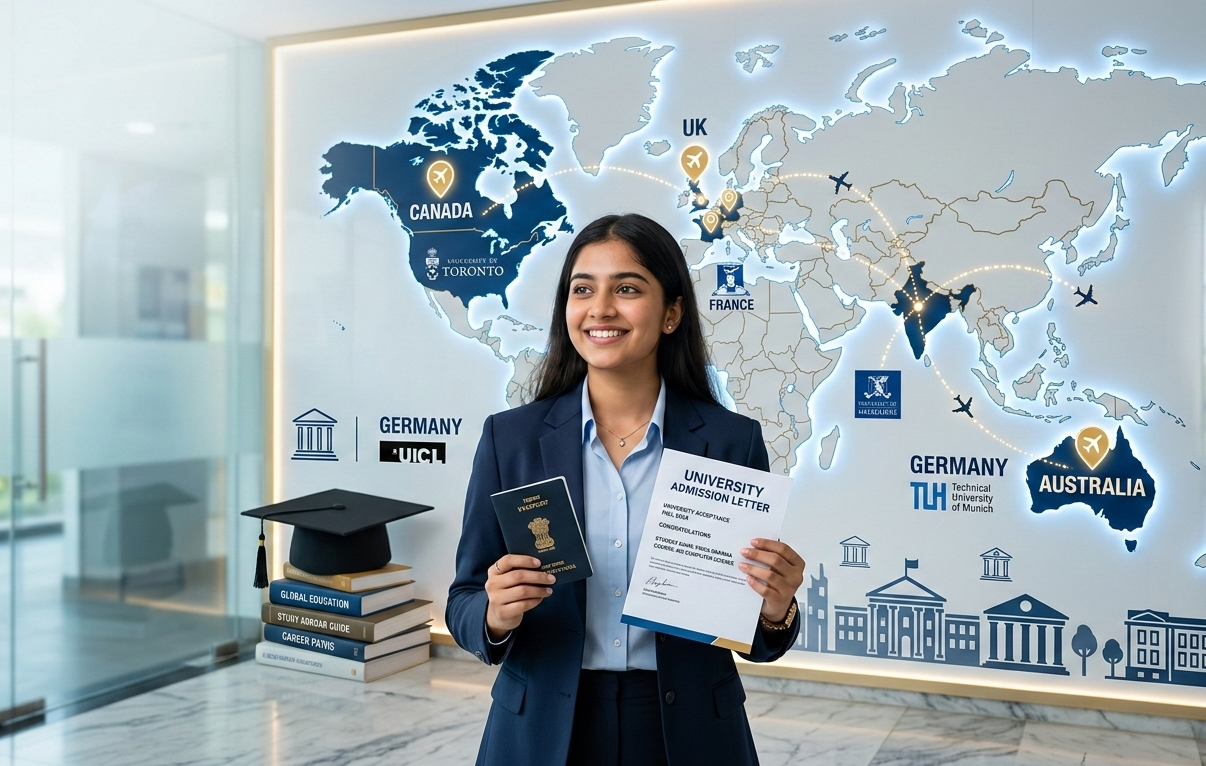

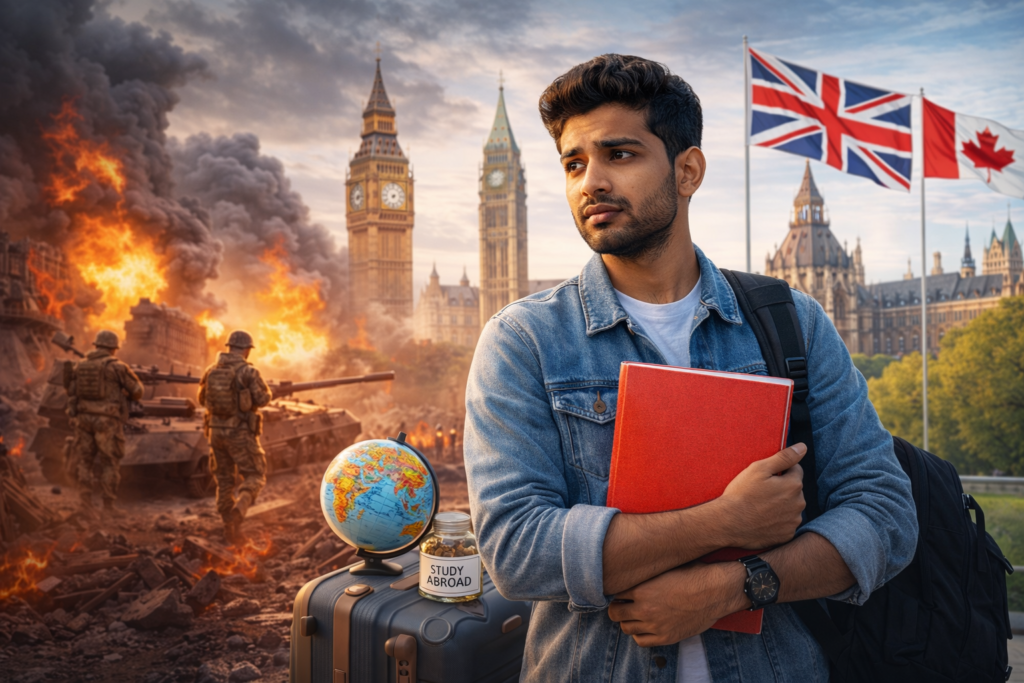
Introduction: Why Global Conflicts Worry Students and Parents
Study abroad during global conflicts has become an important concern for Indian students planning international education in 2026. Understanding how geopolitical tensions affect visas, travel, and universities helps students make safer and smarter decisions.
Planning to study abroad during global conflicts can feel uncertain for many students and families. However, with the right preparation, reliable universities, and updated visa information, studying abroad during global conflicts is still possible and safe for most Indian students.Universities continue supporting students who study abroad during global conflicts.
Every year, hundreds of thousands of Indian students dream of pursuing higher education abroad — from engineering programmes in Germany to business degrees in Canada. International education is no longer a luxury for India’s aspiring youth; it is increasingly a strategic career decision. And the numbers back this up.
According to India’s Ministry of External Affairs (MEA), over 1.33 million Indian students were enrolled in foreign universities in 2024 — one of the highest figures ever recorded. These students collectively spent nearly ₹2.9 trillion on higher education in destinations like the US, UK, Canada, and Australia during the 2023–24 academic year alone.
But in recent years, a serious new concern has entered every counselling session and family discussion: what happens to these plans when the world is not at peace?
From the Russia-Ukraine war that forced the evacuation of over 20,000 Indian students in 2022, to ongoing Middle East tensions and shifting US immigration policies that caused Indian student visa issuances to drop by a staggering 63% in summer 2025 — the impact of global conflicts on international students is real and documented.
The good news: studying abroad during global conflicts remains safe and entirely achievable for students who choose their destinations wisely and plan with expert guidance. This article gives you the data, the clarity, and the practical roadmap you need.
Many students worry about study abroad during global conflicts because news about wars or geopolitical tensions creates uncertainty about travel and visas.
Despite these concerns, study abroad during global conflicts continues successfully because universities and governments implement strong safety policies.
Indian Students Abroad in 2025–26: What the Data Tells Us
Before understanding the risks, it helps to understand the scale and direction of Indian student mobility. Here is what the latest data from the MEA, ICEF Monitor, and India’s Ministry of Education reveals:
Metric | Figure | Source / Year |
Indian students enrolled abroad (2024) | 1.33 million | MEA India, 2024 |
Indian students enrolled abroad (2025) | ~1.26 million (–5.7%) | MEA India, 2025 |
Annual education spend abroad by Indian students | ₹2.9 trillion (2023–24) | NITI Aayog Report |
Indian students in Canada (2024) | ~427,000 | IRCC / MEA |
Indian students in USA (2024) | ~337,000 | IIE Open Doors |
Indian students in UK (2024) | ~185,000 | UK Home Office |
Indian students in Australia (Jan–Sep 2025) | ~139,720 (+4% YoY) | Australia Govt Data |
Indian students in Germany (2024) | ~34,702 (+49% vs 2023) | DAAD / MEA |
Indian students still in Ukraine (2024) | 2,510 (down from 11,987 in 2023) | MEA India |
The sharp drop in Indian students in Ukraine from nearly 12,000 in 2023 to just 2,510 by 2024 is the clearest indicator of how conflict directly reshapes student mobility choices. In contrast, Germany saw a 49% rise in Indian student numbers in the same period — clear evidence that students are actively seeking safer, stable destinations.
How Global Conflicts Can Affect International Education
While top study destinations like Canada, the UK, and Germany are not directly in active conflict zones, geopolitical instability can create ripple effects that touch international student safety and planning in four critical ways:
1. Travel Restrictions and Route Disruptions
When Russia invaded Ukraine in February 2022, Indian airspace was not affected — but Ukraine’s airspace immediately closed, leaving over 20,000 Indian students stranded. Operation Ganga, launched by the Indian government, operated 75 evacuation flights across Romania, Poland, Hungary, Moldova, and Slovakia to bring students home. Students had to walk to border crossings, often in freezing conditions, before being airlifted to safety.
While this is an extreme example, it underscores the importance of avoiding conflict-adjacent destinations. More routinely, regional tensions can result in airspace restrictions that increase flight times and costs to otherwise safe destinations.
2. Visa Processing Delays and Policy Shifts
This is the most immediately felt impact of geopolitical tension for Indian students in 2025–26. A major survey by INTO University Partnerships covering over 2,261 international students found that:
📊 Key Visa Delay Statistics (2024–25 INTO Survey): • 1 in 5 students (21%) cited visa appointment delays as the top reason for postponing university confirmation • This figure rose to 28% among South Asian students — the highest of any region • Of students who missed university orientation, 45% said visa delays were the cause • 20% of those affected by visa delays faced at least one month of additional waiting time
The US situation in 2025 was particularly stark. Following a temporary freeze on all student visa interviews, new F-1 visa issuances to Indian students dropped 63% in summer 2025 compared to summer 2024. Indian students went from representing 25% of all international student visas in summer 2023 to just 8% in summer 2025 — the steepest country-level drop recorded.
The lesson: early application is non-negotiable. For stable destinations like Canada (UK approval rate: 96%), Germany, and Australia, proactive visa filing — ideally 5–6 months before intake — significantly reduces this risk.
3. Currency Fluctuations and Rising Education Costs
Geopolitical uncertainty often triggers currency market volatility. For Indian families, even a modest weakening of the rupee against the pound, dollar, or euro translates into significantly higher costs. Indian students in Canada, the US, UK, and Australia already spend an estimated USD 70 billion annually on direct expenses. A 5–10% currency swing can add ₹3–5 lakhs or more to a family’s total education budget.
India’s education loan disbursements for overseas studies have already grown by over 50% — from ₹15,445 crore in 2021–22 to ₹23,576 crore in 2023–24 — reflecting both growing demand and rising costs. Building a 10–15% financial buffer and exploring forex rate-locking options are increasingly important strategies.
4. University Policy Changes and Intake Modifications
In countries directly affected by conflict, universities may cancel or defer intakes, shift to hybrid learning, or alter scholarship terms. When the Russia-Ukraine war began, Ukrainian universities — many of which had enrolled thousands of Indian medical students due to fees as low as a quarter of India’s private college costs — were forced to suspend operations entirely. Students lost academic years and, in some cases, their entire course investments.
Even in non-conflict destinations, universities adapt their policies in response to the broader geopolitical environment. It is essential to choose universities with clear emergency protocols and a track record of supporting international students during disruptions.
Countries That Remain Safe for Indian Students in 2026: Destination Data
The most powerful tool against study abroad during global conflicts is destination choice. Here is a data-driven look at the five safest and most stable study destinations for Indian students in 2026:
Country | Indian Students (2024–25) | Key Advantage | Visa Approval Rate |
🍁 Canada | ~427,000 | PGWP + PR pathway | ~29% (tightened 2025) |
🇬🇧 United Kingdom | ~185,000 (+44% Q2 2025) | Graduate Route visa (2 yrs) | 96% |
🇩🇪 Germany | ~34,702 (+49% in 2024) | Low/zero tuition fees | High (Schengen stable) |
🇦🇺 Australia | ~139,720 (all-time high) | Post-study work rights | Strong; some state restrictions |
🇮🇪 Ireland | Growing rapidly | English + 2-yr stay-back | High; EU work access |
🍁 Canada
Despite tightened study permit rules in 2025 — with new permits issued to Indian students falling sharply — Canada still hosts the largest number of Indian students globally. The country’s Post-Graduation Work Permit (PGWP) and clear PR pathway remain unmatched. Students who are already admitted and enrolled continue to benefit from strong institutional support and one of the most developed Indian student communities in the world.
🇬🇧 United Kingdom
The UK has emerged as a standout destination in 2025. Up to June 2025, Indian students received nearly as many sponsored study visas (98,015) as Chinese students (99,920) — with an impressive 96% approval rate. The UK’s Graduate Route visa (2 years post-study work rights) and the surge in demand at master’s level (81% of Indian approvals) make it one of the most reliable destinations for 2026 applicants.
🇩🇪 Germany
Germany has quietly become one of the most dramatic growth stories for Indian students. According to DAAD, the number of Indian students in German universities more than doubled between 2020 and 2024 — from 28,905 to 59,420. Low or zero tuition at public universities, 17 QS Top-500 ranked institutions, and a stable, peaceful political environment make Germany an exceptional choice for cost-conscious families.
🇦🇺 Australia
Australian enrolments of Indian students hit an all-time high in 2025, reaching over 139,720. While some Indian states face regional visa scrutiny, university-level enrolments continue to grow. Australia’s geographic distance from global conflict zones, multicultural student support infrastructure, and strong bilateral ties with India make it a reliably safe destination.
🇮🇪 Ireland
Ireland is experiencing rapid growth in Indian student numbers, driven by its English-language environment, a booming tech industry, and a two-year stay-back option. As a politically neutral nation with a long tradition of welcoming international students, Ireland presents minimal geopolitical risk and increasingly competitive university rankings.
How Universities Support International Students During Global Crises
Understanding how universities respond to global instability is a critical part of evaluating the impact of global conflicts on international students. Reputed institutions in safe destinations do not leave students to navigate crises alone. Key support frameworks include:
- Safety Protocols and Emergency Systems: Most universities partner with local law enforcement and government agencies. 24/7 emergency helplines, campus alert systems, and security personnel are standard in Canada, the UK, Australia, and Germany.
- Academic Flexibility: In 2025–26, 72% of US institutions offered incoming international students the option to defer admission to Spring 2026 due to visa delays. Hybrid learning, deadline extensions, and credit transfers are now widely available contingency options.
- Emergency Counselling and Welfare: 93% of surveyed institutions provide guidance on maintaining legal status, and 92% offer comprehensive advising sessions — particularly important during periods of political uncertainty.
- Indian Student Associations: Active Indian student communities at universities across Canada, the UK, Germany, and Australia provide immediate peer support, cultural familiarity, and practical help in navigating any unexpected situation.
Practical Tips for Students Planning to Study Abroad in Uncertain Times
Thoughtful study abroad planning during war or geopolitical tension is not about fear — it is about preparedness. Here is what every Indian student and family should do:
- Choose Politically Stable Destinations: Prioritise countries with consistent peace index rankings. Canada, UK, Germany, Australia, and Ireland have decades-long records of stability and institutional strength.
- Apply for Visas 5–6 Months Early: Given that visa delays affected 21–28% of South Asian students in 2024–25, early application is your single most important risk mitigation step.
- Monitor Official Travel Advisories: Check India’s MEA travel advisories (mea.gov.in) and the destination country’s immigration authority regularly. Subscribe to official alerts.
- Register on the MADAD Portal: The Indian government’s MADAD Portal (madad.gov.in) allows Indian students abroad to register with their nearest Embassy or Consulate — enabling the government to reach you and assist in any emergency.
- Build a Financial Buffer: Indian students already spend ₹2.9 trillion annually abroad. Currency fluctuations can add 10–15% to your costs overnight. Maintain a reserve and explore forex rate-locking instruments.
- Secure Comprehensive Insurance: Choose a policy covering medical emergencies, trip cancellation, and emergency evacuation — critical for any destination during periods of global uncertainty.
- Stay Connected with Your University’s International Office: Register with your university’s international student services immediately upon arrival. Know the emergency contacts and support services available to you.
Why Planning with Expert Guidance Matters More Than Ever
In 2022, over 20,000 Indian students who had enrolled in Ukrainian universities without adequate risk assessment found themselves evacuated in emergency conditions, having lost months or years of academic progress and significant financial investment. It was a preventable crisis — for students who had chosen their destination with expert guidance.
In 2025, Indian students faced a 63% drop in US visa issuances. Those who had proactively applied early, had backup destination strategies, or had worked with an advisor who was tracking US immigration policy changes were far better protected than those who acted alone.
This is exactly the value that a professional study abroad consultancy like GlobalEd provides. Here is what expert advisors deliver in uncertain times:
- Real-time Destination Intelligence: Counsellors track MEA advisories, visa policy changes, and global safety indices continuously — so your destination choice reflects current ground realities, not outdated assumptions.
- Strategic Visa Planning: With 1 in 5 students already experiencing delays, professional advisors ensure your timeline, documents, and submission strategy are optimised for approval.
- Risk-adjusted University Shortlisting: Not all universities have the same level of international student infrastructure or emergency protocols. Advisors match students with institutions that have proven track records of student support.
- Financial Planning Around Volatility: With Indian students spending USD 70 billion annually, even small forex optimisations guided by an advisor can save significant amounts.
- Post-arrival Continuity: The best consultancies do not disappear after you board your flight. Ongoing advisory support helps students navigate challenges on the ground — exactly when it matters most.
Frequently Asked Questions (FAQs)
Q1: Is it safe to study abroad during global conflicts?
Yes — for the vast majority of students choosing established, stable destinations. Countries like Canada, UK, Germany, Australia, and Ireland are geographically and politically removed from current conflict zones. The key is destination selection: India’s own data shows Indian students in Ukraine dropped from nearly 12,000 to just 2,510 as the conflict persisted — while students in Germany grew by 49% and Australia hit all-time highs. The safe destinations are clearly identifiable, and with proper planning, studying in them remains a highly rewarding decision.
Q2: Which countries are safest for Indian students in 2026?
Based on current data: UK (96% visa approval rate, +44% Q2 2025 surge), Germany (49% growth in Indian students, near-zero tuition), Australia (all-time high enrolments), Canada (largest Indian student base globally), and Ireland (rapidly growing, 2-year stay-back). New Zealand is also emerging strongly, with a 24% increase in international students in 2024 and favourable policy conditions.
Q3: Can wars or global conflicts affect student visas?
Yes, indirectly. Geopolitical tensions increase security screenings, and embassies in certain regions reduce operational capacity — both of which slow visa processing. The clearest example: the US temporary freeze on F-1 visa interviews in spring 2025 caused a 49.9% drop in June issuances alone, and Indian students saw a 63% year-on-year decline across summer 2025. Applying early (5–6 months ahead) and choosing destinations with high approval rates (UK: 96%) are the most effective protections.
Q4: What happened to Indian students in Ukraine? What lessons can 2026 students learn?
When Russia invaded Ukraine in February 2022, approximately 20,000 Indian students were stranded — most were medical students drawn by tuition fees as low as a quarter of Indian private college costs. The Indian government launched Operation Ganga, conducting 75 evacuation flights from neighbouring countries. Indian students in Ukraine have since declined from ~11,987 in 2023 to just 2,510 in 2024. The lesson for 2026: always evaluate a destination’s geopolitical stability — not just its affordability — before enrolling.
Q5: How can a study abroad consultant help during uncertain global times?
A professional consultant provides real-time destination intelligence, visa strategy, university shortlisting based on safety and support infrastructure, financial planning around currency fluctuation, and ongoing post-arrival advisory support. Given that 21–28% of South Asian students have already faced visa delays and that major destinations are regularly shifting their immigration policies, navigating study abroad planning without expert guidance in 2026 is a significant and avoidable risk.
Conclusion: Global Education Does Not Stop — Smart Planning Makes All the Difference
The data is clear: global conflicts and geopolitical tensions are real forces that shape international student mobility. They disrupted 20,000 Indian students in Ukraine in 2022. They caused a 63% drop in Indian student visas to the US in summer 2025. They contributed to a 5.7% overall decline in Indian students abroad in 2025.
But the data also shows something equally important: students are adapting, not retreating. Germany grew 49%. Australia hit all-time highs. The UK surged 44% in a single quarter. Ireland and New Zealand are emerging as strong alternatives. The global education map is shifting — and students who understand this shift are finding excellent pathways to safe, high-quality international education in 2026.
What matters is not the headlines. What matters is the intelligence behind your decision — choosing the right destination, applying early, maintaining financial readiness, and working with advisors who monitor the global landscape in real time.
Understanding how study abroad during global conflicts affects visas, travel, and universities helps Indian students plan their international education with confidence.
According to UNESCO data, international student mobility continues to grow even during periods of geopolitical tension.https://www.unesco.org
Your dream of an international degree is worth protecting. Protect it through data, preparation, and the right guidance.
📞 Ready to Plan Your Study Abroad Journey Safely?
Book a FREE counselling session with GlobalEd — your trusted partner for safe and reliable international education.
Our expert advisors track global safety indices, visa policy changes, and destination intelligence in real time — so your decision is always backed by the best available data.
🌐 globaled.co.in — https://globaled.co.in/contact-us/
Your future does not wait for the world to be perfect. Start planning today.