


Learning how to write an SOP for study abroad in 2026 is the single most important skill an Indian student can develop before applying to any university overseas — and it is the skill most students get completely wrong.
Here is the uncomfortable truth: thousands of Indian students with 8+ CGPA, strong IELTS scores, and relevant internships get rejected every year. Not because their profiles are weak. But because their SOP reads like a resume in paragraph form, opens with ‘Since childhood, I have been fascinated by computers,’ and contains not a single sentence that could not have been written by any of the other 5,000 applicants to the same program.
Your Statement of Purpose (SOP) is the one document in your application that is entirely yours. It is where you speak directly to the admissions committee — not through grades, not through test scores, but through your story, your goals, and your clarity of thought. A poorly written SOP kills strong profiles. A brilliantly written SOP rescues average ones.
This is a complete, practical, step-by-step guide on how to write an SOP for study abroad in 2026 — built specifically for Indian students. It covers the correct paragraph structure, what to include in each section, before-and-after examples, country-specific differences, how to handle weaknesses like a gap year or backlog, the 2026 AI detection reality, and a final submission checklist.
If you want our counsellors to personally review your SOP, book a free SOP review session with GlobalEd here. 100% free, no obligation.
What Is an SOP? — And Why It Matters More Than You Think
A Statement of Purpose (SOP) is an essay — typically 800 to 1,000 words — that you submit as part of your university application. It answers three core questions that every admissions committee is trying to resolve:
- Who are you academically and professionally?
- Why do you want this specific program at this specific university?
- What will you do with this degree after graduation?
It is not a biography. It is not a list of achievements. It is not a motivation letter or a cover letter. It is a structured, forward-looking argument for why you deserve a seat in that program.
Why the SOP Carries Disproportionate Weight for Indian Applicants
For Indian students, the SOP matters more than it does for students from many other countries — for one specific reason: profile similarity. Most Indian applicants to engineering, computer science, and business programs abroad have nearly identical academic profiles — 7.5 to 9.0 CGPA, IELTS 7.0 to 7.5, 1 to 3 internships, a final-year project.
When an admissions committee at TU Munich or University of Toronto reads 500 applications from India, the transcripts look almost the same. The SOP is the only document that creates differentiation. It is where your specific story, your specific reasoning, and your specific goals — if articulated well — make you the obvious choice over the next candidate with an identical CGPA.
Admission SOP vs Visa SOP — A Critical Distinction Indian Students Miss
Admission SOP | Visa SOP (Canada / Australia / UK) | |
|---|---|---|
Audience | University admissions committee / professor | Immigration officer (IRCC, Home Office, DHA) |
Purpose | Prove academic fit, research readiness, career clarity | Prove genuine student intent, financial capacity, ties to India |
Tone | Academic, reflective, aspirational | Factual, direct, concise |
Word count | 800–1,000 words | 500–700 words |
Key content | Academic background, research interests, career goals, why this university | Course choice rationale, funding proof, post-study return plan |
Critical mistake | Writing the same SOP for both — leads to visa refusal | Using academic SOP for visa — most common reason for Canada permit rejection |
Critical 2026 warning for Indian students applying to Canada: The IRCC SOP must specifically answer: Why this course? Why Canada and this institution? How will you fund your studies? Why will you return to India after graduating? These are entirely different questions from what the university’s admissions committee wants to read. Always write TWO separate SOPs. |
SOP Format, Word Count & Submission Rules — 2026
Requirement | Standard Rule 2026 | What to Do If Not Specified |
|---|---|---|
Word count | 800–1,000 words (most programs) | Aim for 900 words — not more, not less |
Page length | 1–2 pages (single-spaced) | 1 page for under 900 words; 1.5 pages max |
Font & size | Times New Roman or Arial, 12pt | Arial 12pt — clean and universally accepted |
Line spacing | Single-spaced, paragraph breaks | Add one blank line between paragraphs |
Margins | 1 inch on all sides | Standard Word / Google Docs default |
File format | PDF (unless specified otherwise) | Never submit as .doc — formatting breaks |
Filename | As per university instructions | Default: FirstName_LastName_SOP_ProgramName.pdf |
Heading / title | Usually NOT required | Do not add ‘Statement of Purpose’ as a heading unless asked |
Country-specific word count rules you MUST check: UK (UCAS 2026 new format): Three structured questions replacing the old 4,000-character personal statement. Read the 2026 UCAS prompt before writing. Canada: Admission SOP — 500–800 words. IRCC Visa SOP — usually 1 page, 400–600 words. Germany: Some programs ask for a Motivationsschreiben (motivation letter) — 1–2 pages, structured with research interests prominent. Australia: 500–700 words for admission SOP + separate visa SOP for GTE (Genuine Temporary Entrant) assessment. |
The Winning SOP Paragraph Structure — Section by Section
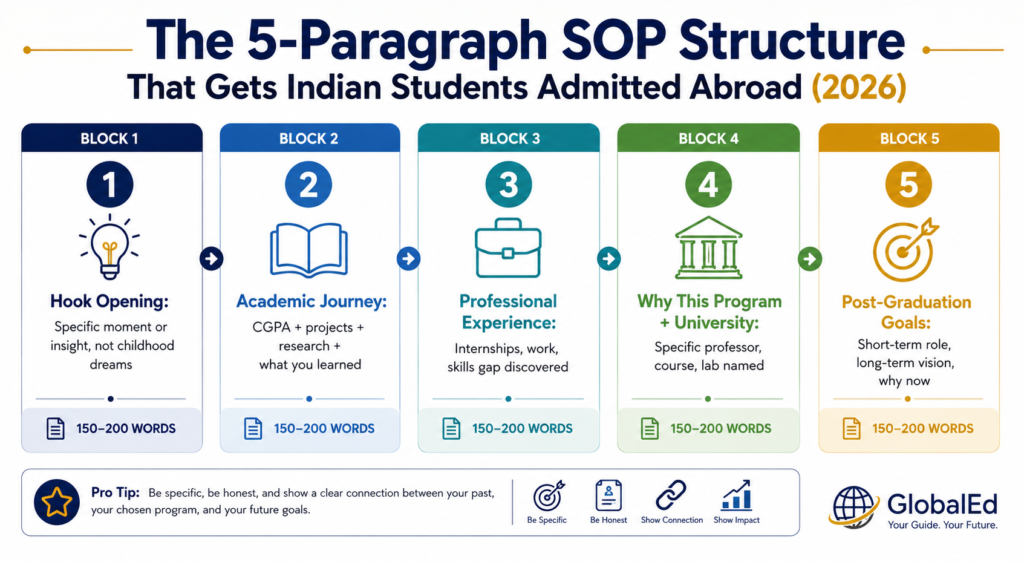
This is the most important paragraph in your SOP. Admissions readers process hundreds of applications. If your opening does not make them lean forward, the rest does not matter.
The rule: Do NOT start with childhood memories, a general statement about your field, or a famous quote. Start with a specific, concrete moment, observation, or problem that explains why you are pursuing this degree.
WEAK OPENING — Gets discarded Since childhood, I have always been fascinated by computers and technology. As I grew up, I realised that my passion for this field was unmatched. This motivated me to pursue a Bachelor’s degree in Computer Science, and now I wish to advance my knowledge by pursuing a Master’s degree at your esteemed university. | STRONG OPENING — Gets read When our team’s fraud-detection model flagged a transaction at 97% confidence and the transaction turned out to be legitimate, I spent three weeks tracing the misclassification back to a single feature: how we had encoded transaction timestamps. That experience taught me more about machine learning pipelines than my entire undergraduate curriculum. It is also the reason I want to pursue the MS in Machine Learning at TU Munich — to build models that do not just predict accurately, but that I can trust. |
The strong version: names a specific incident, demonstrates domain knowledge, and organically leads into the program motivation. The admissions committee already has a reason to keep reading.
Academic Journey
This is where you connect your undergraduate education to your intended graduate program. Do not repeat your transcript. Instead, highlight 2–3 specific academic experiences — courses, thesis, projects, research — and explain what you learned from them and what gaps they revealed.
- Name specific courses that are directly relevant to your target program
- Mention your thesis or final-year project — the problem, your approach, and the outcome
- If you published or presented research, include it with concrete impact (citations, awards, conference name)
- If your CGPA is lower than ideal, do NOT mention it here — address it in a separate sentence in context
WEAK ACADEMIC PARAGRAPH During my Bachelor’s degree in Information Technology, I studied subjects like Data Structures, Algorithms, Database Management, and Machine Learning. I scored well in most subjects and completed my final year project on sentiment analysis. I also received a gold medal for academic performance. | STRONG ACADEMIC PARAGRAPH My undergraduate thesis at VIT Vellore, ‘Sentiment Analysis of Hindi-English Code-Mixed Twitter Data,’ exposed a limitation I had not anticipated: standard NLP pre-processing pipelines collapse when applied to Hinglish text. To address this, I built a custom tokeniser that reduced misclassification by 23%, a result that was later presented at ICON 2024. This gap between multilingual NLP theory and practical implementation is exactly what I intend to close through the Computational Linguistics specialisation at the University of Edinburgh. |
Professional Experience & the Skills Gap
If you have work experience, use this paragraph to show how professional practice revealed a knowledge gap that only graduate study can fill. If you are a fresher, use internship experience or a meaningful project. The key is the ‘gap reveal’ — the moment you encountered something you could not solve with your current knowledge.
The formula: What you did → What problem you discovered → Why you could not solve it with your current knowledge → How this specific program closes that gap
WEAK PROFESSIONAL PARAGRAPH I worked as a software engineer at Infosys for two years. I worked on various projects related to data analytics and machine learning. I gained a lot of experience in Python, SQL, and Tableau. This experience motivated me to pursue higher studies. | STRONG PROFESSIONAL PARAGRAPH At Infosys, I was assigned to optimise churn prediction for a telecom client. Our model had 82% accuracy on historical data but consistently underperformed on new cohorts — a problem I eventually traced to concept drift. I could implement workarounds, but lacked the theoretical grounding to build a system that adapts autonomously. The Advanced ML curriculum at the University of Waterloo — specifically Professor Shai Ben-David’s work on domain adaptation — directly addresses this gap and is the primary reason I chose this program over alternatives at comparable universities. |
Why This Program + Why This University
This is the paragraph most Indian students write generically — and it is the easiest to spot. ‘Your university is ranked in the top 50 globally and has an excellent faculty’ is not a reason. It is something any applicant could write without visiting the program’s website.
What to actually do: Spend 90 minutes researching this specific program. Name a specific professor whose recent research aligns with your interests. Name a specific course, lab, or research group. Explain how it connects to your paragraph 2 or 3 narrative. This paragraph should not be sendable to any other university.
Research checklist for the ‘Why This University’ paragraph: Find 1–2 faculty members whose published research (last 2–3 years) aligns with your thesis or work experience Check if there is a research lab, centre, or industry collaboration relevant to your goals Look for alumni outcomes — where do graduates work? Does it align with your post-study goal? If the program has a co-op, industry project, or capstone — mention it and explain why it matters to you Time investment: 90 minutes minimum per university. This one paragraph is what separates offers from rejections. |
Post-Graduation Goals & Closing
End with a forward-looking, specific statement of what you plan to do with this degree. Admissions committees want to fund students who will use the education purposefully — not students who ‘just want to gain knowledge.’
- State a specific short-term goal (the role, sector, or company you are targeting in the first 2–3 years)
- State a long-term goal (what you want to build, lead, or contribute in 5–10 years)
- Tie it back to paragraph 1 — complete the narrative arc
- For visa SOPs (Canada, Australia, UK): include your return plan or ties to India if not settling abroad
WEAK CLOSING After completing my Master’s, I plan to work in the field of machine learning and contribute to technological advancement. I am confident that your university will provide me with the necessary skills and knowledge to achieve my goals. I look forward to being a part of your diverse and vibrant community. | STRONG CLOSING Upon graduating, my immediate goal is a research scientist role at a company working on production ML systems — ideally Wayfair, Shopify, or a Canadian AI startup. Within five years, I aim to lead a team building adaptive recommendation systems for underserved regional language markets — work that brings me back to the Hinglish classification problem I described in my opening. The University of Waterloo is not the next step in my career. It is the step that makes all the subsequent ones possible. |
Section 4: Country-Specific SOP Requirements for Indian Students 2026
Country | SOP Focus | Key Differences | Word Count | Common Trap |
|---|---|---|---|---|
USA | Research alignment, academic preparation, career goals | Most programs have a specific prompt — answer it directly. Many STEM programs want faculty name mentioned. | 500–1,000 words | Writing a generic SOP without addressing the specific program prompt |
UK (2026) | Intellectual motivation, subject knowledge, readiness for advanced study | UCAS introduced a new 3-question format in 2026. No longer a single open essay. Each question needs a focused answer. | Per question word limits | Submitting a traditional essay-format SOP for a UCAS application in 2026 |
Canada | Academic fit + separate visa SOP for IRCC: genuine student, financial proof, return ties | Two completely separate SOPs required. Most Indian visa refusals happen because only one version is written. | Admission: 600–800 words; Visa: 400–600 words | Using the admission SOP for the IRCC study permit application |
Germany | Research interest, technical depth, academic motivation | Called Motivationsschreiben. German professors expect technical specificity — name their papers. English programs still prefer this format. | 1–2 pages | Writing a story-heavy SOP when a technical motivation letter is expected |
Australia | Academic background + GTE statement (Genuine Temporary Entrant) | GTE assessment required for student visa — prove you are a real student and will return to India. Separate from academic SOP. | Admission: 500–700 words; GTE: 1 page | Not addressing GTE requirements — leads to subclass 500 visa rejection |
Ireland | Academic readiness, field fit, career clarity | Shorter and more focused than US SOPs. Universities are smaller — mention specific courses and research groups. | 500–700 words | Writing a long, story-heavy US-style SOP for an Irish university |
How to Handle Weaknesses in Your SOP — Gap Year, Backlog, Low CGPA, Career Change
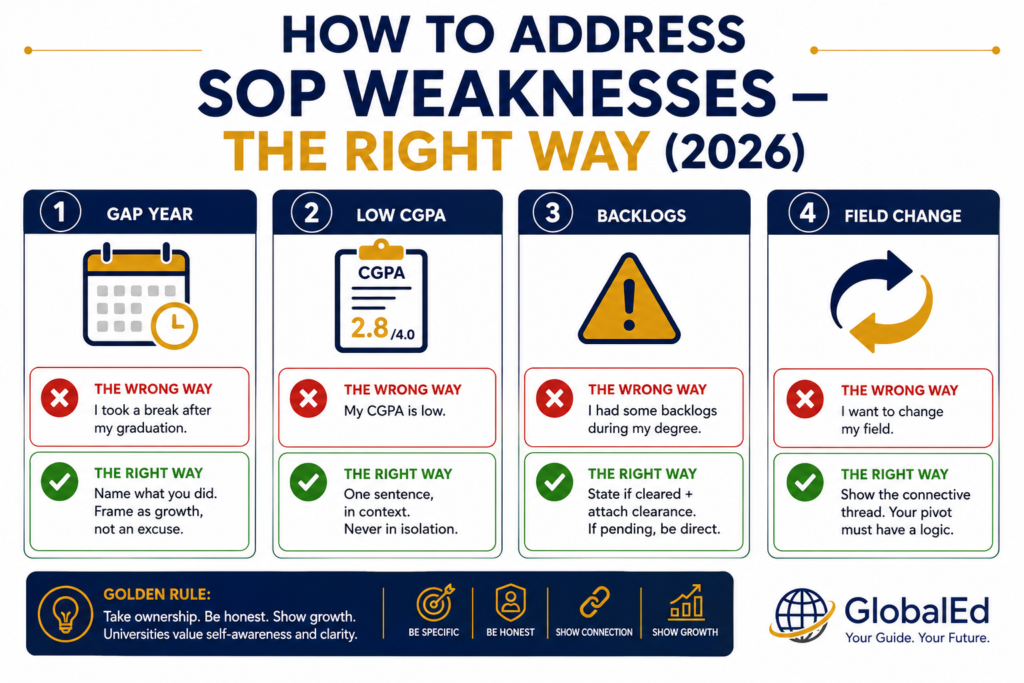
Gap Year
A gap year left unexplained in your SOP signals avoidance — and admissions committees and visa officers notice absences in your transcript timeline immediately.
The rule: Address the gap in one sentence, in context — not in a separate paragraph, not with excessive apology. State what you did, then move on.
WRONG: Avoidance (Silence) [No mention of the 14-month gap between graduation in May 2023 and application in July 2024 — the transcript gap is obvious to the reader] | RIGHT: Direct + brief address Following my graduation in May 2023, I spent 14 months at Tata Consultancy Services as a Systems Engineer. This experience, rather than extending my academic path, clarified the specific gap in my ML understanding that this program addresses — and made my application considerably more focused than it would have been directly after graduation. |
Low CGPA or a Weak Semester
Do not dedicate a paragraph to explaining your CGPA. Do not ignore it entirely if it is below 6.5/10. Address it in one sentence, embedded inside your academic narrative paragraph, immediately followed by a compensating strength.
WRONG: Either ignoring it or over-apologising Although my CGPA of 6.2 does not fully reflect my abilities, I had personal difficulties during my third semester which affected my performance. However, I assure the committee that I am a hardworking student who is fully committed to academic excellence. | RIGHT: One sentence, in context, forward-looking A difficult third semester — during which my father’s hospitalisation required me to take on family responsibilities — is reflected in my transcript. My subsequent four semesters show a consistent 8.1+ average, including a distinction in the Machine Learning and Data Mining courses most relevant to this application. |
Academic Backlogs
If cleared: State that they have been cleared and attach the clearance certificate. One sentence.
If pending: Be direct. State the situation, expected clearance date, and your confidence in clearing them. Silence is always worse than transparency — admissions officers compare your SOP to your transcript and draw their own conclusions if you do not explain.
Career Change / Field Mismatch
If you studied Mechanical Engineering and are applying for an MS in Computer Science, you must show the logical connective thread — the project, the internship, or the professional experience that bridges the two fields. Admissions committees are not opposed to cross-disciplinary applicants; they are opposed to applicants who cannot explain their own pivot.
The AI Detection Reality in 2026 — What Every Indian Student Must Know
2026 Warning: AI-generated SOPs are being flagged before they reach admissions officers AI-generated SOPs are often grammatically perfect but emotionally flat — they lack the specific personal detail, imperfect reasoning, and individual voice that human writing contains. Thousands of Indian students are using similar AI prompts. The resulting SOPs often sound nearly identical — pattern detection tools are built precisely to catch this. An AI-flagged SOP may be silently rejected or escalated for additional scrutiny — without the applicant ever knowing why. |
How to Use AI Responsibly in SOP Writing (Without Getting Flagged)
AI as a research tool — YES:
- Use AI to brainstorm which experiences to include
- Use AI to research faculty publications, lab topics, and program specialisations
- Use AI to check grammar and identify unclear sentences after you have written the draft yourself
- Use AI to generate questions that the admissions committee might ask — then answer them in your SOP
AI as a writer — NO:
- Do NOT ask AI to write your SOP from scratch and then lightly edit it — this is the pattern that gets flagged
- Do NOT use AI-generated paragraphs with corporate buzzwords: ‘spearheaded,’ ‘leveraged,’ ‘synergised,’ ‘cross-functional team’
- Do NOT use AI to replace your personal stories with generic descriptions of what you ‘achieved’ or ‘demonstrated’
AI-GENERATED (flagged pattern) During my tenure as Project Lead, I spearheaded a cross-functional team to migrate our legacy CRM system. By leveraging collaborative communication strategies and aligning stakeholders toward a common goal, we successfully implemented the new system and achieved a 20% efficiency improvement. | HUMAN-WRITTEN (personal, specific, genuine) Late one evening during a project review call, I realised our CRM migration was failing because the sales team in Chennai had a completely different definition of ‘customer’ than the team in Pune. No technical fix could solve a communication problem. I spent two weeks doing what no project plan had budgeted for: sitting with both teams until we agreed on a shared schema. That experience is why I want to study organisational behaviour alongside data systems. |
SOP Tips by Program Type — MS, MBA, UG, Scholarship
SOP for MS / MTech Abroad (Computer Science, Engineering, Data Science)
- Lead with a technical problem or research question — not a personal aspiration
- Name at least one specific faculty member and their recent paper. Show you have read it.
- Describe your thesis or final-year project at a technical level — do not dumb it down
- Be specific about research direction: ‘ML’ is not specific. ‘Domain adaptation in low-resource multilingual NLP’ is.
- Word count: 800–1,000 words. Never over 1,200 unless the program specifies.
SOP for MBA Abroad (USA, UK, Canada, Germany)
- Lead with a professional story that reveals a leadership insight or a strategic problem
- Show the career pivot clearly: where you are now, where you are going, and why the MBA bridges the two
- Mention specific MBA resources: clubs, case competitions, career tracks, industry connections — not just rankings
- Include a 3–5 year career goal and a 10-year vision — MBA admissions committees want long-term thinkers
- Word count: 500–800 words for most programs. Some schools (Wharton, HBS) have specific essay prompts — answer the prompt, not a generic SOP
SOP for Undergraduate Abroad (UK, Canada, Australia)
- More personal and reflective than graduate SOPs — who you are matters as much as what you have done
- Focus on intellectual curiosity: what triggered your interest in this subject, specific books, projects, or events
- Include extracurricular achievements that demonstrate character and leadership — not just academics
- UK UCAS 2026: Use the new three-question format — do not submit an essay-style personal statement
- Word count: As per program. UK UCAS: word limits per question.
SOP for Scholarship Applications (Chevening, DAAD, Fulbright)
- Scholarship SOPs are values-driven, not just career-driven — show broader impact and community contribution
- Chevening: Leadership is the primary criterion — every paragraph should demonstrate leadership in a specific context
- DAAD: Research potential is primary — show academic rigour, publication interest, and faculty alignment
- Fulbright: Cultural exchange and mutual understanding — show how your goals benefit both India and the host country
- Word count: 500–700 words. Shorter and more focused than academic SOPs.
SOP Writing Timeline — When to Start and How Many Drafts
Phase | Activity | Timeline (Fall 2027 intake) |
|---|---|---|
Research Phase | Read program pages, identify faculty, note specific courses and labs relevant to your profile | June–July 2026 |
Brain-dump Draft | Write everything without editing — your story, your experiences, your goals. Do not self-censor. This draft will be messy. | July 2026 |
Structure Draft | Organise into the 5-paragraph structure. Cut anything not relevant to the program. | August 2026 |
University Customisation | Rewrite paragraph 4 (Why This University) from scratch for each program. Budget 90 minutes per university. | August–September 2026 |
Feedback Round 1 | Share with a mentor, professor, or counsellor who knows the target program/field. Get specific, critical feedback. | September 2026 |
Revision Round 1 | Incorporate feedback. Cut words that add nothing. Strengthen the opening and closing. | September 2026 |
Feedback Round 2 | Share with someone who does NOT know your field — can they understand your story and goals? | October 2026 |
Final Polish | Grammar check (Grammarly + human read-aloud). Check word count. Confirm university-specific details are accurate. | October 2026 |
Submission | Convert to PDF, check filename format, attach with application | November–December 2026 |
The 10-12 week rule: Students who start in November for a December deadline consistently produce weaker SOPs — there is not enough time for the revision rounds that transform a good draft into an admissions-winning document. If you are graduating in May/June 2026 and targeting Fall 2027: your first draft should be ready by July 2026. The ‘Why This University’ paragraph alone requires 90 minutes of research per university and should be written fresh for every single application — not copy-pasted. |
10 SOP Mistakes That Get Indian Students Rejected
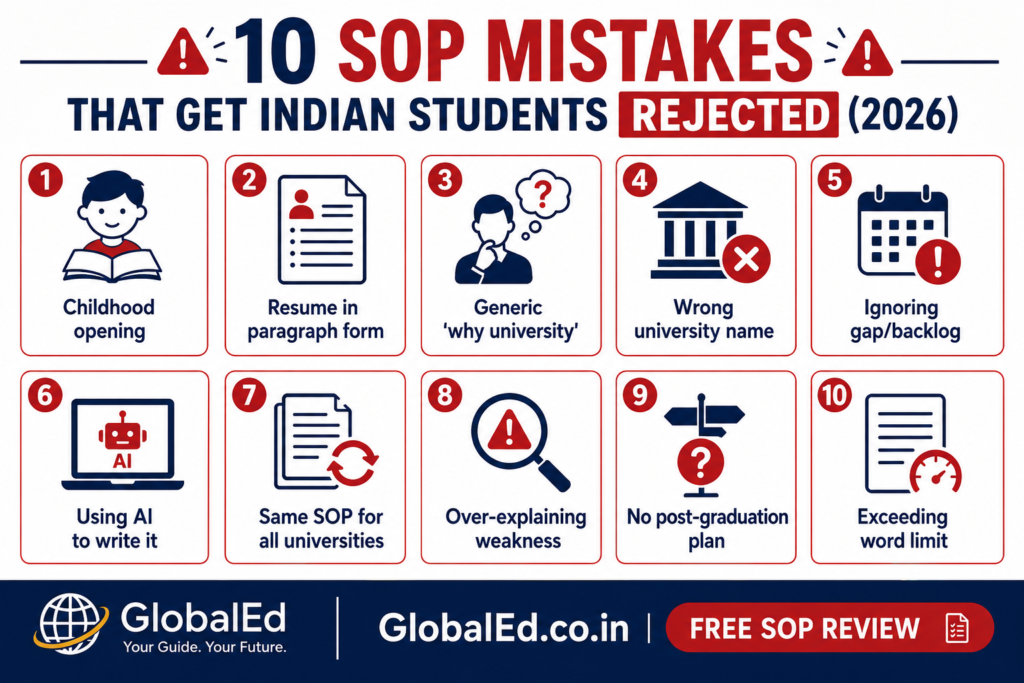
- Opening with ‘Since childhood…’ — The most clichéd opening in study abroad applications. Immediately signals a template SOP.
- Rewriting your resume in paragraph form — Listing projects and internships without explaining what you learned, what gaps they revealed, or why they matter for graduate study.
- Writing a generic ‘why this university’ paragraph — Phrases like ‘your excellent faculty and global ranking’ could apply to any university. Name specific professors, courses, and labs.
- Writing the wrong university name — A fatal error that happens when copy-pasting. Triple-check every single submission.
- Ignoring a gap year, backlog, or low-CGPA semester — Admissions committees see your transcript. Silence reads as evasion. One sentence of honest explanation always performs better than no mention.
- Using AI to write the SOP — AI-generated SOPs often get flagged before they reach the admissions officer. Use AI for research and grammar checks; write the actual content yourself.
- Sending the same SOP to every university — The ‘why this university’ paragraph must be rewritten from scratch for each application. A one-size-fits-all SOP signals low interest.
- Submitting your admission SOP as your visa SOP (Canada, Australia) — Different audiences, different questions, different tone. Using the same document for both is a leading cause of study permit refusals.
- Over-explaining weaknesses or being excessively apologetic — One sentence of direct acknowledgement is enough. A paragraph of apology shifts the reader’s focus to the negative and wastes word count.
- Exceeding the word limit — Going 200 words over a 1,000-word limit signals poor editing skills and inability to follow instructions. Admissions committees notice.
Section 10: SOP Final Submission Checklist 2026
Before you hit submit, run through every item on this checklist:
Content Checklist
- ✅ First sentence is specific, concrete, and does NOT start with ‘Since childhood’ or a quote
- ✅ Paragraph 2 names specific courses, thesis, or project with outcomes — not just subject names
- ✅ Paragraph 3 shows a clear ‘skills gap’ that the program fills — not just ‘I worked at X’
- ✅ Paragraph 4 names at least one specific faculty member, course, or research group unique to this university
- ✅ Closing paragraph states a specific short-term role and a long-term vision
- ✅ Any gap year, backlog, or low-CGPA semester is addressed in one direct sentence
- ✅ The SOP does NOT repeat information already in the resume or transcript
- ✅ The word count is within the program’s specified limit (or 850–950 words if unspecified)
Technical Checklist
- ✅ Saved as PDF — not .doc or .docx — unless the university specifically asks for Word format
- ✅ File named correctly: FirstName_LastName_SOP_ProgramName_University.pdf
- ✅ University name is correct throughout — no leftover mentions of another university
- ✅ Faculty names and research paper titles mentioned are accurate and current (verified on the faculty’s official page)
- ✅ Run through Grammarly AND read aloud — reading aloud catches awkward phrasing that grammar tools miss
- ✅ Shared with at least one reviewer who has given specific, critical feedback (not just ‘it reads well’)
Visa SOP Checklist (Canada, Australia, UK)
- ✅ Written as a SEPARATE document from the admission SOP
- ✅ Answers: Why this course? Why this country and institution? How will you fund your studies?
- ✅ Includes ties to India or post-study return plan if required (Canada IRCC, Australia GTE)
- ✅ Tone is factual and direct — not academic or reflective
- ✅ Length: 400–600 words (one page)
Frequently Asked Questions — SOP Writing for Study Abroad 2026
1. How long should an SOP be for study abroad in 2026?
Most programs specify 800–1,000 words. If no word count is specified, aim for 900 words — long enough to cover all five paragraphs with substance, short enough to respect the reader’s time. Never exceed the specified limit. Going over signals poor editing and is noticed by admissions committees.
2. Should I use ChatGPT or AI to write my SOP?
Use AI as a research and grammar tool — not as a writer. In 2026, several US universities use AI detection systems that flag machine-generated essays before they reach the admissions officer. AI-written SOPs tend to sound professional but generic — lacking the specific personal detail and individual voice that distinguish strong applications. Write the SOP yourself; use AI to check grammar and brainstorm structure.
3. How do I start an SOP?
Start with a specific, concrete moment — an experience, a problem, a question — that explains why you are pursuing this degree. Do not start with a childhood memory, a famous quote, or a general statement about your field. The opening sentence should make the admissions reader lean forward, not reach for the next application.
4. Do I need a different SOP for each university?
The structure and paragraphs 1–3 and 5 can be adapted from a core document. Paragraph 4 — ‘Why This University’ — must be rewritten from scratch for each application. Budget 90 minutes per university. Sending the same ‘Why University’ paragraph to different schools is the most common tell that an SOP is a template — and it reads that way.
5. How do I explain a gap year in my SOP?
Address it in one sentence, in context — typically in your academic or professional paragraph. State what you did during the gap, frame it as something productive or educational, and move on. A gap year addressed transparently reads as self-awareness. Silence reads as evasion. Never dedicate a full paragraph to justifying a gap.
6. What is the difference between an SOP and a personal statement?
An SOP is academic and career-focused: what you have studied, what you have done professionally, and where you are going. A personal statement is more reflective and personal: your values, formative experiences, and what makes you who you are. Many UK undergraduate programs use the term ‘personal statement’ (especially via UCAS). Most US and Canadian graduate programs use ‘SOP.’ Some schools blur the distinction — always read the program’s official prompt before writing.
7. Do I need a separate SOP for my Canada study permit?
Yes. The IRCC study permit SOP is a completely different document from your university admission SOP. The IRCC version must answer: Why this course? Why Canada and this institution? How will you fund your studies? Why will you return to India after graduation? It is factual, direct, and about 400–600 words. Submitting your admission SOP to IRCC is one of the leading causes of study permit refusals for Indian students.
Related Guides on GlobalEd — Read These Alongside This SOP Guide
- LOR Writing Guide 2026: How to Get a Strong Letter of Recommendation for Studying Abroad → [Link to LOR guide on GlobalEd]
- Study in Germany 2026: Free Education, PR Pathways & Top Universities for Indian Students → [Link to Germany blog]
- Is an MBA Abroad Worth It in 2026? ROI Analysis for Indian Students → [Link to MBA ROI blog]
- IELTS vs PTE vs TOEFL 2026: Which English Test Should You Take? → [Link to test comparison blog]
- Top 15 Fully Funded Scholarships for Indian Students in 2026 → [Link to scholarship roundup]
Authoritative Sources & External References
1. MIT Graduate Admissions — What We Look For in a Statement of Purpose — Official MIT guidance on SOP evaluation criteria
2. UCAS 2026 Personal Statement — New Question Format — Official UCAS guidance on the new 3-question format introduced for 2026 UK applications
3. IRCC — Canada Study Permit Application Requirements — Official IRCC guidance on what the Canada visa SOP must contain
4. DAAD — Tips for Motivation Letters (Germany) — Official DAAD scholarship application guidance for Indian students
5. APS India — Academic Evaluation Centre (for Germany applicants) — Mandatory certificate for Indian students applying to German universities
6. British Council India — Guide to UK University Applications — Official British Council guidance for Indian students applying to UK programs
Conclusion: Your SOP Is Your Voice — Make It Yours
An admissions committee reading 500 applications from India is not looking for the candidate with the most achievements. They are looking for the candidate who knows exactly why they are there, what they will do with the opportunity, and how their specific story makes them the right fit for this specific program.
Learning how to write an SOP for study abroad in 2026 means learning to tell that story — with specificity, clarity, and honesty. It means opening with a moment that matters, not a childhood dream. Writing a ‘Why This University’ paragraph that can only be sent to one university. Addressing weaknesses directly, in one sentence, and moving on. And closing with a post-graduation plan that is concrete enough to be believable and ambitious enough to be inspiring.
Your SOP is not a summary of your resume. It is an argument for your admission. Write it like one.
GlobalEd’s counsellors have reviewed hundreds of SOPs for Indian students applying to universities in Germany, UK, Canada, USA, Australia, and Ireland. Our SOP review is free, personalised, and specific — not a template checklist.
→ Book Your Free SOP Review Session with GlobalEd https://globaled.co.in/contact-us/
→ Download the Free SOP Template + Paragraph-by-Paragraph Guide 2026

