


Part-time work for Indian students abroad in 2026 is not just a way to earn pocket money — it is a financial strategy that can cover 40–70% of your monthly living costs, reduce your education loan burden, and add a globally recognised work experience to your resume before you even graduate.Part-time work for Indian students abroad in 2026 is becoming one of the biggest factors while choosing a study abroad destination.
Here is what most study abroad blogs will not tell you: an Indian student working 20 hours per week in Sydney earns approximately ₹1,07,000 per month — before tax. That same student in London earns ₹89,000 per month. In Canada, ₹73,000 per month. In Germany’s Werkstudent system, ₹65,000 per month. None of this is speculation. These are real numbers, calculated at May 2026 exchange rates, using actual minimum wage figures from government sources.
But here is the catch: working abroad is not as simple as showing up and finding a job. Every country has different rules — how many hours you can legally work, what kind of work is allowed, what happens if you cross the limit, and whether your student visa even authorises off-campus employment.
This comprehensive guide on part-time work for Indian students abroad in 2026 covers everything: country-by-country visa work rules, real monthly earnings in INR, the top jobs that pay the most, the Werkstudent system in Germany, tax rules, and an honest breakdown of how much of your living costs you can realistically cover through part-time work.
If you want to know which country gives you the best combination of education quality + part-time earning potential, book a free counselling session with GlobalEd’s experts here. Our team helps you plan your full financial picture before you leave India.
Section 1: Why Part-Time Work Abroad Is a Financial Game-Changer for Indian Students
The average Indian student studying abroad takes an education loan of ₹40–80 lakh. Monthly living costs abroad run ₹60,000–₹1,20,000 depending on the city. Families back home are sending money via wire transfer every month, often stretching themselves thin.
Part-time work changes this equation dramatically. Consider the math:
Country | Monthly Living Cost (est.) | Monthly PT Earnings (20 hrs/wk) | Living Costs Covered by Work |
|---|---|---|---|
UK (London) | ₹90,000–1,20,000 | ₹89,000 | 70–99% |
Australia (Sydney) | ₹80,000–1,10,000 | ₹1,07,000 | 97–100%+ |
Canada (Toronto) | ₹70,000–1,00,000 | ₹73,000 | 73–100% |
Germany (Munich) | ₹76,000–95,000 | ₹65,000 | 68–85% |
USA (on-campus only) | ₹1,00,000–1,40,000 | ₹55,000 | 39–55% |
Ireland (Dublin) | ₹80,000–1,00,000 | ₹80,000 | 80–100% |
Sources: ABS Australia (National Minimum Wage 2026: AUD 24.95/hr), UK National Living Wage 2026: GBP 12.21/hr, Canada Federal Minimum Wage 2026: CAD 17.30/hr, Germany Mindestlohn 2026: EUR 12.41/hr, Ireland National Minimum Wage 2026: EUR 13.50/hr. INR conversions at May 2026 rates: GBP 1=₹107, AUD 1=₹55, CAD 1=₹61, EUR 1=₹91, USD 1=₹84.
The three financial benefits of part-time work abroad that go beyond the salary: Resume value: Employers — both in India and abroad — view international work experience during a degree as a strong differentiator. It signals initiative, cultural adaptability, and real-world skills. PR points advantage (Canada + Australia): Paid work experience during your degree counts toward your CRS score (Canada Express Entry) and points test (Australia General Skilled Migration). Starting work early extends your eligible work experience timeline. |
Section 2: The Master Table — Part-Time Work Rules for Indian Students by Country (2026)
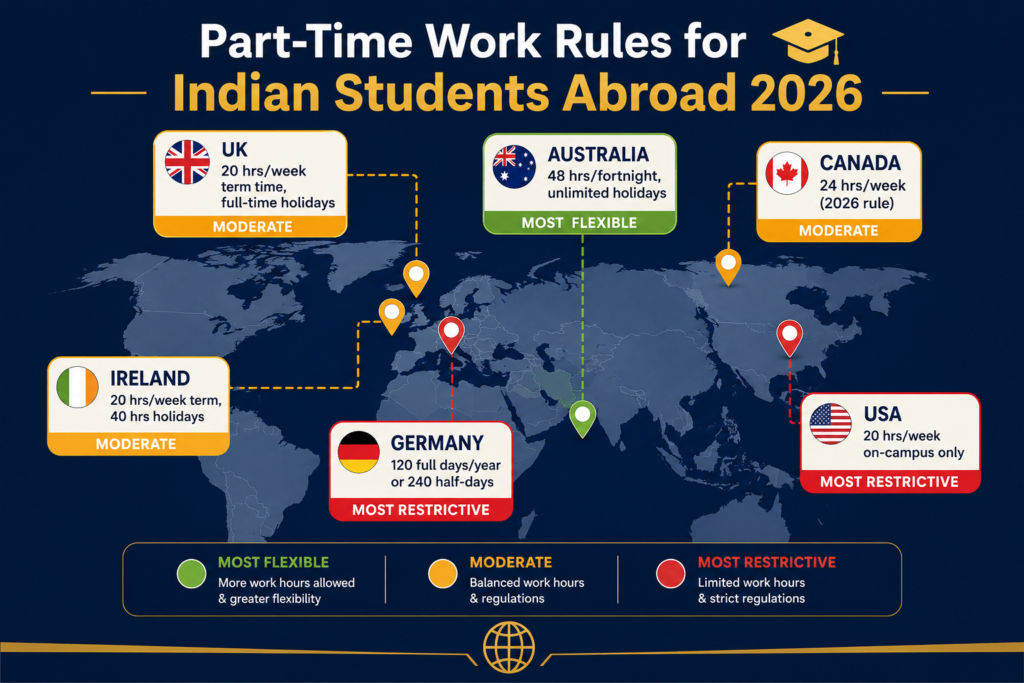
Country | Work Hours (Term) | Work Hours (Holidays) | On/Off Campus | Visa Authorises Work? | Penalty for Breach |
|---|---|---|---|---|---|
🇬🇧 UK | 20 hrs/week | Full-time (unlimited) | Both — any employer | Yes (embedded in CAS) | Visa cancellation, deportation ban |
🇦🇺 Australia | 48 hrs/fortnight (24 hrs/wk) | Unlimited | Both — any employer | Yes (Subclass 500) | Visa cancellation, future visa restrictions |
🇨🇦 Canada | 24 hrs/week off-campus | Full-time | Both | Yes (study permit) | Loss of student status, removal order |
🇩🇪 Germany | 120 full days OR 240 half-days/year | Included in annual limit | Both | Yes (Aufenthaltstitel) | Residence permit issues, tax penalties |
🇺🇸 USA | 20 hrs/week — ON-CAMPUS ONLY (Year 1) | Full-time on-campus OR CPT/OPT off-campus (Year 2+) | On-campus (Year 1); Both with auth. (Year 2+) | Yes (F-1 visa, limited) | Visa status violation — serious |
🇮🇪 Ireland | 20 hrs/week (term) | 40 hrs/week (Jun–Sep, Dec–Jan) | Both | Yes (Stamp 2) | Visa stamp revocation |
🇳🇿 New Zealand | 20 hrs/week | Full-time during scheduled breaks | Both | Yes (Student Visa) | Visa breach — deportation risk |
🇸🇬 Singapore | 16 hrs/week | Full-time during holidays | Both (select institutions) | Yes (Student’s Pass) | Pass cancellation |
Non-negotiable rule: Never breach your work hour limit Breaching your work hour limit is treated as a visa condition violation — not a minor infringement. In Australia and Canada, it can result in immediate visa cancellation and a ban on future visas. In the UK, overstaying your 20-hour limit is flagged by HMRC (tax authority) and reported to the Home Office. Students have lost their visas for working 21–22 hours a week. Keep a personal log of your hours worked each week. Ask your employer to confirm your hours in writing. |
Section 3: What Indian Students Actually Earn — Country-by-Country Real Earnings in INR (2026)
Let us go deep into each major destination with real, government-verified wage data, monthly earnings in INR, and the specific jobs that pay the most for Indian students.
United Kingdom — Best Earnings for City-Based Students
Work Scenario | Hours/Week | Hourly Rate | Monthly Gross | Monthly Gross (INR) |
|---|---|---|---|---|
National Living Wage (21+) | 20 | GBP 12.21 | GBP 976 | ~₹1,04,432 |
Retail / Café (common) | 20 | GBP 12.21–13.00 | GBP 976–1,040 | ~₹1,04,000–1,11,280 |
Library / Campus Admin | 20 | GBP 12.50–15.00 | GBP 1,000–1,200 | ~₹1,07,000–1,28,400 |
Private Tutoring (STEM) | 10 | GBP 20–35 | GBP 800–1,400 | ~₹85,600–1,49,800 |
During holidays (full-time) | 35–40 | GBP 12.21 | GBP 1,711–1,956 | ~₹1,83,077–2,09,292 |
Tax note: UK students get a tax-free Personal Allowance of GBP 12,570/year. At 20 hrs/week for 12 months, you earn approximately GBP 12,700 — just above the threshold. Most students pay minimal or zero UK income tax.
Best paying jobs for Indian students in the UK: STEM tutoring (GBP 20–35/hr), university research assistant (GBP 14–18/hr), IT support (GBP 13–16/hr), hospitality supervisory roles (GBP 13–15/hr), graduate teaching assistant (GBP 15–22/hr).
- Top job portals: Indeed UK, Totaljobs, university job boards, Gumtree, Unitemps
Australia — Highest Minimum Wage in the World for Students
Work Scenario | Hours/Fortnight | Hourly Rate (AUD) | Monthly Gross (AUD) | Monthly Gross (INR) |
|---|---|---|---|---|
National Minimum Wage (2026) | 48 | AUD 24.95 | AUD 1,197 | ~₹65,835 |
Hospitality / Retail | 48 | AUD 25–30 | AUD 1,200–1,440 | ~₹66,000–79,200 |
Campus jobs / Tutoring | 48 | AUD 28–40 | AUD 1,344–1,920 | ~₹73,920–1,05,600 |
IT Support / Tech roles | 48 | AUD 30–50 | AUD 1,440–2,400 | ~₹79,200–1,32,000 |
Holidays (unlimited hours) | 80–90 | AUD 24.95 | AUD 1,996–2,246 | ~₹1,09,780–1,23,530 |
Tax note: International students who have lived in Australia for 6+ months qualify as ‘tax residents’ and get the AUD 18,200 tax-free threshold. Most Indian students working 48 hrs/fortnight earn approximately AUD 14,370/year during term — well below the threshold, meaning ZERO income tax for most students.
Best paying jobs for Indian students in Australia: Barista (AUD 26–32/hr with penalty rates), STEM tutoring (AUD 35–50/hr), campus IT support (AUD 28–35/hr), aged care assistant (AUD 26–30/hr), food delivery during breaks (AUD 20–30/hr including tips).
- Top job portals: Seek.com.au, Indeed Australia, Gumtree Australia, university career portals, StudentJob AU
Canada — Best Flexibility + PR-Points Earning
Work Scenario | Hours/Week | Hourly Rate (CAD) | Monthly Gross (CAD) | Monthly Gross (INR) |
|---|---|---|---|---|
Federal Minimum Wage (2026) | 24 | CAD 17.30 | CAD 1,661 | ~₹1,01,321 |
Ontario Minimum Wage (2026) | 24 | CAD 17.20 | CAD 1,651 | ~₹1,00,711 |
Retail / Food service | 24 | CAD 17–19 | CAD 1,632–1,824 | ~₹99,552–1,11,264 |
Library / Admin / Campus | 20 | CAD 18–22 | CAD 1,440–1,760 | ~₹87,840–1,07,360 |
IT / Tech / Research Asst. | 20 | CAD 20–30 | CAD 1,600–2,400 | ~₹97,600–1,46,400 |
During breaks (full-time) | 40 | CAD 17.30 | CAD 2,768 | ~₹1,68,848 |
2026 rule update: As of 2024, Canada permanently allows eligible international students to work 24 hours per week off-campus during academic sessions (up from the previous 20-hour limit). This is a meaningful increase — at CAD 17.30/hr, 4 extra hours per week adds approximately CAD 277/month (₹16,897) to your earnings.
Tax note: Canada’s basic personal amount for 2026 is CAD 16,129. Most students working 24 hours per week earn approximately CAD 19,927/year — just above the threshold. Expect to pay approximately CAD 300–800 in federal income tax per year — very manageable.
- Top job portals: Indeed Canada, Job Bank (government), campus career centres, LinkedIn, Workopolis
Germany — The Werkstudent System: The Smartest Student Work Model in the World
Work Scenario | Days/Year | Hourly Rate (EUR) | Monthly Avg (EUR) | Monthly Avg (INR) |
|---|---|---|---|---|
Mindestlohn (2026 minimum) | 120 full / 240 half | EUR 12.41 | EUR 497–600 | ~₹45,227–54,600 |
Retail / Campus work | 120 full days | EUR 12.50–14.00 | EUR 500–600 | ~₹45,500–54,600 |
Werkstudent (skilled role) | 240 half days (20 hrs/wk) | EUR 14–20 | EUR 1,120–1,600 | ~₹1,01,920–1,45,600 |
IT / Engineering Werkstudent | 20 hrs/wk | EUR 15–22 | EUR 1,200–1,760 | ~₹1,09,200–1,60,160 |
Research / Teaching Asst (HiWi) | 20 hrs/wk | EUR 12–15 | EUR 960–1,200 | ~₹87,360–1,09,200 |
The Werkstudent system explained: Werkstudent is Germany’s unique framework for student employment at skilled companies — especially in engineering, IT, consulting, and finance. As a Werkstudent, you work up to 20 hours per week during the semester in a role directly related to your field of study. The key advantages over regular part-time work:
- Higher hourly rate (EUR 15–22) vs minimum wage service jobs (EUR 12.41)
- Reduced social security contributions — Werkstudenten pay significantly lower social insurance
- Direct pathway to full-time employment: 60–70% of Werkstudenten receive a full-time job offer from the same company after graduation
- German language not always required — major tech companies in Berlin and Munich hire Werkstudenten in English-speaking roles
Minijob advantage: If you earn under EUR 538/month from a Minijob (casual employment), you pay ZERO income tax and reduced social security in Germany. Ideal for Indian students who want simple, low-commitment work alongside studies.
Tax note: Germany’s tax-free allowance is EUR 11,784/year (2026). Werkstudenten earning EUR 1,200/month (EUR 14,400/year) pay approximately EUR 240/year in income tax — effectively 1.7% effective tax rate.
- Top Werkstudent portals: LinkedIn Germany, Stepstone.de, Indeed Germany, university job boards (Stellenwerk), HiWi portals on campus
USA — Most Restrictive but Highest Skilled Wages
Work Scenario | Hours/Week | Hourly Rate (USD) | Monthly Gross (USD) | Monthly Gross (INR) |
|---|---|---|---|---|
Federal minimum wage | 20 | USD 7.25 | USD 580 | ~₹48,720 |
State min. wage (CA, NY, WA) | 20 | USD 15–17 | USD 1,200–1,360 | ~₹1,00,800–1,14,240 |
Campus library / admin | 20 | USD 12–15 | USD 960–1,200 | ~₹80,640–1,00,800 |
Research assistantship (RA) | 20 | USD 18–25 | USD 1,440–2,000 | ~₹1,20,960–1,68,000 |
Teaching assistantship (TA) | 20 | USD 18–25+stipend | USD 1,440–2,000+ | ~₹1,20,960+ |
CPT internship (Year 2+ STEM) | Up to 40 (full-time CPT) | USD 25–45 | USD 4,000–7,200 | ~₹3,36,000–6,04,800 |
USA work rules — what Indian students must understand Year 2+ (CPT): Curricular Practical Training allows off-campus internships directly tied to your major. This is where the real money is — USD 25–45/hr in STEM roles. OPT after graduation: 12 months work authorization (36 months for STEM graduates). Average STEM OPT salaries are USD 85,000–110,000/year. Research and Teaching Assistantships (RA/TA): Available to PhD and some Master’s students. These often include a full tuition waiver PLUS a monthly stipend — effectively free education plus a salary. State minimum wage matters: California (USD 16.50), New York (USD 16), Washington (USD 16.66) — always check your specific state. |
Section 4: Top 10 Part-Time Jobs for Indian Students Abroad That Pay the Most (2026)
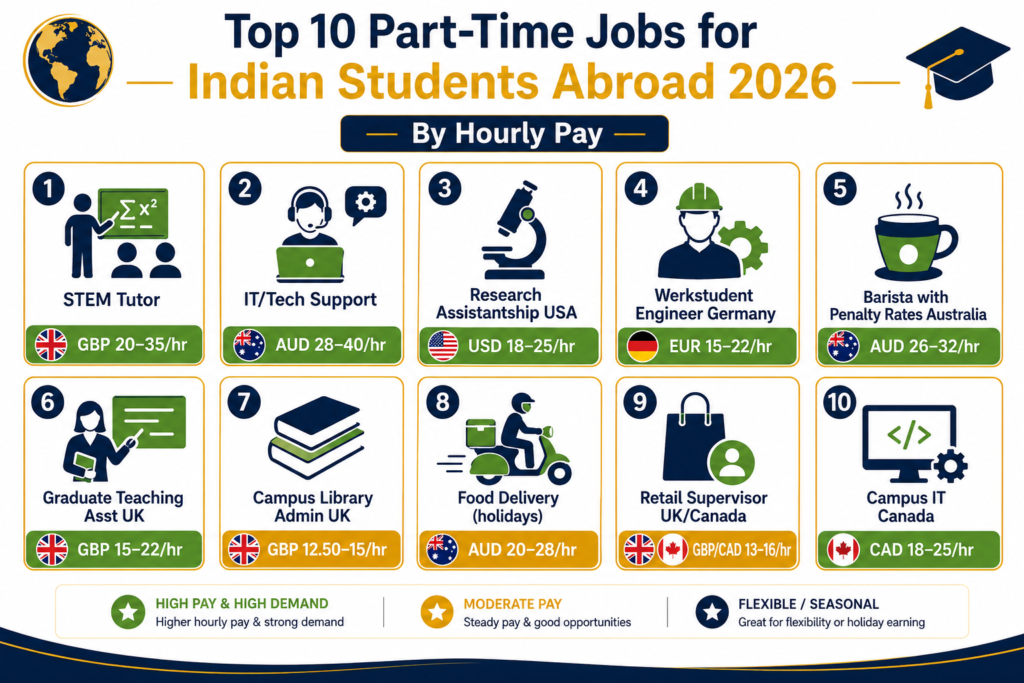
Rank | Job Type | Best Country | Hourly Rate (Local) | Hourly Rate (INR) | Skill Required |
|---|---|---|---|---|---|
1 | STEM / IIT Private Tutor | UK, Australia | GBP 20–35 / AUD 35–50 | ₹2,140–3,745 / ₹1,925–2,750 | Subject expertise |
2 | Research Assistantship (RA) | USA | USD 18–25 | ₹1,512–2,100 | Graduate enrollment, lab skills |
3 | Werkstudent (IT/Engineering) | Germany | EUR 15–22 | ₹1,365–2,002 | English + field knowledge |
4 | Graduate Teaching Asst (TA) | UK, USA | GBP 15–22 / USD 18–25 | ₹1,605–2,354 / ₹1,512–2,100 | Strong academics |
5 | IT / Tech Support on Campus | Australia, Canada | AUD 28–40 / CAD 20–28 | ₹1,540–2,200 / ₹1,220–1,708 | IT skills |
6 | Barista (penalty rates, AUS) | Australia | AUD 26–32 (+ weekend rates) | ₹1,430–1,760 | Barista training (free courses available) |
7 | Campus Library / Admin | UK, Ireland | GBP 12.50–15 / EUR 14–18 | ₹1,338–1,605 / ₹1,274–1,638 | None (training given) |
8 | Hospitality Supervisor | Ireland, UK | EUR 14–17 / GBP 13–15 | ₹1,274–1,547 / ₹1,391–1,605 | Experience preferred |
9 | Retail (evenings + weekends) | Canada, Australia | CAD 17–19 / AUD 25–30 | ₹1,037–1,159 / ₹1,375–1,650 | None |
10 | Food Delivery (during breaks) | Australia, UK | AUD 20–28 / GBP 12–15 | ₹1,100–1,540 / ₹1,284–1,605 | Vehicle / bicycle |
Strategic tip for Indian students: Start with on-campus jobs (library, admin, campus café) in your first semester to build a local reference and understand workplace culture. By semester two, pivot to higher-paying Werkstudent or tutoring roles. The jump from ₹1,100/hr to ₹2,000+/hr is achievable within one academic year.
Section 5: How Much of Your Living Costs Can Part-Time Work Actually Cover? (Real Calculation)
This is the question Indian parents ask most. Let us do the honest maths — using real minimum wage figures, government-verified living cost data, and actual student budgets.
Country & City | Monthly Living Cost (₹) | PT Earnings at Min Wage (₹) | % Living Costs Covered | Shortfall per month |
|---|---|---|---|---|
UK — London | ₹95,000–1,20,000 | ₹1,04,000 (20 hrs @ GBP 12.21) | 87–100% | ₹0–16,000 |
UK — Manchester / Leeds | ₹65,000–85,000 | ₹1,04,000 | 100%+ | Surplus ₹19,000–39,000 |
Australia — Sydney | ₹85,000–1,10,000 | ₹65,835 (48 hrs/fortnight @ AUD 24.95) | 60–77% | ₹19,165–44,165 |
Australia — Melbourne | ₹75,000–95,000 | ₹65,835 | 69–87% | ₹9,165–29,165 |
Canada — Toronto | ₹75,000–1,00,000 | ₹1,01,321 (24 hrs @ CAD 17.30) | 100%+ | Surplus ₹1,321–26,321 |
Canada — Waterloo / Halifax | ₹55,000–70,000 | ₹1,01,321 | 100%+ | Surplus ₹31,321–46,321 |
Germany — Munich | ₹80,000–95,000 | ₹65,000 (min wage) to ₹1,09,000 (Werkstudent) | 68–100%+ | ₹0–30,000 |
Germany — Leipzig / Dresden | ₹55,000–70,000 | ₹65,000 to ₹1,09,000 | 100%+ | Surplus ₹10,000–54,000 |
USA — New York / California | ₹1,05,000–1,40,000 | ₹1,00,800 (20 hrs @ USD 15) | 72–96% | ₹4,200–39,200 |
Ireland — Dublin | ₹80,000–1,00,000 | ₹97,200 (20 hrs @ EUR 13.50) | 97–100% | ₹0–2,800 |
3 key insights from this data: Australia’s minimum wage is the world’s highest for students (AUD 24.95/hr), but Sydney and Melbourne’s high rents mean coverage is around 70–90%. Skilled jobs at AUD 30–40/hr close this gap completely. Germany is the hidden winner for students who secure Werkstudent roles. At EUR 15–22/hr, students in mid-size cities (Leipzig, Dresden, Nuremberg) can fully cover living costs and save ₹20,000–40,000/month. |
Want to know your exact earning potential in your target country? Our counsellors will build a personalised financial plan — tuition, living costs, part-time earnings, and loan impact — before you apply. |
Section 6: Tax Rules for Indian Students Working Abroad — Country by Country 2026
Most Indian students ignore taxes until they receive an unexpected bill — or miss a refund they were entitled to. Here is the essential tax overview for each major destination.
Country | Tax-Free Threshold | Typical Student Tax Rate | Do You Need to File? | Key Tip |
|---|---|---|---|---|
UK | GBP 12,570/year (~₹13.4 lakh) | 0% for most part-time students | Yes if taxed — claim refund via P800/P50 | Use your National Insurance number as soon as you arrive. HMRC often over-withholds — file a return and get it back. |
Australia | AUD 18,200/year (~₹10 lakh) for tax residents (6+ months) | 0–16% above threshold | Yes — ATO MyTax portal. Most students get a refund. | Register for a TFN (Tax File Number) in Week 1. Without it, employers deduct 47% tax — you get it back but it takes months. |
Canada | CAD 16,129/year (~₹9.8 lakh) — basic personal amount | 15–20.5% on income above threshold | Yes (T1 return) — file by April 30 each year | Tuition credits and moving expenses are deductible. International students can often reduce tax to zero through credits. |
Germany | EUR 11,784/year (~₹10.7 lakh) | 0–14% for income up to EUR 17,005 | Yes — ELSTER portal. Most students get refund. | Mini-job earnings (under EUR 538/month) are tax-free. Werkstudenten benefit from reduced KV and PV insurance contributions. |
USA | USD 14,600 standard deduction (2026) | 10–22% federal + state | Yes — Form 1040-NR for F-1 students | F-1 students are EXEMPT from Social Security (FICA) and Medicare taxes — make sure your employer knows. Many employers deduct this in error; claim it back. |
Ireland | EUR 16,500 tax credit effective threshold | 0–20% (standard rate band) | Yes — Revenue MyAccount portal | Ireland’s PAYE system automatically deducts tax. File an end-of-year return to claim any overpayment. |
Most important action in Week 1 of arriving abroad: Register for your tax identification number immediately — TFN in Australia, NI number in the UK, SIN in Canada, Tax Number in Germany, SSN in the USA. Without it, your employer cannot pay you properly, or will deduct maximum tax. This is not optional.
Section 7: How Indian Students Can Find Part-Time Jobs Abroad — Step-by-Step Strategy
Step 1: Start Before You Land
Most Indian students wait until they arrive to start looking for jobs. This costs them 4–6 weeks of earnings. The right approach:
- Create a LinkedIn profile with ‘Open to Work’ set to your destination city, 3 months before departure
- Research the job portals specific to your destination country (see Section 8)
- Tailor your resume to the local format — no photo in the UK, no date of birth in Australia, one page maximum
- For Werkstudent roles in Germany: email HR departments directly with your degree details and start date. German companies plan Werkstudent hiring 2–3 months in advance.
Step 2: Use Your University in Week 1
University career centres and student employment offices are dramatically underused by Indian students. In Week 1:
- Register with your university’s Student Employment Service or Career Centre
- Check the university’s internal job board — these are often not listed on public portals
- Ask your department administrator if there are paid Research Assistantship or Teaching Assistantship openings
- Visit the campus café, library, IT help desk, and student union — all frequently hire students informally in the first week of term
Step 3: Build a UK/Australia/Canada-Format Resume
A resume that works for Indian employers will be rejected by UK/Australian/Canadian employers. Key differences:
- Maximum 1 page for undergraduate/postgraduate student jobs
- No photo, no date of birth, no gender, no marital status (illegal to ask in UK, Australia, Canada)
- Skills section should emphasise soft skills — communication, teamwork, customer service — not just technical abilities
- Include any Indian work experience translated into local terminology (e.g., ‘Client-facing IT support’ not ‘TCS L1 service desk’)
Step 4: The Job Portals by Country
Country | Best Job Portals for Students | Best for Skilled/Werkstudent Roles |
|---|---|---|
UK | Indeed UK, Totaljobs, Gumtree, Unitemps, university job board | LinkedIn UK, Glassdoor UK, Gradcracker |
Australia | Seek.com.au, Indeed Australia, Gumtree, StudentJob AU | LinkedIn, Adzuna, campus career portal |
Canada | Indeed Canada, Job Bank (govt), LinkedIn, campus career centre | LinkedIn, Glassdoor, Workopolis, AngelList |
Germany | Indeed Germany, Stepstone.de, LinkedIn, Stellenwerk (campus) | LinkedIn, Xing.de, company career pages |
USA | University job board (Handshake), campus career centre | LinkedIn, Glassdoor, Indeed, Internships.com |
Ireland | Jobs.ie, Indeed Ireland, LinkedIn, campus board | LinkedIn, IrishJobs.ie, Glassdoor |
Step 5: The First 30 Days Action Plan
- Day 1–3: Register for tax ID (TFN/NI/SIN), open a local bank account (Revolut or local bank), set up phone with local SIM
- Day 4–7: Visit the university career centre, check internal job board, speak to your Student Union about part-time opportunities
- Week 2: Apply to 10–15 on-campus or nearby jobs via university portal and Indeed. Tailor resume for each.
- Week 3–4: Follow up applications, attend any campus job fairs or employer events. LinkedIn connect with peers already working.
- Month 2 onward: Once settled in studies, scale up to higher-paying roles (tutoring, Werkstudent, research assistant)
Section 8: 6 Costly Mistakes Indian Students Make With Part-Time Work Abroad
- Working more hours than your visa allows. This is the single most damaging mistake — it can result in visa cancellation and a ban on re-entry. Set a weekly alarm for Friday to count your hours.
- Not getting a tax ID in Week 1. Without a Tax File Number (Australia), National Insurance number (UK), or SIN (Canada), employers withhold maximum tax. You get it back eventually, but the process takes 3–6 months.
- Taking only minimum wage jobs and never upgrading. Many Indian students work at the same retail job for 2 years when they could have pivoted to tutoring or Werkstudent roles after one semester and doubled their hourly rate.
- Letting work affect academic performance. Universities abroad track academic progress. A GPA below the program requirement can result in losing your student status — and with it, your work authorisation.
- Freelancing or self-employment on a student visa. In most countries (UK, Canada, Australia), self-employment is not permitted on a student visa. ‘Freelancing’ counts as self-employment. If you earn via Fiverr, Upwork, or direct client contracts, you may be breaching your visa conditions.
- Not saving anything. The purpose of part-time work is financial resilience — not lifestyle inflation. Indian students who treat their part-time earnings as spending money rather than loan-offset money often graduate with the same debt burden as students who did not work at all.
Section 9: How Part-Time Work While Studying Impacts Your PR Application
This section is critical and almost never covered in part-time work guides. In Canada and Australia — the two most popular PR destinations for Indian students — the work experience you accumulate WHILE studying counts toward your permanent residency application.
Country | PR Pathway | How Student Work Counts | Minimum Work Needed for PR | Start Working from: |
|---|---|---|---|---|
Canada | Express Entry (CRS score) | Canadian work experience (NOC TEER 0/1/2/3) earns CRS points. 12 months full-time equivalent triggers core human capital factor boost. | 12 months full-time equivalent (can include part-time) | Semester 1 — every hour counts |
Australia | General Skilled Migration (points) | Australian work experience in a skilled occupation adds up to 20 points to your points test score. | 1–3 years skilled work for maximum points benefit | As early as possible — 485 visa starts after graduation |
Germany | EU Blue Card → Niederlassungserlaubnis | Time in Germany on student visa does NOT count toward PR residency period. But Werkstudent experience accelerates job offers post-graduation. | 2 years post-grad skilled work | Werkstudent role from Year 1 builds network |
UK | Skilled Worker Visa | Work experience during study builds references and employer relationships but does not count toward Indefinite Leave to Remain (ILR). | 5 years legal residence post-graduation | 2-year Graduate Route starts after graduation |
The Canada insight: If you work 24 hours per week for 2 years during your Masters in Canada, you accumulate approximately 2,496 hours of work experience. The 1560-hour threshold for Express Entry’s ‘Canadian work experience’ factor can be met WHILE you are still studying — before you even graduate. Starting work in Semester 1 is not just financial — it is a PR strategy.
Frequently Asked Questions — Part-Time Work for Indian Students Abroad 2026
1. Can Indian students work while studying abroad in 2026?
Yes. In the UK, Australia, Canada, Germany, and Ireland, your student visa automatically authorises a set number of part-time working hours — typically 20–24 hours per week during term and full-time during holidays. In the USA, Year 1 F-1 students are restricted to on-campus work only, with off-campus authorisation available from Year 2 via CPT. Always verify the exact terms of your specific visa before starting work.
2. How much can Indian students earn working part-time abroad in 2026?
At government minimum wages and 20 hours per week, monthly earnings range from ₹55,000 (USA, federal minimum) to ₹1,07,000 (Australia, national minimum). At skilled rates (tutoring, Werkstudent, research assistant), earnings can reach ₹1,60,000–₹2,10,000 per month. During semester breaks when full-time work is permitted, monthly earnings can exceed ₹2,00,000.
3. What happens if I work more hours than allowed on my student visa?
Working more hours than your visa permits is a serious breach of visa conditions. In Australia, it can result in immediate visa cancellation. In the UK, it is reported to the Home Office by HMRC and can result in visa refusal for future applications. In Canada, it can lead to loss of student status and a removal order. Always track your hours weekly and never exceed the limit — even by one hour.
4. Can Indian students freelance or do online work while studying abroad?
In most countries — UK, Canada, Australia — freelancing is classified as self-employment, which is not permitted on a student visa. Earning money via Fiverr, Upwork, or direct client contracts while on a student visa is a visa breach in these countries, even if the client is in India. Germany and some Nordic countries have more flexibility. Always check the specific visa conditions for your destination.
5. What is the Werkstudent system in Germany?
The Werkstudent system allows international students in Germany to work in skilled, part-time roles directly related to their field of study — typically at companies in engineering, IT, consulting, and finance — for up to 20 hours per week during the semester. Werkstudenten benefit from higher hourly rates (EUR 15–22/hr vs the EUR 12.41 minimum wage), reduced social security contributions, and a direct pathway to full-time employment with the same company after graduation.
6. Which country is best for part-time work for Indian students in 2026?
Canada (outside Toronto/Vancouver) offers the best combination of earnings vs cost of living — students can cover 100% of living costs and build PR-eligible work experience simultaneously. Germany is best for career-building (Werkstudent roles lead to full-time offers). Australia has the world’s highest minimum wage for students (AUD 24.95/hr) and generous tax rules. The UK is best for students in London who want the highest absolute earnings from skilled tutoring or research roles.
Related Guides on GlobalEd — Read These Before You Apply
- Study in Germany 2026: Free Education, PR Pathways & Top Universities for Indian Students → [Internal link: globaled.co.in/study-in-germany-for-indian-students]
- Education Loan for Study Abroad Without Collateral: Best Banks & NBFCs 2026 → [Internal link: globaled.co.in/education-loan-study-abroad-without-collateral]
- Canada Student Visa Rejection Rate 2026: Top Reasons & How to Avoid Refusal → [Internal link: globaled.co.in/canada-student-visa-rejection-rate-2026]
- Is an MBA Abroad Worth It in 2026? ROI Analysis for Indian Students → [Internal link: globaled.co.in/is-an-mba-abroad-worth-it-in-2026-roi-analysis-for-indian-students]
- Full Scholarships for Indian Students to Study Abroad in 2026 → [Internal link: globaled.co.in/full-scholarships-indian-students-2026]
Sources & Authoritative References
1. Australian Government Fair Work Commission — National Minimum Wage 2026 — AUD 24.95/hr official rate, effective July 2026
2. UK Government — National Living Wage and National Minimum Wage Rates — GBP 12.21/hr for workers aged 21+, April 2026
3. Government of Canada — IRCC: Off-Campus Work for International Students — Official 24-hour/week rule for international students in Canada
4. Make it in Germany — Working While Studying: Rules and Hours — Official German government portal on Werkstudent rules and 120-day limit
5. Australian Taxation Office — International Students and Tax in Australia — AUD 18,200 tax-free threshold for student tax residents
6. IRCC Canada — Express Entry: Canadian Work Experience Factor — Official CRS scoring guide showing how student work counts for PR
Conclusion: Part-Time Work Abroad Is Not Optional — It Is a Financial Strategy
Part-time work for Indian students abroad in 2026 is not about pocket money for weekend trips. It is a systematic financial strategy that can reduce your education loan burden by ₹6–12 lakh over the loan term, cover 70–100% of your monthly living costs, build a globally recognised work resume before graduation, and — in Canada and Australia — accumulate the work experience that directly accelerates your PR application.
The difference between a student who graduates with ₹50 lakh of debt and one who graduates with ₹25 lakh of debt is often not the loan they took — it is whether they worked strategically during their degree. The countries that reward this most are Canada (highest earnings-to-cost ratio outside Toronto), Germany (Werkstudent career advantage), and Australia (world’s highest minimum wage for students).
But to maximise this, you need to choose the right country, the right city within that country, and the right program that gives you the academic breathing room to work 20+ hours per week without academic risk. This is exactly the kind of personalised planning that GlobalEd’s counsellors provide — free of charge.
Ready to plan your study abroad finances the right way? |
→ Explore GlobalEd’s study abroad services
→ Read our full guide: Education Loan for Studying Abroad Without Collateral 2026