

Studying in Japan for Indian students in 2026 is a topic that has moved from curiosity to serious conversation — and for good reason. Japan has surpassed its 2033 international student enrolment target eight years early, its public university tuition is a fraction of the UK or USA, and it is home to some of the world’s most advanced robotics, AI, and engineering research labs.
Study in Japan for Indian Students 2026 is becoming one of the most attractive options for Indian students seeking affordable world-class education, scholarships and career opportunities.
But every blog you will find online tells you only half the story. They show you the sakura photos, the QS rankings, and the ¥535,800 annual tuition. They do not tell you about the JLPT language wall that blocks most graduates from finding jobs, the deeply hierarchical workplace culture that clashes with how most Indian professionals are trained, or the fact that Japan’s permanent residency pathway — while technically available — requires a level of Japanese language commitment that most Indian students are unprepared for.
This guide answers the one question Indian students and parents are actually asking: is Japan genuinely worth it in 2026, or is it a beautifully marketed distraction from more practical destinations like Germany, Canada, or Australia?
You will get the real answer — with real data. Costs in INR. Accurate visa rules. MEXT scholarship truth. The new J-Find visa that specifically benefits IIT and IIM graduates. The honest language reality. And a final verdict built on six clear decision criteria.
Not sure whether Japan is the right fit for your profile? Book a free destination counselling session with GlobalEd — we will compare Japan against Germany, Canada, and Australia based on your specific goals.
Section 1: Hidden Gem or Overhyped? The Verdict Before We Deep-Dive
Most blogs bury the conclusion. We give it to you first — because your time is valuable.
✅ HIDDEN GEM — IF:You are in STEM — robotics, AI, engineering, automotive, materials scienceYou are applying for the MEXT Scholarship (full funding — zero cost to you) You are genuinely willing to learn Japanese to N2 level over 2-3 years You want to build a career in Japan’s technology or research sectors | ⚠️ OVERHYPED — IF: You are targeting MBA, law, liberal arts, or social sciences You expect your English alone to get you a job at a Japanese company You are comparing total cost and need the cheapest all-in option (Germany wins) |
This verdict is expanded in full detail throughout this guide. Read every section — the nuance matters significantly for a decision of this magnitude.
Section 2: Why India’s Interest in Japan Is Exploding in 2026 — The Real Numbers
Japan has surpassed its 2033 international student enrolment target of 400,000 students in 2026 — eight years ahead of schedule. India is one of the fastest-growing source countries, driven by four structural shifts that have made Japan more accessible and appealing than at any point in the past 30 years.
Factor | What Changed | Impact for Indian Students 2026 |
|---|---|---|
English-taught programs | Top universities including Tohoku, Tsukuba, and Hiroshima have dramatically expanded English-medium Master’s and PhD programs | Indian students no longer need Japanese proficiency to apply and study — only to work after graduation |
Tuition cap removal | Japan removed university tuition caps in 2024, allowing universities to compete globally. National university tuition remains approximately ₹3.1 lakh/year. | More premium programs are now available at national universities; private university fees remain competitive vs USA/UK |
J-Find Visa for global graduates | Japan launched the J-Find Visa specifically for graduates of designated top global universities — including IITs and IIMs | IIT/IIM graduates can now enter Japan for a 2-year job-search period WITHOUT a prior job offer or Japanese language requirement |
866,000+ highly skilled foreign professionals | Japan’s workforce now includes over 866,000 highly skilled foreign professionals — the highest in the country’s history | Indian STEM graduates have broader employment options than ever; Japanese companies are actively recruiting global talent |
Yen depreciation | The Japanese yen has weakened significantly against the Indian rupee — costs that seemed high in 2019 are now significantly more affordable in INR terms | Total cost of studying in Japan has dropped in INR terms by 20-30% compared to 2019-2020 estimates |
India-Japan relations | India and Japan upgraded to a Special Strategic and Global Partnership — bilateral student and research exchange programs are expanding | More joint research opportunities, bilateral scholarships, and academic collaborations opening for Indian students |
Section 3: Real Cost of Studying in Japan for Indian Students 2026 — Every Rupee Counted
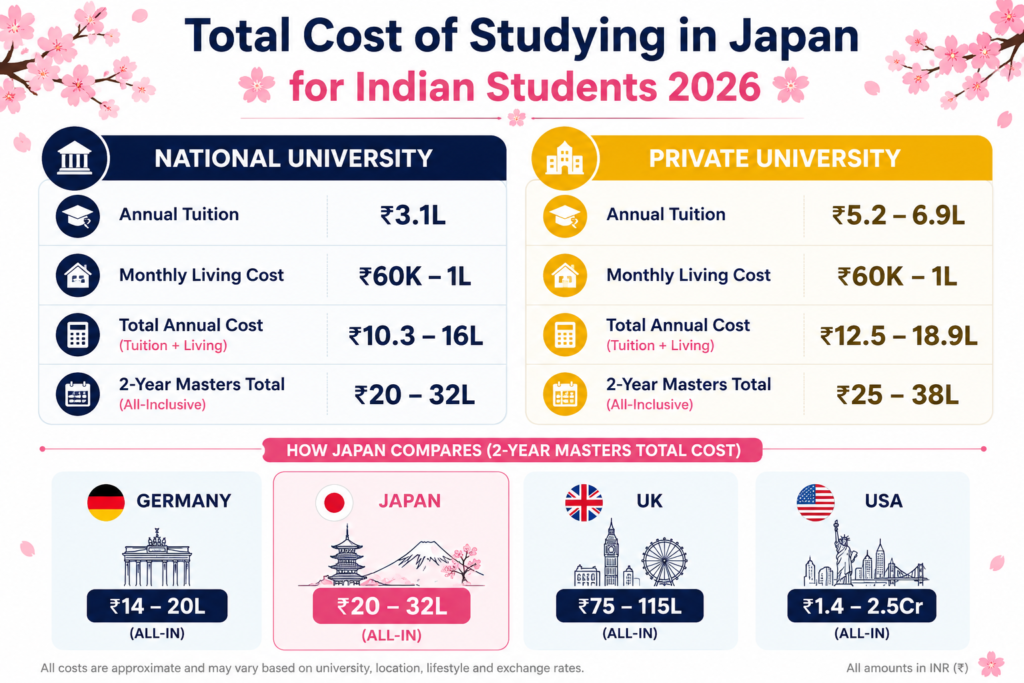
All figures converted at ₹0.58/JPY (May 2026). Source: JASSO, individual university fee schedules, Tokyo Metropolitan Government living cost data.
Tuition Fees
University Type | Annual Tuition (JPY) | Annual Tuition (INR) | Examples |
|---|---|---|---|
National University (public) | ¥535,800 | ~₹3.1 lakh/year | University of Tokyo, Kyoto, Osaka, Tohoku, Tsukuba |
Public University (prefectural) | ¥535,800–600,000 | ~₹3.1–3.5 lakh/year | Tokyo Metropolitan, Osaka Prefecture |
Private University | ¥900,000–1,200,000 | ~₹5.2–6.9 lakh/year | Waseda, Keio, Sophia, Ritsumeikan |
Graduate School (national) | ¥535,800 | ~₹3.1 lakh/year | Most national university master’s programs |
Entrance Examination Fee | ¥30,000 | ~₹17,400 | One-time, at application |
Admission Fee (first year only) | ¥282,000 | ~₹1.6 lakh | One-time national university fee |
Monthly Living Expenses in Japan — INR Breakdown
Expense Category | Tokyo (JPY/month) | Tokyo (INR/month) | Other Cities (INR/month) |
|---|---|---|---|
Accommodation (shared/student dormitory) | ¥40,000–65,000 | ₹23,200–37,700 | ₹15,000–28,000 |
Food & Groceries | ¥25,000–40,000 | ₹14,500–23,200 | ₹12,000–20,000 |
Public Transport | ¥10,000–15,000 | ₹5,800–8,700 | ₹3,500–7,000 |
Health Insurance (National) | ¥2,000–3,000 | ₹1,160–1,740 | ₹1,160–1,740 |
Mobile + Internet | ¥3,000–5,000 | ₹1,740–2,900 | ₹1,500–2,500 |
Books & Academic Materials | ¥5,000–8,000 | ₹2,900–4,640 | ₹2,000–4,000 |
Miscellaneous / Personal | ¥10,000–15,000 | ₹5,800–8,700 | ₹4,000–7,000 |
TOTAL | ¥95,000–151,000 | ₹55,100–87,600 | ₹39,160–70,240 |
Total Investment — 2-Year Master’s in Japan vs Competing Destinations
Destination | Tuition (2 yrs) | Living (2 yrs) | All-In Total (INR) |
|---|---|---|---|
Japan — National University | ₹6.2–7.2 lakh | ₹14–21 lakh | ₹20–28 lakh |
Japan — Private University | ₹10.4–13.8 lakh | ₹14–21 lakh | ₹24–35 lakh |
Germany — Public University | ₹2–8 lakh (admin fees only) | ₹14–20 lakh | ₹16–28 lakh |
UK — 1-Year Master’s | ₹28–45 lakh | ₹18–26 lakh | ₹46–71 lakh |
Canada — 2-Year Master’s | ₹20–38 lakh | ₹18–28 lakh | ₹38–66 lakh |
USA — 2-Year Master’s (state uni) | ₹35–60 lakh | ₹22–32 lakh | ₹57–92 lakh |
Australia — 2-Year Master’s | ₹22–40 lakh | ₹18–28 lakh | ₹40–68 lakh |
The honest cost comparison between Japan and Germany: When living costs are included, Japan and Germany are comparable — both cost ₹20–28 lakh for a 2-year national/public university Master’s. However, Germany’s post-graduation earning potential in EUR and faster PR pathway (21 months on EU Blue Card) give it a stronger long-term ROI. Japan’s cost advantage over UK, Canada, USA, and Australia is real and significant. Japan is NOT the cheapest option overall — but it is competitive with Germany when total cost is counted. The yen’s recent weakness has made Japan 20–30% more affordable for Indian students compared to 2019. This is a genuine current advantage. |
Section 4: Top Universities in Japan for Indian Students 2026
Japan has 5 universities in the QS World Top 200, and 3 in the global top 100 — more than most countries Indian students consider. Here are the most relevant ones for Indian applicants:
University | QS 2026 Rank | Location | Strengths for Indian Students | English Programs (Masters) |
|---|---|---|---|---|
University of Tokyo (UTokyo) | 28 | Tokyo | Computer Science, Engineering, Life Sciences, Physics, AI | Yes — multiple English-medium programs |
Kyoto University | 46 | Kyoto | Life Sciences, Chemistry, Disaster Prevention, Bioinformatics | Yes — limited but growing |
Osaka University | 88 | Osaka | Engineering, Medicine, Economics, AI & Data Science | Yes — several Masters tracks |
Tohoku University | 137 | Sendai | Materials Science, Engineering, Physics, Environmental Studies | Yes — International Programs in English |
Tokyo Institute of Technology (Institute of Science Tokyo) | 168 | Tokyo | Engineering, Computer Science, AI, Robotics, Materials | Yes — strong English MS programs |
Nagoya University | 175 | Nagoya | Engineering, Automotive, Molecular Biology | Yes — English graduate programs |
University of Tsukuba | ~301–350 | Ibaraki (near Tokyo) | Sports Science, Computer Science, Biology, Social Sciences | Yes — English programs widely available |
Waseda University (Private) | ~401–450 | Tokyo | Business, Politics, Engineering, International Studies | Yes — strongest English offering among privates |
Keio University (Private) | ~401–450 | Tokyo | Business, Medicine, Engineering, Law | Yes — SFC campus fully English-medium |
How to find English-taught programs in Japan: The MEXT-sponsored Global 30 and Top Global University Project programs are specifically designed for international students and are almost entirely English-medium. Tohoku University’s International Programs in English (IPE) and the University of Tsukuba’s Master’s programs are widely considered the most India-friendly in terms of English content and support infrastructure. Always verify current English program status directly on the university website before applying — program availability changes annually. |
Section 5: MEXT Scholarship 2026 — The One Thing That Makes Japan Genuinely Unbeatable
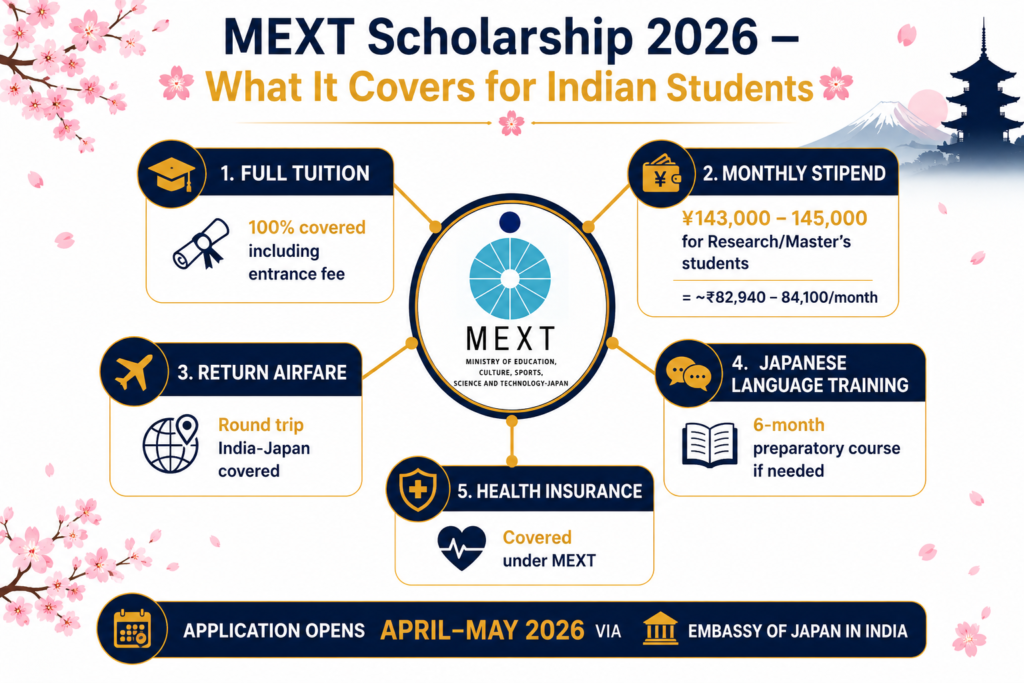
The MEXT (Monbukagakusho) Scholarship is the Japanese Government’s flagship funding program — and for Indian students who win it, it makes Japan the single most affordable and comprehensive study-abroad option in the world.
What MEXT Covers — The Full Package
MEXT Benefit | Details | Value in INR |
|---|---|---|
Full tuition waiver | 100% of tuition including entrance and examination fees | ₹6.2–8.5 lakh saved over 2 years |
Monthly living stipend (Master’s/Research) | ¥143,000–145,000/month | ~₹82,940–84,100/month — covers full living costs |
Round-trip airfare | Economy class India-Japan and return | ~₹60,000–90,000 saved |
Japanese language training | 6-month preparatory Japanese course if required | ₹50,000–1 lakh saved |
Health insurance contribution | Covered or substantially subsidised | ₹10,000–15,000/year saved |
TOTAL value over 2-year Master’s | Tuition + stipend + airfare + language | ~₹22–24 lakh in total benefit over 2 years |
How to Apply for MEXT 2026 — Two Routes
Route | How It Works | Pros | Who Should Choose This |
|---|---|---|---|
Embassy Recommendation Route | Apply through the Embassy of Japan in India (New Delhi). Embassy screens, tests, and recommends to MEXT Japan. Application opens April–May 2026. | Most accessible; no prior Japanese university contact needed; transparent process | Students without specific Japanese university contacts; first-time Japan applicants; undergraduates |
University Recommendation Route | A Japanese university (which you have already contacted independently) nominates you to MEXT. | Higher acceptance rate if you have a strong faculty relationship; more research-aligned | PhD applicants; students with specific research proposals and established professor contact |
MEXT 2026 Eligibility for Indian Students
- Age: Under 35 years at time of application for research students; under 25 for undergraduate track
- Academic: 65–70% or above in the last completed degree (varies by track and embassy evaluation)
- Nationality: Indian citizens — apply through Embassy of Japan in India
- Japanese language: NOT mandatory at application stage — but JLPT N4 or N5 significantly improves your written exam performance and embassy interview outcome
- English proficiency: IELTS or TOEFL not always mandatory — your undergraduate academic records may be sufficient for English-taught programs
The honest MEXT competition reality: The Embassy written examination covers Japanese language (including for applicants who have never studied Japanese), Mathematics, and Science. Students with JLPT N4 or N5 perform significantly better. The scholarship is awarded for a full degree program — if you qualify, you receive complete funding with no conditions attached to your academic performance (beyond standard university requirements). University Recommendation route has no fixed quota per country and can be more accessible for PhD-level applicants with strong research proposals and faculty connections. Strategic advice: Begin MEXT preparation 12–18 months before the application window opens. Start Japanese language study immediately — even N5 gives you a measurable advantage in the written examination. |
Section 6: The J-Find Visa — Japan’s Game-Changer for IIT and IIM Graduates
This is the most important 2026 development that almost no Indian student knows about: Japan’s J-Find (Future Creation Individual) Visa specifically benefits graduates of top Indian institutions including IITs and IIMs.
Announced as part of Japan’s strategy to attract highly skilled global graduates, the J-Find Visa allows graduates of Japan-designated top global universities to enter Japan for up to 2 years to look for a job, start a business, or engage in other economic activities — without a job offer and without any Japanese language requirement.
J-Find Visa Feature | Details for Indian Graduates 2026 |
|---|---|
What it is | A 2-year job-search and entrepreneurship visa for graduates of designated top global universities |
Eligible Indian institutions | IITs, IIMs, IISc, and other NIRF top-ranked institutions designated by Japan MHLW |
Japanese language requirement | NONE — the J-Find Visa does not require JLPT at any level |
What you can do | Job search, start a business, freelance work, network — full economic activity permitted |
Duration | Up to 2 years in Japan without a specific employer sponsor |
Conversion | Upon securing employment, convert to standard work visa (Engineer/HSP/Highly Skilled Professional) |
PR pathway from J-Find | Convert to HSP (Highly Skilled Professional) visa → PR in 1–3 years depending on HSP points score |
Who qualifies | Recent graduates of designated global universities — IIT graduates are specifically listed |
Difference from MEXT | J-Find is for WORKING in Japan, not studying. Combine: study via MEXT → work via J-Find or direct work visa |
How IIT/IIM graduates can use J-Find strategically in 2026: If you want to study in Japan first, complete your Master’s at a Japanese university, then transition to a work visa or HSP visa upon employment — the J-Find pathway is available for those from qualifying institutions who want an additional option. The J-Find Visa is Japan’s direct signal that it wants Indian STEM talent. For IIT graduates specifically, this is a first-mover advantage in a market where Indian students are still a small but growing cohort. Contact the Embassy of Japan in India (japanembassy.gov.in) for the current designated institution list and application procedure — the J-Find Visa documentation requirements are available on the official Japanese Ministry of Foreign Affairs website. |
Section 7: Jobs, Work Visa & PR in Japan After a Master’s Degree — The Honest Picture
This is where the Japan story gets complicated — and where most blogs fail to give Indian students an honest picture. Japan has abundant job opportunities for STEM graduates and an ageing population that actively needs foreign talent. But the path from graduation to permanent residency has a significant language barrier that students must plan for before enrolling.
Post-Graduation Pathway in Japan
Stage | What Happens | Timeline | Language Requirement |
|---|---|---|---|
Graduate from Japanese university | Apply to change visa status from ‘Student’ to ‘Designated Activities’ (job-seeking) | After graduation | None for visa change — JLPT not required at this stage |
Job-seeking visa | Designated Activities visa for job searching — 3–6 months renewable | Up to 1 year total | JLPT N2 required by April 2027 for Engineer/Specialist work visa — plan ahead |
Engineer/Specialist in Humanities Visa | Standard work visa once employed. NOTE: Japanese language requirement for this visa taking effect April 2027 | Immediately on job offer | JLPT N2 required from April 2027 (current policy — verify latest from Japan ISA) |
Highly Skilled Professional (HSP) Visa | Points-based work visa — 70+ HSP points unlocks PR in 3 years; 80+ points in 1 year | Any time with qualifying offer | No Japanese required for HSP — points-based system rewards skills and salary instead |
Permanent Residency (PR) | Standard: 10 years continuous residence | HSP standard: 3 years | HSP 80+ points: 1 year | 1–10 years depending on route | Japanese language encouraged but not legally mandatory for standard PR (good conduct + financial stability required) |
The HSP Points System — How Indian Students Score
HSP Points Factor | Typical Indian Master’s Graduate | Points |
|---|---|---|
Academic qualification (Master’s degree) | Master’s from a Japanese top 10 university | 20 points |
Age (under 30) | 25-year-old graduate | 15 points |
Annual salary (¥4 million / ~₹23L) | Entry-level tech role in Tokyo | 10 points |
Japanese language proficiency (N1) | Achievable with 2 years serious study | 15 points |
Graduated from a designated university (UTokyo, Tohoku etc.) | Yes if from listed institution | 10 points |
Worked for a designated highly innovative company in Japan | Available at major Japanese tech firms | 10 points |
Typical total for a well-prepared Indian graduate | 70+ points — enables PR in 3 years | 80+ points — PR in 1 year | 70–85 points |
The language barrier — the most critical honest assessment in this guide: JLPT N2 is not beginner Japanese. It requires reading newspapers, understanding office conversations without preparation, and writing professional emails in Japanese. Most Indian students who do not start before or immediately upon arrival will not achieve N2 by graduation. Students who do NOT achieve JLPT N2 will need to target the HSP (Highly Skilled Professional) Visa instead — which has no language requirement but requires a salary of ¥4 million+ (~₹23 lakh/year) and strong HSP points score. The honest advice: if you are serious about staying in Japan after graduation, start learning Japanese before departure. Enroll in a JLPT N5 course in India, reach N3 by end of year 1, and N2 by graduation. This is achievable — but only with a structured plan that begins immediately. |
Top Sectors Hiring Indian Graduates in Japan 2026
Sector | Japan’s Demand | Salary Range (JPY/year) | Salary (INR/year) |
|---|---|---|---|
IT / Software Engineering | Very high — critical shortage in digital transformation | ¥4.5–8 million | ₹26–46 lakh |
AI / Machine Learning / Data Science | Very high — national AI strategy driving demand | ¥5–10 million | ₹29–58 lakh |
Robotics / Automation | High — Japan global leader | ¥4.5–8 million | ₹26–46 lakh |
Semiconductor / Electronics Engineering | Very high — TSMC, Samsung, domestic fabs expanding | ¥5–9 million | ₹29–52 lakh |
Life Sciences / Biomedical Research | Growing — aging population drives demand | ¥4–7 million | ₹23–41 lakh |
Civil / Structural Engineering | High — infrastructure rebuilding post-earthquake programmes | ¥4–6.5 million | ₹23–37 lakh |
Finance / Fintech (English-medium firms) | Moderate — primarily Tokyo-based global firms | ¥5–9 million | ₹29–52 lakh |
Section 8: Japan Student Visa — Step-by-Step for Indian Students 2026
Step | Action | Timeline | Notes |
|---|---|---|---|
1 | Receive admission letter + COE (Certificate of Eligibility) from Japanese university | 8–12 weeks after acceptance | University applies for COE on your behalf — this is mandatory before visa application |
2 | Submit student visa application at VFS Japan Visa Application Centre in India | After COE arrives | Visa centres in Delhi, Mumbai, Chennai, Kolkata, Bengaluru, Hyderabad, Ahmedabad |
3 | Visa processing | 3–5 working days after document submission | Much faster than most countries — Japan student visa is typically straightforward |
4 | Arrive in Japan, register at local municipal office (within 14 days) | Within 2 weeks of arrival | Resident Registration (Jyumin Kihon Daicho) — mandatory; gives you My Number card |
5 | Register with National Health Insurance | Within first month | Monthly premium: ¥2,000–3,000 for students (₹1,160–1,740) |
Documents Required for Japan Student Visa
- Valid passport (minimum 6 months validity beyond program end date)
- Certificate of Eligibility (COE) — issued by Japanese immigration via your university
- Application form (download from Embassy of Japan website)
- Photograph (4.5cm x 4.5cm, white background — Japanese standard differs from Indian passport photo)
- Financial proof — bank statements showing ₹12–15 lakh or proof of scholarship
- Admission letter from Japanese university
- Academic transcripts and degree certificates (with official English translations if originals are in regional language)
Part-Time Work Rights for Indian Students in Japan
Rule | Details 2026 |
|---|---|
Permitted weekly hours | 28 hours per week during academic term | Full-time during designated vacation periods |
Authorisation required | Apply for ‘Permission to Engage in Activity Other than That Permitted’ at immigration office on arrival |
Minimum wage 2026 | ¥1,004/hour (Tokyo) — approximately ₹583/hour | National average: ¥961/hour (~₹558/hour) |
Monthly earnings (28 hrs/week) | ¥112,448/month (~₹65,200/month in Tokyo) |
Types of work available | Convenience stores (konbini), restaurants, tutoring, university research assistant (RA), IT part-time |
Tax on part-time earnings | Income below ¥1,030,000/year (~₹5.97 lakh) — exempt from income tax under 2026 rule |
Section 9: The Real Challenges — What Every Indian Student Must Know Before Choosing Japan
This section is the most important in the guide. Every destination has challenges — but Japan’s challenges are specific, structural, and frequently underestimated by Indian students.
Challenge 1: The Japanese Language Wall
This is not a small hurdle. Japanese is consistently rated as one of the hardest languages in the world for English speakers. JLPT N2 — required for the most common post-study work visa from April 2027 — takes most motivated learners 1,000–1,200 hours of structured study from zero. That is roughly 2.5 hours per day for 14 months without a break, on top of a full-time Master’s program.
Realistic language learning timeline from zero (starting in India): JLPT N5 in India before departure (3–4 months) → N4 by end of semester 1 → N3 by end of year 1 → N2 by graduation. This is achievable — but only if you start immediately and treat it as a parallel full-time commitment alongside your studies.
Challenge 2: Japan’s Hiring Culture Is Fundamentally Different
Japan’s shinsotsu ikkatsu saiyou (new graduate mass hiring) system hires most employees in April for an April start — and the application process begins 12–18 months before graduation. Indian students who are not culturally prepared for this process, who cannot participate in company orientation sessions in Japanese, or who apply too late miss the primary hiring cycle entirely.
What this means practically: Job searching in Japan is not like applying in India or the West. You need to attend company briefing sessions (company visits, gaishoku, online sessions), submit a Japanese-format resume (rirekisho), complete group discussions (GD) in Japanese at many firms, and pass multiple interview rounds that test cultural fit as much as technical skill.
Challenge 3: Indian Food and Social Life Requires Adjustment
Japan is not a vegetarian-friendly country. Finding halal or pure vegetarian food options requires active research and planning — Tokyo and major university cities have options, but smaller cities have very limited availability. Indian students consistently report that dietary adjustment is one of their top day-to-day challenges, particularly in the first 6 months.
Challenge 4: The Workplace Culture Gap
Japanese workplace culture places significant emphasis on group harmony (wa), hierarchy, long working hours, and non-verbal communication. Indian professionals trained in a more assertive, individual-contribution culture frequently report a cultural adjustment period of 6–12 months when entering Japanese companies. This is not insurmountable — but it requires deliberate preparation and a willingness to adapt.
Challenge 5: PR Pathway Is Slower Than Canada or Germany
Standard PR in Japan requires 10 years of continuous residence. HSP (Highly Skilled Professional) visa holders can qualify in 3 years (70+ HSP points) or 1 year (80+ points) — but this requires a salary of ¥4 million+ and a points score that demands either Japanese language proficiency, a top-ranked university degree, or exceptionally high earnings.
Comparison: Germany’s EU Blue Card gives PR in 21 months. Canada’s Express Entry gives PR in 2–3 years. Japan’s fastest legal route (HSP 80+ points) gives PR in 1 year — but reaching 80+ HSP points requires either JLPT N1, a salary of ¥8 million+, or a combination of factors that most fresh graduates cannot meet immediately.
Section 10: Japan vs Germany, Canada & Australia for Indian Students — Honest 2026 Scorecard
Criteria | Japan | Germany | Canada | Australia |
|---|---|---|---|---|
Total 2-yr Master’s cost (INR) | ₹20–32 lakh | ₹16–28 lakh | ₹38–66 lakh | ₹40–68 lakh |
English-taught programs | Growing — but limited at top schools | Strong — most Masters have English tracks | Full English — no local language needed | Full English — no local language needed |
Language barrier for jobs | HIGH — JLPT N2 from April 2027 for standard visa | MEDIUM — B1 German helps; not legally required | LOW — English sufficient | LOW — English sufficient |
Post-study work visa | Job-seeker: 3–6 months + standard work visa | 18-month job-seeker visa (very flexible) | PGWP up to 3 years (excellent) | 485 Temporary Graduate: 2–4 years |
PR timeline (realistic) | 3–10 years (HSP: 1–3 years with high score) | 21 months (EU Blue Card + B1 German) | 2–3 years (Express Entry) | 3–5 years (GSM points) |
Part-time work earnings (INR/month) | ~₹65,000 (28 hrs, Tokyo minimum wage) | ~₹95,000 (20 hrs, €12.82/hr) | ~₹98,500 (24 hrs, CAD $16.75/hr) | ~₹1,32,000 (24 hrs, AUD $24.95/hr) |
University ranking quality | 5 in QS Top 200 — excellent STEM research | 9 in QS Top 200 — excellent STEM research | Good — 3 in QS Top 200 | Good — 5 in QS Top 200 |
MEXT / Full scholarship availability | YES — MEXT is among the world’s best scholarships | DAAD is strong but lower stipend | Limited full scholarships | Limited full scholarships |
Best for Indian students in: | STEM, robotics, AI, materials; MEXT applicants; IIT/IIM J-Find | Engineering, CS; cost-focused; European PR goal | English STEM; PR as primary goal; families | Lifestyle; healthcare; construction; regional study |
Section 11: Should You Study in Japan? — Your Personal Decision Checklist
Japan is the right choice if you tick at least 4 of these 6 boxes:
- ✅ You are in engineering, CS, AI, robotics, materials science, life sciences, or automotive — fields where Japan’s universities and industry are genuinely world-leading
- ✅ You are applying for the MEXT Scholarship — if you win it, Japan becomes the most financially efficient study-abroad decision in the world
- ✅ You are an IIT or IIM graduate who qualifies for the J-Find Visa — this gives you a 2-year job-search window in Japan without a job offer or language requirement
- ✅ You are committed to learning Japanese to at least JLPT N3 during your degree and N2 before graduation — you have a specific, structured plan to do so
- ✅ You are genuinely drawn to Japan’s culture, work environment, and lifestyle — not just the cherry blossoms, but the discipline, the work ethic, and the long-term integration into Japanese society
- ✅ You are comparing Japan with Germany specifically — both are comparable in cost; Japan wins on culture and research culture; Germany wins on PR speed and EU mobility
Japan is NOT the right choice if you tick 3 or more of these:
- ❌ Your primary goal is permanent residency within 3 years — Canada’s Express Entry or Germany’s EU Blue Card are significantly faster
- ❌ You are not prepared to learn Japanese beyond a survival level — without N2 from April 2027, the standard work visa route closes
- ❌ You are targeting MBA, business management, law, or humanities — Japan’s English-medium offerings in these fields are limited; UK, Canada, or USA are stronger
- ❌ You need the highest possible part-time earnings during study — Australia and Canada pay significantly more per hour
- ❌ You are in a hurry — Japan’s admission process, COE, and cultural adaptation all take time; Germany and Canada have faster, more streamlined admission pathways
Frequently Asked Questions — Studying in Japan for Indian Students 2026
1. Is Japan a good study destination for Indian students in 2026?
Japan is an excellent destination for Indian students in specific circumstances: STEM fields (engineering, robotics, AI, materials science), MEXT scholarship applicants, and IIT/IIM graduates who qualify for the J-Find Visa. For students who want English-medium education, clear PR pathways, and no language barrier to employment, Canada, Germany, or Australia are more practical choices.
2. Can I study in Japan without knowing Japanese?
Yes — many top Japanese universities now offer English-medium Master’s and PhD programs, particularly at Tohoku, Tsukuba, Osaka, and Tokyo Institute of Technology. You can complete your degree in English. However, finding a job at a Japanese company after graduation is extremely difficult without at least JLPT N3, and from April 2027, the standard Engineer/Specialist work visa requires JLPT N2. Learning Japanese is not mandatory for study — but it is effectively mandatory for staying and working after graduation.
3. How much does it cost to study in Japan for Indian students in 2026?
At a national (public) university, annual tuition is approximately ₹3.1 lakh. Monthly living costs are ₹55,000–87,600 depending on city. The total all-in cost for a 2-year Master’s at a national university is approximately ₹20–28 lakh — comparable to Germany, significantly cheaper than Canada, Australia, UK, or USA. If you receive the MEXT Scholarship, your total cost is effectively zero — the scholarship covers tuition, living stipend (~₹83,000/month), and airfare.
4. What is the MEXT Scholarship and how do I apply from India?
The MEXT (Monbukagakusho) Scholarship is the Japanese Government’s flagship scholarship for international students. It covers 100% of tuition, provides a monthly living stipend of approximately ¥143,000–145,000 (~₹83,000–84,000), and includes return airfare. Indian students apply through the Embassy Recommendation Route (opening April–May each year at the Embassy of Japan in India) or the University Recommendation Route (via a specific Japanese university’s nomination). Japanese language proficiency is not mandatory at application but significantly improves outcomes in the written examination and interview.
5. What is the J-Find Visa and do IIT graduates qualify?
The J-Find (Future Creation Individual) Visa allows graduates of Japan-designated top global universities — including IITs and IIMs — to enter Japan for up to 2 years to find a job, start a business, or engage in economic activities, without a job offer and without any Japanese language requirement. It is one of Japan’s most significant new immigration measures specifically designed to attract Indian STEM talent. IIT graduates should contact the Embassy of Japan in India to confirm their institution is on the current designated list and to obtain current application requirements.
6. How long does it take to get PR in Japan after a Master’s degree?
The standard PR (Permanent Residency) timeline in Japan is 10 years of continuous legal residence. However, the Highly Skilled Professional (HSP) Visa offers a fast-track route: 70+ HSP points enables PR in 3 years; 80+ HSP points enables PR in 1 year. Building an 80+ HSP score requires a combination of: Master’s degree from a top Japanese university (20 points), age under 30 (15 points), high salary ¥8M+ (25 points), and/or JLPT N1 (15 points). Most fresh graduates reach 70+ points first, targeting PR in 3 years from employment start.
7. Is Japan’s PR pathway competitive with Canada or Germany for Indian students?
No — for most Indian students, Canada and Germany offer faster and more predictable PR pathways. Canada’s Express Entry gives PR in 2–3 years after graduation. Germany’s EU Blue Card gives PR in 21 months with B1 German. Japan’s HSP fast-track gives PR in 1–3 years but requires either a very high salary or JLPT language proficiency that takes years to achieve. For Indian students whose primary goal is PR and settlement, Canada or Germany are the recommended choices. Japan is the right choice when the education experience, research environment, and career in Japan are the primary motivations.
Related Guides on GlobalEd — Read These Alongside This Japan Guide
- Study in Germany 2026: Free Education, PR Pathways & Top Universities for Indian Students → [Link to Germany blog on GlobalEd]
- PR After Masters Abroad 2026: Which Country Gives Permanent Residency Fastest for Indian Students? → [Link to PR blog]
- Top 15 Fully Funded Scholarships for Indian Students Studying Abroad in 2026 → [Link to scholarships blog]
- SOP Writing Guide 2026: How to Write a Statement of Purpose That Gets You Admitted → [Link to SOP guide]
- Part-Time Work for Indian Students Abroad 2026: Real Earnings Guide → [Link to part-time work blog]
Authoritative Sources & External References
1. JASSO — Japan Student Services Organisation: Study in Japan Guide — Official database of English-taught programs, scholarships, and living cost data for international students in Japan
2. Embassy of Japan in India — MEXT Scholarship Official Page — Official MEXT Scholarship application information for Indian students
3. Japan Immigration Services Agency — HSP Visa and Points System — Official HSP points calculation and PR fast-track pathway
4. Ministry of Foreign Affairs Japan — J-Find Visa Official Information — Official J-Find Visa eligibility including designated global university list
5. QS World University Rankings 2026 — Japan — University ranking reference for Japanese institutions
6. Tokyo Metropolitan Government — Living Costs for International Students — Official Tokyo living cost data used for expense estimates in this guide
Conclusion: Japan in 2026 — Hidden Gem for the Right Indian Student, Overhyped for Everyone Else
Japan is a genuinely extraordinary study destination — but it is not the right destination for every Indian student, and any counsellor or blog that tells you otherwise is doing you a disservice.
Japan is a hidden gem for Indian students who: are in STEM, are applying for MEXT, are IIT/IIM graduates eligible for J-Find, are willing to learn Japanese seriously, and are drawn to building a career in one of the world’s most advanced technology ecosystems.
Japan is overhyped for Indian students who: prioritise PR speed above all else, are not willing to invest in Japanese language, are targeting English-only career environments, or are comparing purely on cost — in which case Germany is cheaper, simpler, and faster to settle in.
The yen’s weakness, Japan’s expanding English programs, the J-Find Visa for IIT graduates, and the MEXT Scholarship collectively make 2026 the best year in a generation to apply to Japan. But only if the fit is right for you specifically.
At GlobalEd, our counsellors build personalised destination comparisons for Indian students across Japan, Germany, Canada, UK, Australia, and the USA — based on your specific academic profile, budget, career goals, and settlement priorities. Our counselling is free, honest, and based on real data.
→ Book Your Free Japan vs Germany vs Canada Counselling Session
→ Download the Free Japan Study Abroad Checklist 2026 for Indian Students

