

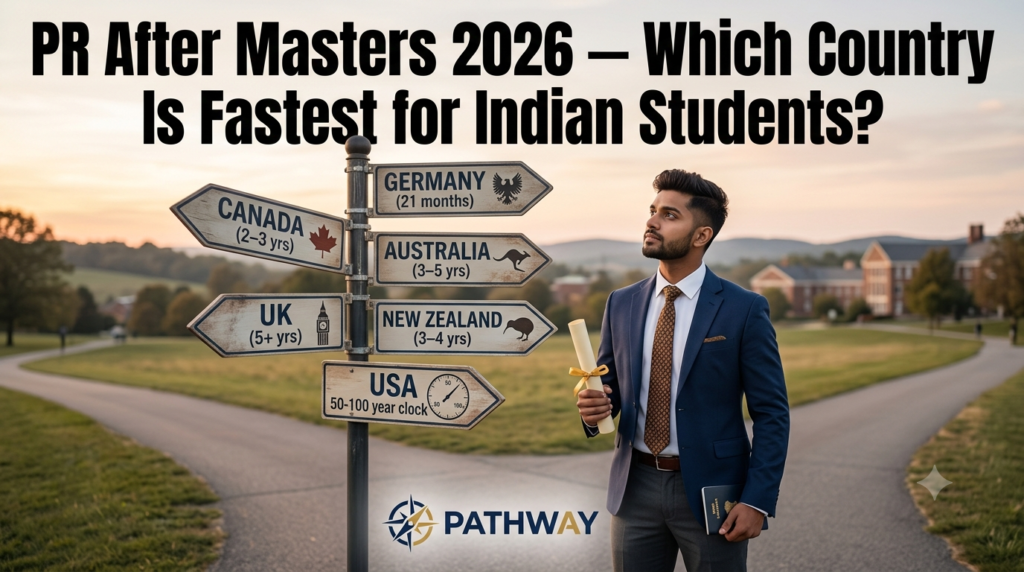
The single most important question driving every Indian family’s study-abroad decision in 2026 is not rankings, tuition, or even salary — it is PR after masters for Indian students: which country will actually let you stay, settle, and build a life after you graduate?
And it is the right question to ask first. Spending ₹60 lakh to ₹2.5 crore on a foreign master’s degree and then being forced out of the country because your visa expired, your H-1B lottery failed, or the immigration rules changed overnight is a financial and personal catastrophe that thousands of Indian students have lived through in the past decade.
In 2026, the landscape has shifted dramatically. The USA’s F-1 rejection rate for Indian students has hit 61 percent. Canada’s study permit approvals have tightened significantly. Australia has classified Indian applicants at Evidence Level 3. The UK is planning to reduce its Graduate Route from 2 years to 18 months from January 2027.
But within this tightening environment, three countries still offer clear, structured, and achievable PR pathways for Indian master’s graduates — with Germany now offering the fastest timeline of any country in the world. This guide gives you the real 2026 numbers, the complete visa-to-PR roadmap for each country, and a decision framework built specifically for Indian graduates.
Want to know which country’s PR pathway fits your profile? Book a free 30-minute PR pathway counselling session with GlobalEd. Personalised plan — zero cost.
Section 1: Why You Must Plan Your PR Pathway Before Choosing a University — Not After
Most Indian students choose a university based on rankings, then a country based on cost, and think about PR when their visa is about to expire. This is the single biggest strategic mistake in study-abroad planning — and it costs students years of their life and lakhs of rupees.
Here is why planning backwards — starting with your PR goal and working back to your university choice — produces dramatically better outcomes:
- Immigration rules change constantly. The PR pathway that exists when you apply may not exist when you graduate 2 years later. Students who built their plans around 2022 Canada rules are graduating in 2024 into a completely different immigration environment.
- Not all universities in a country give the same PR access. In Canada, only graduates of DLI-listed programs on the eligible CIP code list qualify for PGWP. In Germany, graduates of public universities access the EU Blue Card more easily than private university graduates.
- Your occupation matters as much as your degree. Australia’s General Skilled Migration points system rewards graduates in specific ANZSCO-listed occupations. Choosing the wrong degree for the Australian market costs you 10–20 points on the SkillSelect scorecard.
- Timeline certainty has a financial value. Canada and Germany offer predictable, points-based PR pathways. The USA offers a lottery and a 100-year wait. That certainty is worth planning for — even if another country seems more prestigious.
Section 2: The Complete 2026 PR Comparison — All Countries at a Glance
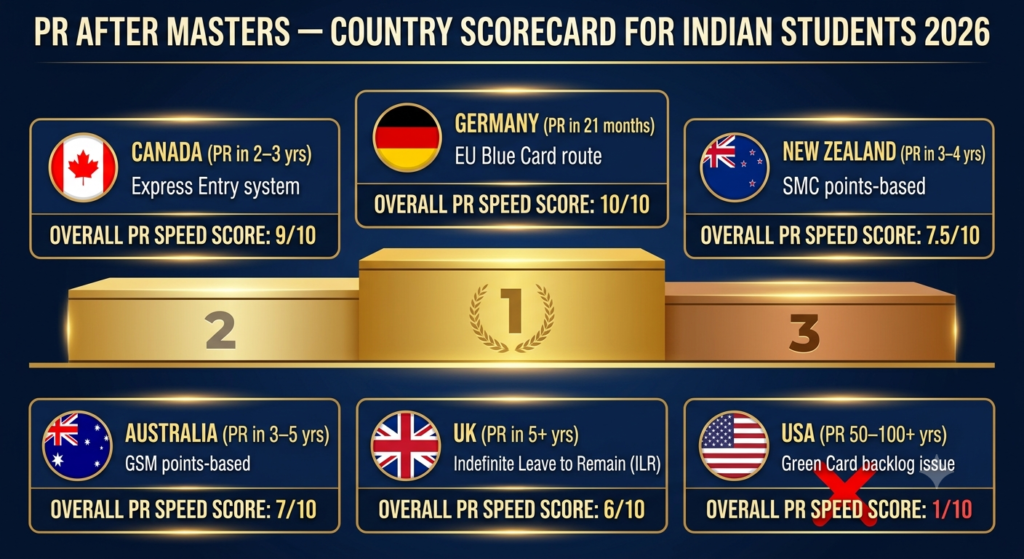
Country | Post-Study Work Visa | Minimum PR Timeline | PR Route | Employer Needed? | Language for PR? | 2026 Difficulty for Indians |
|---|---|---|---|---|---|---|
🇩🇪 Germany | 18-month Job Seeker Visa | 21 months (EU Blue Card + B1 German) | EU Blue Card → Niederlassungserlaubnis | Yes — for Blue Card | B1 German for 21-month route | Low — 95%+ visa approval rate |
🇨🇦 Canada | PGWP up to 3 years | 2–3 years after graduation | Express Entry / PNP | No — open work permit | English (already have) | Moderate — permits reduced but pathway clear |
🇳🇿 New Zealand | PSWV up to 3 years | 3–4 years after graduation | Skilled Migrant Category (points) | No — points-based | English (already have) | Low-Moderate — less competition than AU/CA |
🇦🇺 Australia | Subclass 485: 2–4 years | 3–5 years after graduation | General Skilled Migration (points) | No — points-based | English 7.0+ (already have) | Moderate — Evidence Level 3 for Indians |
🇬🇧 UK | Graduate Route: 2 yrs (apply by Dec 2026) / 18 months from Jan 2027 | 5+ years (ILR = 5 yrs legal residence) | Skilled Worker → ILR | Yes — Skilled Worker sponsor | English (already have) | Moderate-High — long timeline, employer dependent |
🇺🇸 USA | OPT 1yr + STEM OPT 3yrs | 50–100+ years (EB-2 India backlog) | H-1B → EB-2/EB-3 Green Card | Yes — H-1B sponsor + lottery | English (already have) | Very High — lottery + century-long wait |
Sources: BAMF Germany EU Blue Card rules 2026 | IRCC Canada PGWP guide | Immigration NZ Skilled Migrant | Australian DHA Subclass 485 | UK Home Office Graduate Route | USCIS EB-2 Visa Bulletin June 2026.
Section 3: Germany — Fastest PR in the World for Eligible Indian Graduates (21 Months)
Germany’s EU Blue Card gives Indian master’s graduates permanent residency in just 21 months — the fastest legal PR timeline of any country in this guide, faster than Canada, faster than Australia, faster than New Zealand, and incomparably faster than the USA.
And it comes at the lowest total cost of any destination: national university tuition is approximately ₹3.1 lakh per year, total all-in cost for a 2-year master’s is ₹20–28 lakh, and the post-graduation salary in a Blue Card role is €55,000–75,000 per year (~₹58–79 lakh).
Germany Study-to-PR Roadmap — Step by Step
Stage | What Happens | Timeline | Key Requirement |
|---|---|---|---|
1. Complete Master’s | Graduate from a recognised German university (public or accredited private) | 2 years | Valid student residence permit + APS certificate at entry |
2. Job Seeker Residence Permit | 18-month permit to find employment — full work rights, any employer | Immediately after graduation | Graduation certificate + proof of funds (€1,027/month) |
3. Secure EU Blue Card Employment | Job offer meeting salary threshold → Blue Card issued within weeks | On receiving job offer | Salary ≥ €45,300 (STEM/shortage) or €50,700 (all other fields) in 2026 |
4. Apply for PR (Niederlassungserlaubnis) | Permanent Residency granted | 21 months on Blue Card WITH B1 German OR 33 months WITHOUT German | 60 months pension contributions + financial independence + no criminal record |
5. German Citizenship | EU/German passport eligible | 5 years total legal residence (reform Oct 2025 — reduced from 8 years) | B1 German + integration test + financial independence |
EU Blue Card 2026 — The Key Numbers
Blue Card Factor | 2026 Detail |
|---|---|
Minimum salary — shortage occupations (STEM, healthcare, engineering) | €45,300/year (~₹47.6 lakh/year) |
Minimum salary — all other qualified occupations | €50,700/year (~₹53.3 lakh/year) |
PR with B1 German proficiency | 21 months after Blue Card issued |
PR without German language | 33 months after Blue Card issued |
Spouse family reunification | Immediate upon Blue Card issuance — spouse gets residence permit within weeks |
EU freedom of movement | Blue Card holders can work in any EU country after 18 months of residence in Germany |
Citizenship | 5 years total legal residence (reduced from 8 in October 2025 reform) |
Why Germany is the PR champion for Indian STEM graduates in 2026: Zero tuition at public universities means the total all-in investment (₹20–28 lakh for 2-year Master’s) is the lowest of any English-medium Western destination — making the PR ROI the highest. The Chancenkarte (Opportunity Card) allows IIT/IIM graduates to enter Germany for 2 years without a job offer to explore the market — a parallel entry route to the same Blue Card PR pathway. B1 German is achievable in 12 months with consistent study (start A1 in India before departure). This single investment unlocks the 21-month PR timeline and significantly improves salary negotiation. Germany has Europe’s largest economy, the strongest automotive-tech-engineering employer ecosystem, and 866,000+ highly skilled foreign professionals already working — making the job market genuinely accessible for Indian STEM graduates. |
PR timeline from Day 1 of studies to PR card: approximately 3.5–4 years. No lottery. No employer dependency. No per-country cap. Just qualification, employment, and time.
Section 4: Canada — The Most Structured English-Language PR Pathway for Indian Graduates
Canada’s Express Entry system remains the gold standard for study-to-PR pathways in an English-language environment. It is transparent, points-based, and does not depend on a lottery or a single employer’s sponsorship decision.
Canada Study-to-PR Roadmap — Step by Step
Stage | What Happens | Timeline | Key Requirement |
|---|---|---|---|
1. Complete Master’s | Graduate from a DLI (Designated Learning Institution) on the eligible CIP code list | 2 years | Full-time enrollment + active study permit |
2. Apply for PGWP | Post-Graduate Work Permit — work for ANY Canadian employer | Apply within 180 days of graduation: up to 3 years | Program must be on IRCC-eligible CIP code list; degree-level master’s is always eligible |
3. Build Skilled Work Experience | Work full-time in a NOC TEER 0, 1, 2, or 3 occupation | 12 months minimum | Full-time, paid, in-Canada skilled work with T4 slips and employer letters |
4. Enter Express Entry Pool | Create profile — CRS score calculated from age, education, language, and Canadian work experience | Ongoing — draws every 2 weeks | Active PGWP + IELTS CLB 7+ + Canadian work experience = competitive profile |
5. Receive ITA and Apply for PR | Invitation to Apply for Permanent Residence issued | 6–12 months processing after ITA | Police clearance, medicals, proof of funds (CAD $13,757 for single applicant) |
6. Become Permanent Resident | 5-year PR card issued — eligible for citizenship after 3 years of PR | 3–4 years total from first day of studies | Meet health and security admissibility requirements |
CRS Score Estimate for a Typical Indian Master’s Graduate in 2026
CRS Factor | Profile | Points |
|---|---|---|
Age (25–29 at ITA) | Most Indian MS graduates fall in this range | 110 points |
Education (Canadian Master’s) | Master’s completed at Canadian university | 135 points |
First language English (CLB 9+) | IELTS 7.5+ overall | 160 points |
Canadian work experience (1 year TEER 1) | 12 months in a skilled role after graduation | 80 points |
Subtotal — core human capital (no job offer, no nomination) | Competitive for category-based STEM draws | ~485 points |
Provincial Nomination (if secured) | PNP adds 600 CRS points — guaranteed ITA regardless of base score | 485 + 600 = 1,085 points |
STEM category draw (dedicated draw for tech/engineering occupations) | CRS cutoff: typically 470–490 for STEM category draws | Eligible at ~485 points |
2026 Critical Canada Updates Indian Students Must Know
Canada 2026 — What Has Changed: Canada study permit rejection rate: India’s study permit rejection rate has risen sharply in 2024-26. However, the rejection rate affects NEW applicants — not students already enrolled. Focus on a strong GIC, SOP, and financial documentation. Express Entry CRS cutoffs: Category-based draws (STEM, healthcare, French, trades) have dedicated lower cutoffs. Indian CS, data science, and engineering graduates are well-positioned for STEM-category draws. Provincial Nominee Programs: Ontario, BC, and Saskatchewan PNP streams remain active for master’s graduates. A provincial nomination adds 600 CRS points — making PR virtually guaranteed regardless of your base score. Spouse open work permit: Spouses of PGWP holders in Canada receive an open work permit — both partners can work for any employer simultaneously, a major family advantage over Germany or the UK. |
PR timeline from Day 1 of studies to PR card: 3–4 years. No lottery. Employer-independent. Family-inclusive. Citizenship possible 3 years after PR.
Section 5: Australia — A Points-Based PR Path That Rewards STEM, Regional Study & Strong English
Australia remains one of the most sought-after study-to-PR destinations for Indian students — but 2026 has brought tighter scrutiny that makes strategic planning more important than ever.
Australia Study-to-PR Roadmap — Step by Step
Stage | What Happens | Timeline | Key Requirement |
|---|---|---|---|
1. Complete Master’s | Graduate from a CRICOS-registered institution | 2 years | Valid Subclass 500 visa + strong Genuine Student statement |
2. Apply for Subclass 485 | Temporary Graduate Visa — work for any Australian employer | Apply within 6 months of graduation: 2–3 years (metro) or 3–4 years (regional/STEM programs) | AUD $1,895+ fee; Australian degree from eligible CRICOS institution |
3. Skills Assessment | Assessment by relevant authority — ACS for IT, Engineers Australia, CPA for accounting | 3–6 months — apply in your FINAL YEAR, not after graduation | Degree + experience documents + assessment fee (~AUD $500–800) |
4. Lodge EOI in SkillSelect | Expression of Interest in General Skilled Migration — score calculated | Ongoing — state/territory invitation rounds are periodic | Score 65+ points minimum; target 75–85 for competitive invitations |
5. State Nomination or Direct Invitation | State nomination (190 visa: +5 pts / 491 provisional: +15 pts) boosts score significantly | 6–18 months depending on state stream and occupation | Skilled work in nominated occupation + state residency requirements |
6. Lodge PR Application | Subclass 189 (independent) / 190 (state nominated) / 491 to 191 (regional) | 8–18 months processing | Full medicals, police clearance, health insurance history |
How Indian Master’s Graduates Score on the Australia Points Test 2026
Points Factor | Typical Indian Graduate Profile | Points |
|---|---|---|
Age (25–32 at time of invitation) | Most Indian MS applicants | 30 points |
English — Superior (IELTS 8+ overall) | Achievable with preparation — worth targeting for PR | 20 points (vs 10 for Proficient 7+) |
Australian Master’s degree | 2-year master’s from Australian university | 5 points |
Overseas skilled employment (3–5 years pre-study) | Working in relevant field before going to Australia | 10 points |
Australian skilled employment (1 year post-graduation) | Working on 485 visa in ANZSCO-listed skilled occupation | 10 points |
Regional study (studied outside major cities) | Geelong, Wollongong, Cairns, regional campuses | 5 points |
State/territory nomination (Subclass 190) | State government nominates you | 5 points |
Typical competitive total for Indian STEM graduate | Without partner points or community language bonus | 75–85 points |
Australia 2026 — Changes Indian Students Must Know: Subclass 485 fee increase: The Temporary Graduate Visa application fee has increased significantly in 2026. Verify the current fee at immi.homeaffairs.gov.au before budgeting for post-graduation. ACS assessment backlog: IT skills assessments from ACS are taking 6–9 months in 2026. Apply for your skills assessment in your FINAL YEAR of study — not after graduation. A 6-month ACS delay wastes 6 months of your 485 visa. Regional advantage is real: Studying in regional Australia adds 5 points to your SkillSelect score AND extends your 485 visa duration by 1–2 years. Students who choose Wollongong, Deakin (Geelong), James Cook (Cairns), or Charles Sturt (Albury) gain a measurable PR advantage over metro-city students. Occupations in demand: Software engineers, registered nurses, civil engineers, accountants, and construction project managers are on priority lists — these occupations receive faster state nomination invitations. |
PR timeline from Day 1 of studies to PR: 4–5 years. Points-based — no employer needed. Regional study and strong IELTS scores are the two highest-leverage investments for Indian students targeting Australian PR.
Section 6: New Zealand — The Underrated Pathway with Less Competition and Clear PR Rules
New Zealand is consistently the most underestimated PR pathway for Indian students. It has a structured points-based system, a 3-year post-study work visa, a smaller applicant pool than Australia or Canada, and is actively expanding its international student intake — with the government targeting a doubling of international students by 2034.
New Zealand Study-to-PR Roadmap
Stage | What Happens | Timeline | Key Requirement |
|---|---|---|---|
1. Complete Master’s | Graduate from a New Zealand institution (Level 9 qualification) | 1.5–2 years | Valid student visa + full-time enrollment |
2. Post-Study Work Visa (PSWV) | Work for any NZ employer — open work rights | Apply before student visa expires: up to 3 years for Level 9 (Master’s) | Completed Level 9 program; application within 3 months of graduation |
3. Gain Skilled Work Experience | Work in a skill shortage role — median wage NZD $29.66/hour or above | 12–24 months | NOC ANZSCO role at required skill level with payslips and employer confirmation |
4. Apply for Skilled Migrant Category (SMC) | Points-based EOI — need 160+ points for pool selection | Pool selections every 2 weeks | Points from age, qualifications, NZ work experience, job offer |
5. Receive Invitation to Apply + Lodge PR | Skilled Migrant Category Resident Visa issued | 6–12 months processing | Police clearance, medicals, character requirements |
NZ PR Factor | Detail 2026 |
|---|---|
Post-study work visa duration (Level 9 Master’s) | Up to 3 years — among the longest of any country |
Minimum SMC points for PR | 160 points in expression of interest |
Points for NZ Master’s degree | 50 points |
Points for NZ skilled work experience (2+ years) | 30+ points |
Points for job offer in skill shortage area | 50 points — often makes the difference |
Part-time work during study | 25 hours per week (increased from 20 in 2025 — beneficial for Indian students) |
Spouse work rights | Open work permit for spouse of student visa holder |
Key advantage vs Australia | Significantly lower competition; more accessible state nomination equivalent; faster SMC processing |
PR timeline from Day 1 of studies to PR: 3–4 years. New Zealand is the most accessible points-based PR pathway for Indian STEM graduates after Canada and Australia — with meaningfully less competition.
Section 7: UK — World-Class Degree, Longest PR Timeline, Apply for Graduate Route Before 2027
The UK offers a globally prestigious degree and a well-structured post-study work pathway — but the PR (called ILR — Indefinite Leave to Remain) timeline is the longest of any country in this guide at 5+ years, and requires employer sponsorship for most of that period.
UK Study-to-PR Roadmap
Stage | What Happens | Timeline | Key Requirement |
|---|---|---|---|
1. Complete Master’s | Graduate from a UK UKVI-licensed institution (1-year format most common) | 1–2 years | Valid Student Visa + enrollment at licensed sponsor institution |
2. Graduate Route Visa | Work for ANY UK employer, any role or salary — maximum flexibility | Apply before 31 Dec 2026: 2 years | Apply from 1 Jan 2027: 18 months | Apply from WITHIN the UK before student visa expires |
3. Skilled Worker Visa | Employer sponsors you under the Skilled Worker route | Requires qualifying job offer at £38,700+/year (2024 threshold) | Employer must hold a sponsor licence; role on eligible occupation code list |
4. Accumulate 5 Years’ Residence | Continuous legal residence — Student + Graduate + Skilled Worker all count | 5 years from first UK entry | No significant UK absences (max 180 days/year; max 548 days over 5 years) |
5. Apply for ILR | Indefinite Leave to Remain — UK Permanent Residency | 2–8 weeks processing | Life in the UK test + IELTS B1+ (or proof of degree taught in English) + no criminal record |
6. British Citizenship | Full British passport eligible | 1 year after ILR | ILR + 1 year = citizenship eligible |
UK 2026 — Two Critical Deadlines Indian Students Must Not Miss: Skilled Worker salary threshold: The minimum salary rose to £38,700 in April 2024. Healthcare and education have separate lower thresholds. This is a barrier for some Indian graduates in first roles at smaller companies. ILR timeline advantage: A 1-year UK Master’s student who applies for Graduate Route on Day 1 of graduation can count: 1 year Study + 2 years Graduate Route + 2 years Skilled Worker = 5 years ILR eligibility. The combined counting is the key advantage. India-UK FTA: The India-UK Free Trade Agreement (under final negotiation) is expected to include professional services mobility provisions in 2026-27 that could improve the Skilled Worker pathway for Indian professionals. |
PR timeline from Day 1 of studies to ILR: 5–6 years. Employer-dependent after Graduate Route expires. Best for students targeting London finance, consulting, or tech who can secure qualifying Skilled Worker sponsorship.
Section 8: USA — The Hard Truth About PR for Indian Students in 2026
The USA offers the highest post-graduation STEM salaries in the world — but for Indian nationals, it is effectively closed as a permanent residency destination for the foreseeable future.
USA PR Metric | 2026 Reality |
|---|---|
EB-2 India priority date (June 2026) | February 2013 — Indian nationals filing today wait 50–100+ years |
Per-country cap | India receives 7% of annual Green Cards — same cap as Luxembourg, despite 1.4 billion population |
H-1B lottery odds (FY2027) | ~1 in 3 selection odds; FY2027 cap hit in 25 days (March 31, 2026) |
OPT / STEM OPT status | Under proposed restriction by USCIS Director — monitor Federal Register |
F-1 rejection rate for Indian students | 61% in 2025-26 — highest in over a decade |
Congressional fix for Indian backlog | No legislative fix currently advancing |
Who the USA suits | Career accelerators who want max salary and global brand — NOT PR seekers |
The honest verdict on USA: Choose the USA if your goal is 3-5 years of maximum earnings and career acceleration at a top tech company, and you accept the H-1B lottery risk and indefinite Green Card uncertainty. Do NOT choose the USA if permanent residency within 10 years is your primary goal — Canada, Germany, or Australia deliver this faster, more predictably, and with less financial risk.
Section 9: Which PR Pathway Is Right for You? — Your 2026 Decision Framework
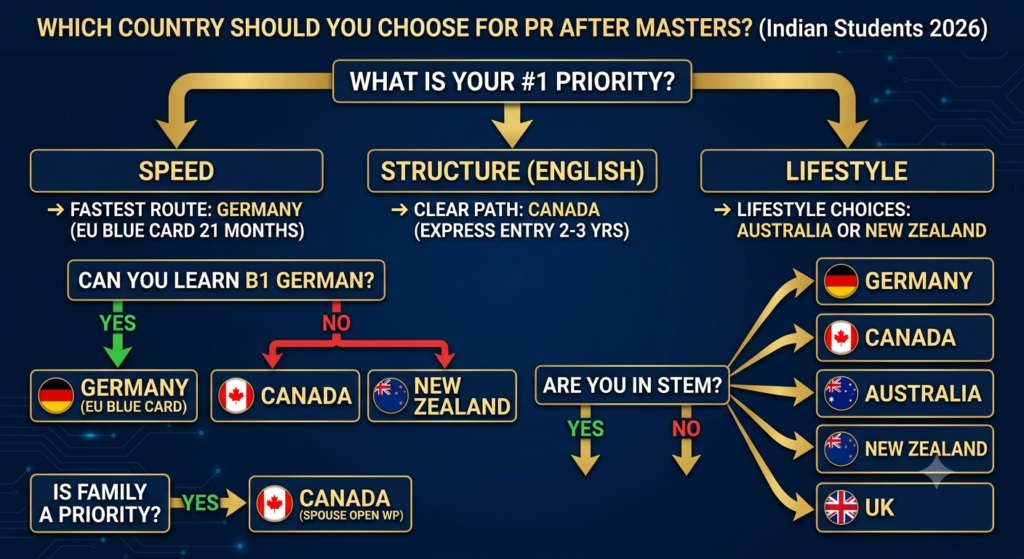
Choose Germany If You:
- ✅ Are in STEM — engineering, computer science, data science, automotive, materials science, healthcare
- ✅ Want the fastest PR in the world — 21 months on EU Blue Card with B1 German
- ✅ Want to minimise total investment — zero tuition + lowest living costs = highest PR ROI of any country
- ✅ Are willing to learn B1 German — this single investment unlocks the 21-month timeline and improves your salary
- ✅ Want EU mobility — Blue Card holders can work in any EU country after 18 months in Germany
- ✅ Want citizenship eligibility in 5 years (reduced from 8 in October 2025)
Choose Canada If You:
- ✅ Want the clearest, most predictable English-language PR pathway
- ✅ Prefer a North American lifestyle and want your spouse to work from Day 1 on an open work permit
- ✅ Are targeting STEM, healthcare, finance, or business — sectors where Canadian employers are globally competitive
- ✅ Want to apply for citizenship after just 3 years of PR (one of the world’s fastest citizenship timelines)
- ✅ Are targeting provincial programs — Ontario, BC, and Saskatchewan PNPs are particularly Indian-student-friendly
Choose Australia If You:
- ✅ Are in healthcare, construction, civil engineering, or IT — sectors on Australia’s shortage occupation list
- ✅ Can achieve IELTS 8+ — the 10-point jump from 7.5 to 8.0 is worth the preparation effort for PR
- ✅ Are willing to study or work in regional Australia — adds 5 SkillSelect points AND extends your 485 visa
- ✅ Prioritise lifestyle — Australia ranks consistently in the global top 5 for quality of life
- ✅ Have obtained (or will obtain) an ACS or Engineers Australia skills assessment during your final year of study
Choose New Zealand If You:
- ✅ Want a structured PR pathway with significantly less competition than Australia or Canada
- ✅ Are in technology, healthcare, construction, or agriculture — New Zealand’s key shortage sectors
- ✅ Prefer a smaller, quieter environment — Auckland and Wellington have strong Indian communities
- ✅ Your NZ university can offer a 25-hour part-time work allowance during studies (recently increased from 20)
Choose UK If You:
- ✅ Want the brand prestige of a UK degree for global career mobility — LBS, Oxford, Imperial, Edinburgh
- ✅ Are targeting London’s finance, consulting, or technology sectors — where the Skilled Worker pathway is strong
- ✅ Can secure a qualifying Skilled Worker role at £38,700+ after your Graduate Route expires
- ✅ Are graduating in 2026 and applying for Graduate Route BEFORE 31 December 2026 to secure 2 years
Avoid USA If Your Primary Goal Is PR and You:
- ❌ Are an Indian national — EB-2/EB-3 Green Card backlog is 50–100+ years for new applicants
- ❌ Cannot afford H-1B lottery rejection — losing OPT after lottery failure forces return to India with a ₹2 crore+ loan
- ❌ Have a family who needs long-term planning certainty — the lottery + century-long Green Card wait makes this impossible
Section 10: 7 Mistakes Indian Students Make When Planning PR After Masters
- Choosing a country based on university ranking, not immigration pathway. A top-30 US ranking means nothing if you cannot stay. Choose your PR destination first, then your university within it.
- Not verifying PGWP eligibility before enrolling in Canada. Master’s degree programs are universally eligible — but confirm your specific program and institution are on the IRCC DLI list before accepting admission.
- Assuming current rules will still apply when you graduate. Immigration policy changes constantly. Build your plan around today’s most conservative rules, not the most optimistic projections. The students who succeeded in 2024 are those who planned for 2022’s tougher conditions.
- Not starting German language before departure. B1 German is achievable in 12 months — but only if you start from A1 before you leave India. Students who arrive in Germany with zero German miss the 21-month PR window and fall to the 33-month or 5-year timeline.
- Applying for Australian skills assessment after graduation instead of during final year. ACS assessments for IT graduates take 6–9 months in 2026. Applying after graduation wastes months of your 485 visa on waiting.
- Ignoring the Graduate Route deadline in UK. Applications before 31 December 2026 get 2 years. Applications from 1 January 2027 get 18 months. This 6-month difference matters significantly for job-search and salary negotiation timelines.
- Not applying for Canadian PR immediately when eligible. Some students delay Express Entry applications thinking they need more CRS points. If you have 480+ CRS and are eligible for a category-based draw — apply immediately. CRS cutoffs and draw patterns change unpredictably.
Frequently Asked Questions — PR After Masters for Indian Students 2026
1. Which country gives PR fastest after a master’s degree for Indian students in 2026?
Germany offers the fastest PR timeline — 21 months after securing an EU Blue Card with B1 German language proficiency. This requires a qualifying job offer at €45,300+ per year (shortage occupations) or €50,700+ (all other fields). Canada is a close second at 2–3 years via PGWP plus Express Entry. New Zealand and Australia both offer PR in 3–5 years via points-based systems. The UK requires 5+ years. The USA effectively has a 50–100+ year wait for Indian nationals due to the per-country Green Card cap backlog.
2. Can I get Canadian PR after a 2-year master’s degree?
Yes — Canada’s PGWP (Post-Graduate Work Permit) of up to 3 years is available to all graduates of eligible 2-year master’s programs at Designated Learning Institutions. After 12 months of skilled work experience on PGWP, you enter the Express Entry pool. With a typical CRS score of 480–510 for Indian master’s graduates, category-based STEM draws or a provincial nomination make PR highly achievable. Total timeline from first day of study to PR card: 3–4 years.
3. Is Germany’s EU Blue Card PR really only 21 months?
Yes — but only if two conditions are met simultaneously: first, employment in a qualifying role at or above the 2026 EU Blue Card salary threshold (€45,934 for STEM/shortage occupations or €50,700 for all other qualified occupations); and second, B1 German language proficiency. Without B1 German, the EU Blue Card PR timeline extends to 33 months. Without an EU Blue Card (using a regular work permit instead), the standard PR timeline is 5 years. The 21-month route requires deliberate planning — start German language from India, secure an eligible role, and the timeline is genuinely achievable.
4. Has Australia become harder for Indian students to get PR in 2026?
Australia has become more selective, not impossible. India’s Evidence Level 3 classification means student visa applications receive more intensive scrutiny. The Subclass 485 fee has increased sharply. ACS IT assessments take 6–9 months. However, the General Skilled Migration points pathway remains transparent and employer-independent. Indian students who study in regional Australia, achieve IELTS 8+ (superior English), start skills assessments in their final year, and target shortage occupations can competitively reach 75–85 points for an invitation. The strategy matters more than ever.
5. What is the UK Graduate Route change and how does it affect PR planning?
The UK Government has confirmed the Graduate Route visa will be reduced to 18 months for applications made from 1 January 2027 (currently 2 years for bachelor’s and master’s graduates). If you are graduating in 2026, apply for the Graduate Route immediately upon graduation — before 31 December 2026 — to secure the 2-year window. The Graduate Route counts toward the 5-year ILR requirement when combined with Student visa time and subsequent Skilled Worker time. A 1-year Master’s student who counts 1 year study + 2 years Graduate Route + 2 years Skilled Worker = 5 years ILR eligibility — the most efficient UK PR timeline.
6. Can my spouse work while I pursue PR after my master’s abroad?
Canada is the most family-friendly: spouses of PGWP holders receive an open work permit allowing employment with any Canadian employer from Day 1 — both partners work simultaneously with no employer restrictions. Germany issues a residence permit to spouses of EU Blue Card holders immediately upon Blue Card issuance. Australia’s Subclass 485 visa includes secondary applicant rights for spouses. New Zealand’s post-study work visa includes open work rights for accompanying partners. The UK allows spouse dependants on Graduate Route but they cannot work independently without an employer sponsoring them separately.
7. What is the single most important thing Indian students should do to improve their PR chances?
Choose your country before your university. The single biggest difference between Indian students who achieve PR and those who do not is this: the successful ones chose their destination with the PR pathway as the primary criterion — and then found the best university within that destination. Students who choose a university first and figure out PR later are consistently less prepared for the immigration complexity they face after graduation. Once you have chosen your country, the second most impactful action is language: start German if going to Germany, or target IELTS 8+ (superior English) if going to Australia.
Related Guides on GlobalEd — Read These Alongside This PR Guide
- Study in Germany 2026: Free Education, PR Pathways & Top Universities for Indian Students → [Link to Germany blog]
- Part-Time Work for Indian Students Abroad 2026: Real Earnings Guide → [Link to part-time work blog]
- Is an MBA Abroad Worth It in 2026? ROI Analysis for Indian Students → [Link to MBA ROI blog]
- SOP Writing Guide 2026: How to Write a Statement of Purpose That Gets You Admitted → [Link to SOP guide]
- India–US Trade Deal 2026: What It Means for Indian Students Applying to American Universities → [Link to trade deal blog]
Authoritative Sources & External References
1. BAMF Germany — EU Blue Card Residence Permit Information — Official Federal Office for Migration: EU Blue Card salary thresholds and PR timelines 2026
2. IRCC Canada — Post-Graduation Work Permit — Official IRCC PGWP eligibility, duration, and Express Entry pathway
3. Australian Department of Home Affairs — Subclass 485 Temporary Graduate Visa — Official 485 visa eligibility, duration, and 2026 application fee
4. UK Home Office — Graduate Route Visa Official Guide — Official Graduate Route duration, eligibility, and 2027 reduction confirmation
5. Immigration New Zealand — Post-Study Work Visa — Official NZ post-study work visa duration and Skilled Migrant Category pathway
6. Make it in Germany — EU Blue Card Official Portal — Official German government portal: Blue Card salary thresholds, PR fast-track, and Chancenkarte information
Conclusion: PR After Masters Is Achievable — But Only If You Plan Before You Apply
The most important message in this entire guide is not a timeline or a points score. It is this: the Indian students who achieve PR after masters abroad in 2026 are the ones who planned their immigration pathway before they chose their university — not after they graduated.
Germany gives you the fastest PR in the world — 21 months — at the lowest total cost. Canada gives you the most structured, family-friendly, English-language pathway with a 3-year PGWP and direct Express Entry access. New Zealand is the underrated option with less competition and a clear points-based system. Australia rewards STEM skills, regional study, and strong English. The UK offers brand prestige with a longer but achievable ILR timeline. The USA is a career accelerator, not a PR destination, for Indian nationals in 2026.
Choose your country based on where you want to live in five years — not where the most famous university is. Then choose the best university within that country. That sequence of decisions, made clearly and early, is the difference between a study-abroad journey that ends in settled life abroad and one that ends in a visa expiry letter.
At GlobalEd, we have guided 500+ Indian students through personalised study-to-PR journeys across Germany, Canada, Australia, the UK, and New Zealand. Our PR pathway counselling is free, personalised to your academic profile and career goals, and based on real 2026 immigration data — not brochure promises.
→ Book Your Free PR Pathway Counselling Session with GlobalEd
→ Download the Free Study-to-PR Country Comparison Guide 2026