


Foreign universities opening campuses in India in 2026 represent the most significant shift in Indian higher education in two decades — and every Indian student planning to study abroad must understand what this development actually means for their decision.
On June 9, 2026, the UGC issued Letters of Approval to three more institutions — the University of Bristol, the University of York, and the University of New South Wales (UNSW Sydney). That brings the total approved foreign universities in India to five with formal letters of approval, with 18-19 institutions holding UGC or IFSCA approval overall, and over 15 Letters of Intent issued to institutions including Illinois Institute of Technology, Lancaster University, University of Aberdeen, and La Trobe University.
The University of Southampton’s Gurugram campus — India’s first UGC mainland foreign campus — began operations in August 2025 with approximately 170 students. Deakin University at GIFT City enrolled 43 students in its first cohort in 2024. The University of Wollongong followed with 9 students. By August 2026, Liverpool, Bristol, UNSW Sydney, York, Aberdeen, and Western Australia will all begin operations across Mumbai, Bengaluru, and GIFT City.
But enrolment numbers — fewer than 250 students across all operational foreign campuses in year one — tell an important story: regulatory approval is not the same as student demand, and degree quality is not the same as career outcome.
This guide gives Indian students the honest answer to the question that actually matters: for your specific goals, budget, and career plans — should you study at a foreign university campus in India, or go abroad?
Confused about whether an Indian campus or going abroad is right for you? Book a free counselling session with GlobalEd — we will build a personalised comparison based on your goals.
Section 1: Study in India or Go Abroad? — The Verdict Before We Deep-Dive
Most guides bury the conclusion. We give it to you first, because your time has value.
🏛️ STUDY IN INDIA (Foreign Campus) — IF: You cannot get a study visa (F-1 rejection 61%, Canada rejection 74%, Australia Evidence Level 3) — Indian campus is a strong contingency Your family situation requires you to stay in India — parents, dependants, or financial obligations You are in business, finance, data science, or fintech — GIFT City campuses have strong industry connections in these fields You want a globally recognised degree without the immigration uncertainty and culture shock You are applying to a campus that is already operational and has verifiable career outcomes (Southampton, Deakin, Wollongong) | ✈️ GO ABROAD — IF:q You want maximum exposure to a global environment — international cohort, overseas internships, campus life abroad You are applying for the MEXT Scholarship (Japan), DAAD (Germany), or Chevening (UK) — these require study in the host country Your target employers hire specifically from overseas-based graduates or require in-country experience You are in fields where the Indian campuses offer no or limited programs — medicine, law, architecture, research You are at a strong profile (IELTS 7.5+, GPA 8+) where top overseas programs would admit you — the opportunity cost of staying in India is too high |
This verdict is expanded in full detail throughout this guide. The nuance matters enormously — read every section before making your decision.
Section 2: What Is Actually Happening — The Complete 2026 Status of Foreign University Campuses in India
Most media coverage of this topic is either breathlessly optimistic or hopelessly vague. Here is the precise, verified status as of July 2026.
The Two Regulatory Frameworks — UGC and IFSCA — Are Not the Same
Feature | UGC Framework (Mainland India) | IFSCA Framework (GIFT City only) |
|---|---|---|
Governing body | University Grants Commission (UGC) — Regulations 2023 | International Financial Services Centres Authority (IFSCA) |
Geographic scope | Anywhere in India — Gurugram, Mumbai, Bengaluru, etc. | Only within GIFT City, Gandhinagar, Gujarat |
Approval duration | 10 years, renewable after quality audit | 5 years, renewable (shorter cycle) |
Degree recognition in India | Automatically equivalent to Indian degrees | May require equivalence certification for some purposes — verify for UPSC, teaching jobs, etc. |
Key institutions | University of Southampton (Gurugram), Liverpool, Bristol, York, UNSW, Aberdeen (all 2026) | Deakin University, University of Wollongong, Queen’s University Belfast, Coventry, University of Surrey |
Critical student advice | Safer choice for degrees used in Indian government jobs or further Indian education | Ideal for finance, fintech, and business careers — industry connection at GIFT City is unique |
Critical: Check UGC or IFSCA approval BEFORE applying Letters of Intent (LoI) are preliminary — they do NOT confirm the university will open on schedule. Several universities holding LoIs have faced delays of 6–18 months beyond their announced opening dates. Regulatory Approval is NOT the same as Student Demand. UNSW Singapore opened in 2007 with 15,000 projected students, enrolled 150, and closed after 5 months. Do not let announcements substitute for verified first cohort data. Always ask: Is this campus currently accepting students? What was the size of the first cohort? What are the career outcomes of the first graduates? If a campus cannot answer these questions, it has not been open long enough to evaluate. |
Complete Status: Every Foreign University Campus in India — July 2026
University | Country | Location | Status (July 2026) | Courses | Annual Fees (INR) |
|---|---|---|---|---|---|
University of Southampton | UK | Gurugram, Haryana | OPERATIONAL — Aug 2025 (~170 students) | BSc CS, Economics, Accounting & Finance, Business | MSc Finance, International Management | ₹12–18 lakh/yr |
Deakin University | Australia | GIFT City, Gujarat | OPERATIONAL — Jul 2024 (~43 students yr 1) | Masters: Business Analytics, Cyber Security | ₹10–16 lakh/yr |
University of Wollongong | Australia | GIFT City, Gujarat | OPERATIONAL — Nov 2024 (~9 students yr 1) | Masters: FinTech, Computing & Data Analytics | ₹10–15 lakh/yr |
Queen’s University Belfast | UK | GIFT City, Gujarat | OPERATIONAL — Jan 2026 (first Russell Group in India) | MSc Finance, Business Analytics, Financial Analytics, Construction & Project Mgmt, Public Policy | ₹10–16 lakh/yr |
University of Liverpool | UK | Bengaluru, Karnataka | OPENING Aug 2026 — admissions open | UG & PG in Business, Science, Technology | ₹12–18 lakh/yr (est.) |
University of Bristol | UK | Mumbai (Powai), Maharashtra | OPENING Aug 2026 — admissions open | UG: Data Science, Economics | PG: Sustainability, FinTech, Finance & Investment | ₹14–20 lakh/yr (est.) |
University of York | UK | Mumbai, Maharashtra | OPENING 2026 — 250+ UG & PG courses planned | Business, Technology, Arts, Social Sciences | ₹12–18 lakh/yr (est.) |
University of Aberdeen | UK (Scotland) | Mumbai, Maharashtra | OPENING Aug–Sep 2026 | CS, Data Science, Business Mgmt, Economics, AI, MBA | ₹14–18 lakh/yr (est.) |
UNSW Sydney | Australia | Bengaluru, Karnataka | APPROVED Jun 2026 — 2026/27 opening | Business, Computer Science, Cyber Security, Renewable Energy, Health | TBC |
University of Western Australia (UWA) | Australia | Mumbai + Chennai | OPENING Sep 2026 (Group of Eight member) | Business, Engineering, Science, Health, Law | ₹14–20 lakh/yr (est.) |
Illinois Institute of Technology | USA | Mumbai, Maharashtra | OPENING 2026 — first US university in India | Engineering, Computer Science, Business, Architecture | ₹15–22 lakh/yr (est.) |
Lancaster University | UK | Bengaluru, Karnataka | OPENING Dec 2026 | Business, Management, Data Science | ₹12–18 lakh/yr (est.) |
Coventry University | UK | GIFT City, Gujarat | OPENING 2026 | BSc International Business, BSc Business & Finance | ₹10–15 lakh/yr |
Victoria University | Australia | Greater Noida, UP | APPROVED — opening 2026 | UG Business programs | ₹11–24 lakh/yr |
Birkbeck, University of London | UK | Bengaluru, Karnataka | OPENED Apr 2026 | BSc Business Management, Business Analytics, International Business | ₹12–16 lakh/yr (est.) |
Istituto Europeo di Design (IED) | Italy | Mumbai / GIFT City | OPENING 2026–27 | Design, Fashion, Visual Arts, Communication | TBC |
Sources: UGC FHEI Portal, IFSCA website, Vidyamandir/Collegedunia verified campus data, individual university India admissions pages. Status as of July 2026. Always verify current status before applying.
Section 3: What You Actually Get at a Foreign University Campus in India — Degree, Faculty, Experience
What Is the Same as Studying Abroad
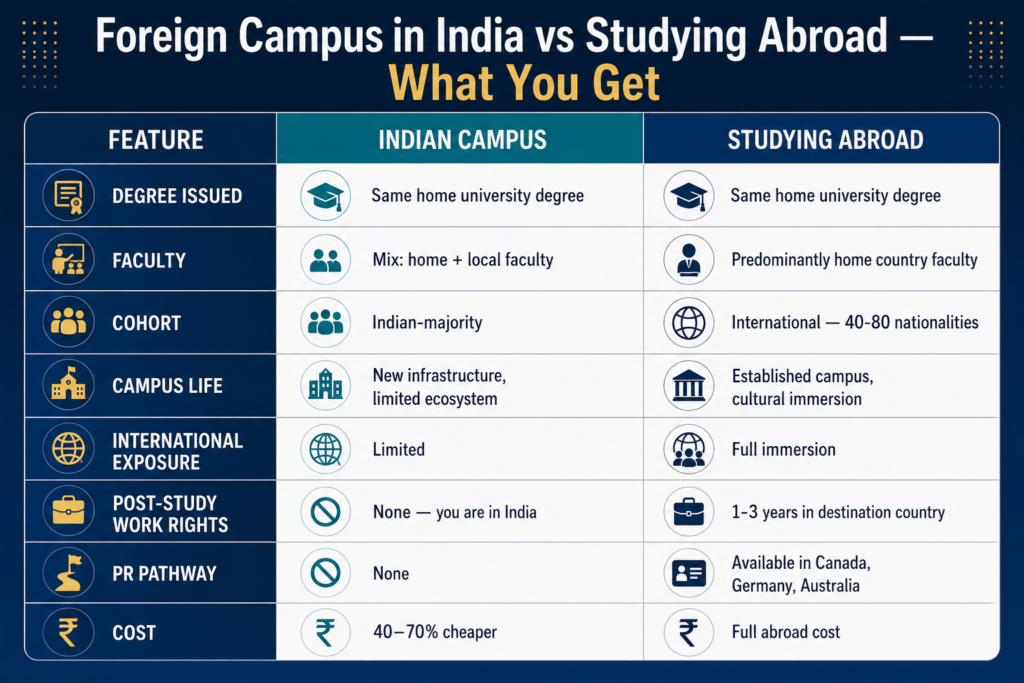
- The degree is identical — your certificate says University of Southampton, not University of Southampton India Campus. The home university issues the degree.
- Academic content is the same curriculum taught at the home campus — assessments, course structure, and quality standards are monitored by the home institution and its home country accreditation body (TEQSA for Australian universities, QAA for UK).
- University recognition globally — an employer in the UK, USA, or Australia sees ‘University of Southampton’ and treats it the same as any other Southampton graduate.
- library access, online resources, and alumni networks of the home university are available.
What Is Different from Studying Abroad
- No post-study work rights in the UK, Australia, or Canada. You are studying in India, so you do not qualify for the UK Graduate Route, Australian Subclass 485, or Canadian PGWP. This is the single biggest difference.
- Cohort is predominantly Indian. International exposure — one of the most valuable and least quantifiable benefits of studying abroad — is limited at Indian campuses in their first years.
- Faculty mix. Most operational campuses in India combine visiting faculty from the home institution with locally hired academics. Full-time, permanent overseas faculty are expensive to relocate and are not present in the same proportion as at home campuses.
- Campus ecosystem is new. Industry connections, research centres, sports facilities, student life, and alumni density take years to build. Southampton Gurugram has 170 students — Southampton UK has 27,000. The ecosystem difference is real.
- No opportunity for cultural immersion, language learning, or international professional network building that comes from living abroad.
The most important reality check for Indian students and parents: UNSW Singapore opened in 2007 projecting 15,000 students, enrolled 150, and shut after 5 months. Globally, more than 25 international branch campuses that opened since 2000 have since closed. This does NOT mean Indian campuses will fail — but it means early adopters carry early-adopter risk. Students in the 2026 cohort of Liverpool, Bristol, or York India are joining institutions that have zero graduate placement data for India. The career outcome question — what jobs do Indian campus graduates get, and at what salaries? — will only be answerable from 2028 onwards when first graduates complete their programs. This is not a reason to avoid these campuses entirely. But it IS a reason to ask hard questions before paying ₹40-60 lakh in fees. |
Section 4: Fees Comparison — Indian Campus vs Going Abroad — Real INR Numbers
Cost is the most compelling argument for Indian campuses. Here is the honest comparison:
Scenario | Annual Tuition (INR) | 2-Year Total Tuition | 2-Year All-In (with living) | vs Going Abroad |
|---|---|---|---|---|
University of Southampton — Gurugram (India) | ₹12–18 lakh | ₹24–36 lakh | ₹28–40 lakh (live at home option) | vs ₹65–95 lakh for Southampton UK |
Deakin University — GIFT City (India) | ₹10–16 lakh | ₹20–32 lakh | ₹24–36 lakh | vs ₹70–100 lakh for Deakin Australia |
University of Liverpool — Bengaluru (India) | ₹12–18 lakh (est.) | ₹24–36 lakh | ₹28–42 lakh | vs ₹60–90 lakh for Liverpool UK |
UNSW Sydney — Bengaluru (India) | TBC — est. ₹14–20 lakh | ₹28–40 lakh (est.) | ₹32–46 lakh | vs ₹80–120 lakh for UNSW Australia |
University of Southampton — UK (abroad) | ₹30–38 lakh | ₹30–38 lakh (1-yr) | ₹50–72 lakh (tuition + UK living) | Full abroad cost |
Deakin University — Australia (abroad) | ₹20–28 lakh | ₹40–56 lakh (2-yr) | ₹70–100 lakh (with living) | Full abroad cost |
Germany — Public University (abroad, free tuition) | ₹2–4 lakh (sem fee only) | ₹4–8 lakh | ₹22–30 lakh all-in | Cheapest abroad option |
Canada — Master’s (abroad) | ₹22–35 lakh | ₹44–70 lakh | ₹70–100 lakh all-in | Plus PGWP and PR pathway |
The cost advantage is real and significant. Studying at Southampton Gurugram versus Southampton UK saves ₹25–55 lakh in total cost while giving you the same degree. For cost-focused Indian families, this is a compelling argument. But cost is not the only variable — and for many student profiles, the ₹25–55 lakh savings are less valuable than the post-study work rights and PR pathway that going abroad delivers.
When the cost saving does NOT justify the Indian campus choice: If going to Germany costs ₹22–30 lakh all-in (free tuition at public university) versus ₹30–40 lakh at an Indian campus of a UK university — Germany is cheaper AND gives EU Blue Card PR in 21 months. The cost comparison must include opportunity cost: what you give up by staying in India (post-study work visa, international work experience, PR pathway) versus what you save. |
Section 5: Is a Foreign University India Campus Degree Recognised? — The Honest Legal Answer
This is the most frequently asked question about foreign campuses in India — and it has a nuanced answer depending on what you plan to do with your degree.
For Private Sector Employment in India
Yes — fully recognised. The degree reads University of Southampton (or whichever institution) and is treated by private Indian employers the same as any overseas degree from that university. For corporate careers in finance, technology, consulting, and management, the degree carries the same weight.
For Employment or Further Study Abroad
Yes — same degree, same recognition. An employer in the UK, Australia, or Canada sees ‘University of Southampton’ and applies the same evaluation criteria regardless of where you studied. Your transcript and degree certificate will identify the India campus — but the degree-granting institution is identical.
For Indian Government Jobs, Public Sector, and Regulatory Professions
UGC Mainland Campuses: Automatically equivalent to Indian degrees. The UGC Regulations 2023 explicitly state that degrees from approved foreign campuses under the UGC framework are automatically equivalent to degrees from Indian universities and valid for all purposes including government employment and further Indian education.
IFSCA / GIFT City Campuses: Verify before applying. Degrees from GIFT City campuses operate under IFSCA regulations, not UGC. For some purposes — UPSC civil services, teaching positions in government colleges, regulatory professions — equivalence certification may be required. Always verify the specific use case with the relevant authority before committing to a GIFT City program.
For Professional Licensing — Engineering, Accounting, Medicine, Law
Engineering: Degrees from UGC-approved campuses are valid for engineering council recognition. However, if you plan to be licensed as an engineer in Australia or UK specifically, you may need to meet additional requirements of Engineers Australia or Engineering Council UK based on your specific program.
- Accounting/Finance: ACCA, ICAI, CPA recognition depends on the specific program accreditation — verify with the relevant professional body, not the university’s marketing material.
- Medicine and Law: NONE of the current foreign campuses in India offer MBBS, MD, LLB, or LLM programs. These disciplines remain exclusively in the domain of going abroad.
Section 6: The One Benefit You Cannot Get at an Indian Campus — Post-Study Work Rights & PR
This is the section that changes the decision for most students who are seriously considering going abroad.
When you study at a foreign university campus in India, you are studying in India. You are not on a UK Student Visa, an Australian Subclass 500, a Canadian Study Permit, or a German Student Residence Permit. This means:
Post-Study Benefit | If You Study at Foreign Campus in India | If You Go Abroad |
|---|---|---|
UK Graduate Route Visa (2 years work in UK) | NOT available — you studied in India | Available: apply immediately after graduating in the UK |
Australian Subclass 485 (2–4 years work in Australia) | NOT available | Available after graduating in Australia |
Canadian PGWP (up to 3 years work in Canada) | NOT available | Available: feeds directly into Express Entry PR |
German 18-month Job Seeker Visa | NOT available | Available after graduating in Germany |
EU Blue Card (PR in 21 months, Germany) | NOT available | Available upon qualifying employment in Germany |
Express Entry CRS points (Canada PR) | NOT available — no Canadian work experience | Canadian skilled work on PGWP adds 40–80 CRS points |
International work experience on CV | Limited — India-based internships only | Full international employment on post-study work visa |
Part-time earnings during study | India part-time rates (₹15,000–30,000/month) | UK: ₹1.08 lakh/month | Canada: ₹98,500/month | Australia: ₹1.32 lakh/month |
The bottom line: If permanent residency in the UK, Australia, Canada, or Germany is part of your plan — even a distant future possibility — studying at an Indian campus of a foreign university closes that door completely. You would need to go abroad separately for a second degree or a work visa to reopen it.
Section 7: Who Should Seriously Consider a Foreign University India Campus in 2026
Profile 1: The Visa-Rejected Student With a Strong Academic Profile
India’s F-1 rejection rate for American universities is 61 percent. Canada’s study permit rejection rate for Indians has reached 74 percent. Australia has classified Indian students at Evidence Level 3. For a student who has been rejected — or who assesses their visa risk as high — an Indian campus of a globally ranked university is a genuinely excellent alternative.
Specific scenario: A student with a strong profile applying to the University of Southampton UK gets a visa rejection. The same student applies to Southampton Gurugram, gets the same degree, saves ₹40–50 lakh, and enters the Indian corporate market as a Southampton graduate. The visa problem is completely eliminated.
Profile 2: The Budget-Constrained Student in Business, Finance, or Tech
For families where ₹80-100 lakh for a UK or Australian degree is not feasible, but ₹35-50 lakh is possible, Indian campuses offer a realistic path to an internationally recognised business or technology degree. The GIFT City campuses (Deakin, Wollongong, Queen’s Belfast) have specific industry connections with HSBC, KPMG, National Australia Bank, Aditya Birla Group, and EY that make them particularly relevant for finance and fintech careers.
Profile 3: The Student With Family Obligations Requiring India Residence
Caring for elderly parents, running a family business, or financial obligations that require India residence are completely valid reasons to stay. Foreign campuses make it possible to earn a globally recognised degree without the social and financial cost of leaving India for 2-3 years.
Profile 4: The Student Who Wants International Exposure Before Full Abroad Commitment
Some students use a foreign campus in India as a stepping stone — completing an undergraduate degree at Southampton Gurugram or Deakin GIFT City, then pursuing a master’s abroad where post-study work rights apply. This approach gives them international degree recognition while staying in India during the relatively lower-stakes undergraduate years, then maximising the post-study work and PR benefits during the graduate program.
Section 8: Who Should Still Go Abroad — Even With Indian Campus Options Available
Profile 1: The PR-Focused Student
If permanent residency is your goal within 5–10 years, go abroad. No Indian campus provides post-study work rights or a PR pathway. Canada’s Express Entry, Germany’s EU Blue Card, and Australia’s General Skilled Migration are only accessible to students who actually lived and worked in those countries. An Indian campus degree from Liverpool or Bristol does not make you eligible for the UK Graduate Route, the Canadian PGWP, or the Australian 485 visa.
Profile 2: The MEXT, DAAD, Chevening, or Fulbright Scholar
Major government scholarships that Indian students target — Japan’s MEXT, Germany’s DAAD, the UK’s Chevening, and the US’s Fulbright — require you to physically study in the host country. These scholarships can cover 100% of costs including living expenses. A student who qualifies for one of these scholarships and chooses an Indian campus instead is leaving lakhs of rupees of funding on the table.
Profile 3: The Research-Focused Student
PhD students and students targeting research careers need access to world-class research labs, equipment, and academic networks that exist at the home campuses, not at newly established Indian branches with 50-200 students. Research supervision quality, grant access, and publication networks are all significantly stronger at overseas campuses for the foreseeable future.
Profile 4: The Student in Medicine, Law, Architecture, or Specialised Fields
None of the current or announced foreign campuses in India offer MBBS, MD, LLB, LLM, BArch, or specialist programs in these professional fields. Students targeting these qualifications must go abroad.
Profile 5: The Strong Profile Student Who Can Get Scholarships Abroad
If your profile — CGPA 8+, IELTS 7.5+, strong SOP — makes you competitive for the Chevening, DAAD, or university merit scholarships that cover 30-50% of costs abroad, the cost gap between studying in India and going abroad narrows significantly. A 50% scholarship on a ₹80 lakh UK degree costs ₹40 lakh — comparable to an Indian campus of the same university, but with post-study work rights and an international cohort included.
Section 9: The Complete 2026 Decision Matrix — Indian Campus vs Going Abroad
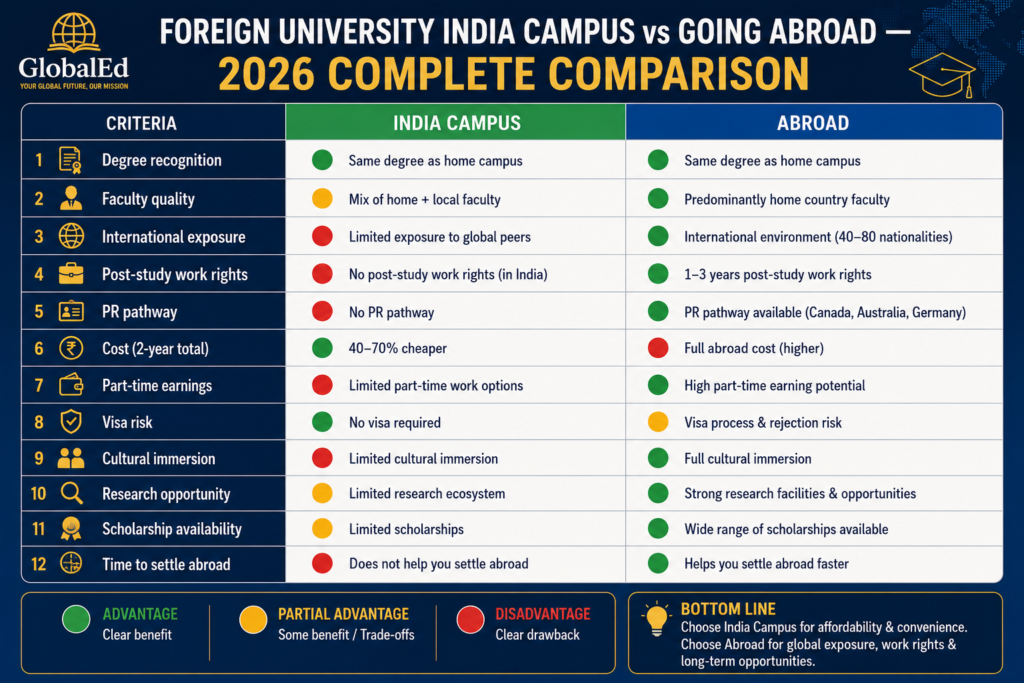
Criteria | Foreign Campus in India | Going Abroad (UK/Canada/Germany/Australia) |
|---|---|---|
Degree recognition (private sector) | ✅ Fully recognised — same degree as home campus | ✅ Same — no difference |
Degree recognition (Indian govt/UPSC) | ✅ UGC mainland: yes | ⚠️ GIFT City/IFSCA: verify | ✅ Yes — with equivalence certificate |
Cost (2-year Master’s, all-in) | ✅ ₹28–45 lakh typically | ⚠️ ₹55–100 lakh (excl. Germany ₹22–30L) |
Post-study work rights | ❌ None — you stay in India | ✅ 18 months–3 years depending on country |
PR pathway | ❌ Not applicable — you are in India | ✅ Canada 2-3 yrs | Germany 21 months | Australia 3-5 yrs |
International cohort exposure | ⚠️ Limited — India-majority cohort | ✅ 40-80 nationalities on campus |
Faculty quality | ⚠️ Mixed — visiting + local hire | ✅ Full home-campus faculty standards |
Campus ecosystem (year 1–3) | ⚠️ New and building — limited clubs, research, industry | ✅ Established ecosystem decades old |
Scholarship opportunities | ⚠️ Some university scholarships — no government funding | ✅ DAAD, Chevening, MEXT, Fulbright available |
Part-time work earnings | ⚠️ India rates (₹15-30K/month) | ✅ ₹65K–1.32L/month depending on country |
Cultural immersion | ❌ Studying in India — no immersion | ✅ Full international living experience |
Visa risk | ✅ Zero — no visa required | ⚠️ 39-74% rejection rate by country for Indians |
Research opportunities (PhD) | ❌ Limited at new campuses | ✅ World-class labs and supervision |
Career network (international) | ⚠️ Alumni base building — limited global network | ✅ International alumni network from day one |
Section 10: 10 Questions Every Indian Student Must Ask Before Applying to a Foreign Campus in India
- Is this university’s India campus currently operational — or just announced? Verify on ugcfhei.in or the IFSCA website. An announcement is not an approved campus.
- What was the size of the first cohort? A campus with 9 students (Wollongong year 1) or 43 students (Deakin year 1) has an ecosystem very different from what the brochure implies.
- Where are the first graduates working, and at what salaries? If the campus cannot show you graduate employment data, it has not been open long enough to evaluate.
- Is this a UGC mainland campus or a GIFT City / IFSCA campus? If GIFT City, verify degree equivalence for your specific career plans.
- What proportion of faculty are permanently based in India versus visiting from the home campus? Ask for the specific faculty roster, not the generic ‘our faculty are the same as UK’ marketing line.
- What are the scholarship options and what percentage of students receive financial support?
- Is post-study work rights ever part of this program? (The answer should always be no — but verify.) If a campus implies any pathway to a UK/Australian/Canadian work visa through their India program, be extremely sceptical and seek legal advice.
- Is going abroad and applying for a scholarship — DAAD, Chevening, MEXT, university merit — a realistic option for my profile? If yes, have I explored it before choosing the India campus?
- What is the fee refund or deferral policy if the campus delays opening? Several campuses with LoIs have already pushed back opening dates.
- What does my target employer think of this specific campus? The best way to answer this is to find 2-3 graduates of the home campus in your target role and ask them directly whether they would evaluate an India campus graduate the same way.
Frequently Asked Questions — Foreign Universities Opening Campuses in India 2026
1. Which foreign universities are opening campuses in India in 2026?
As of July 2026, the following are operational or opening in 2026: University of Southampton (Gurugram, operational Aug 2025), Deakin University (GIFT City, operational Jul 2024), University of Wollongong (GIFT City, operational Nov 2024), Queen’s University Belfast (GIFT City, operational Jan 2026), University of Liverpool (Bengaluru, opening Aug 2026), University of Bristol (Mumbai, opening Aug 2026), University of York (Mumbai, opening 2026), University of Aberdeen (Mumbai, opening Aug-Sep 2026), UNSW Sydney (Bengaluru, approved Jun 2026), University of Western Australia (Mumbai + Chennai, opening Sep 2026), Illinois Institute of Technology (Mumbai, opening 2026), Birkbeck University of London (Bengaluru, opened Apr 2026), and Coventry University (GIFT City, opening 2026).
2. Are degrees from foreign university campuses in India recognised?
Yes, for most purposes. Degrees from UGC-approved mainland campuses are explicitly stated to be automatically equivalent to Indian degrees and valid for all purposes including government employment. The degree certificate is issued by the home university — so an employer sees ‘University of Southampton’ regardless of where you studied. For GIFT City/IFSCA campuses, degree equivalence for specific purposes such as government jobs or regulated professions should be verified with the relevant authority before applying.
3. Can I get a UK or Australian work visa after studying at their Indian campus?
No. Post-study work visas — the UK Graduate Route, Australian Subclass 485, Canadian PGWP, and German 18-month Job Seeker Visa — are available only to students who physically studied in those countries on valid student visas. Studying at the Indian campus of a UK or Australian university makes you eligible for an Indian degree from that institution, but does NOT give you any right to work in the UK, Australia, or Canada after graduation.
4. How much do foreign university India campus fees cost compared to studying abroad?
Indian campus fees are typically 40–70% cheaper than the same degree at the home campus abroad. University of Southampton Gurugram charges approximately ₹12–18 lakh per year versus ₹30–38 lakh per year in the UK. Deakin GIFT City charges ₹10–16 lakh versus ₹20–28 lakh in Australia. The total all-in cost (including living) for 2 years at an Indian campus is typically ₹28–46 lakh, compared to ₹55–100 lakh for the same degree abroad (except Germany which is comparably priced at ₹22–30 lakh all-in with free tuition).
5. Is it better to study at a foreign campus in India or go to Germany?
For most STEM students, going to Germany is a stronger choice than studying at a foreign campus in India — and it may cost less. Germany’s public universities charge near-zero tuition, with total all-in costs of ₹22–30 lakh for a 2-year Master’s. Post-graduation, graduates qualify for an 18-month job-seeker visa and the EU Blue Card, which gives permanent residency in 21 months with B1 German. An Indian campus gives you the same degree cost (₹30–45 lakh typically) without any post-study work rights or PR pathway. For cost-focused students who also want a settlement pathway, Germany is the stronger option.
6. What is the difference between UGC and IFSCA foreign campuses in India?
UGC-regulated campuses operate anywhere in India under UGC Regulations 2023 — degrees are automatically equivalent to Indian degrees, valid for all purposes including government employment. IFSCA-regulated campuses operate only within GIFT City, Gandhinagar, Gujarat, under a separate financial services framework. GIFT City campus degrees may require equivalence certification for certain purposes such as UPSC, teaching in government institutions, or regulated professions. Always verify your specific use case with the relevant authority before choosing a GIFT City campus.
7. Should I wait for more Indian campuses to open or apply to study abroad now?
Apply now for abroad if your admission profile is strong and visa approval odds are reasonable for your target country. Do not defer a strong abroad application to wait for an Indian campus that has not yet opened — campus delays are common (several institutions with Letters of Intent have already pushed back their launch dates by 6-18 months), and the cost of a gap year typically exceeds the cost difference between the options. If your visa risk is high or your budget is constrained, the currently operational campuses (Southampton, Deakin, Wollongong, Queen’s Belfast) are safer choices than unproven upcoming campuses.
Authoritative Sources & External References
1. UGC FHEI Portal — Official List of Approved Foreign Higher Education Institutions in India — Verify any foreign university’s approval status before applying
2. IFSCA — International Financial Services Centres Authority (GIFT City Campuses) — Official regulatory framework for GIFT City foreign university campuses
3. University of Southampton India — Official Admissions Page — First UGC mainland foreign campus in India; operational data and course information
4. UGC Regulations 2023 — Setting up and Operation of Campuses of Foreign Higher Educational Institutions in India — Full regulatory framework governing foreign university campuses in India
5. PIB — Press Information Bureau: UGC Issues Letters of Approval to Foreign Universities June 2026 — Official government press releases on UGC approvals for Bristol, York, and UNSW Sydney
6. RAYSolute Consultants — Foreign University India Entry Analysis 2026 — Independent research data on first-cohort enrolment numbers and campus status
Conclusion: Foreign Campuses in India Are a Genuine Option — For the Right Student
Foreign universities opening campuses in India in 2026 represent a meaningful expansion of choice for Indian students — not a replacement for studying abroad, and not a complete alternative, but a genuine third option that works extremely well for specific student profiles.
Study at an Indian campus if: you have been rejected for a study visa, your budget makes abroad unaffordable, your family situation requires India residence, or you are targeting a business, finance, or technology career in India where the degree recognition and campus industry connections are directly relevant.
Go abroad if: permanent residency is part of your plan, you are a strong profile student eligible for government scholarships, you are in a field not offered at Indian campuses (medicine, law, research), or you are comparing India campus cost with Germany — where going abroad may cost the same or less and delivers EU Blue Card PR in 21 months.
The campuses are real. The degrees are recognised. The cost savings are genuine. But the post-study work rights do not exist, the first-cohort ecosystem is thin, and the career outcome data will not be available until 2028. Make this decision with full information — not just the announcement headlines.
At GlobalEd, we help Indian students compare every option — foreign campus in India, studying abroad, scholarships, and hybrid pathways — based on your specific profile, goals, and budget. Our counselling is free, honest, and built on current 2026 data.
→ Book Your Free India Campus vs Abroad Comparison Session with GlobalEd
→ Download the Free Foreign University India Campus Checklist 2026

