

Australia vs Canada for Indian students in 2026 is the most-searched study-abroad comparison query from India — and for good reason. Both countries are English-speaking, have world-class universities, offer post-study work rights, and provide genuine pathways to permanent residency. But in 2026, the two countries have diverged significantly on visa policies, costs, PR timelines, and job market conditions.
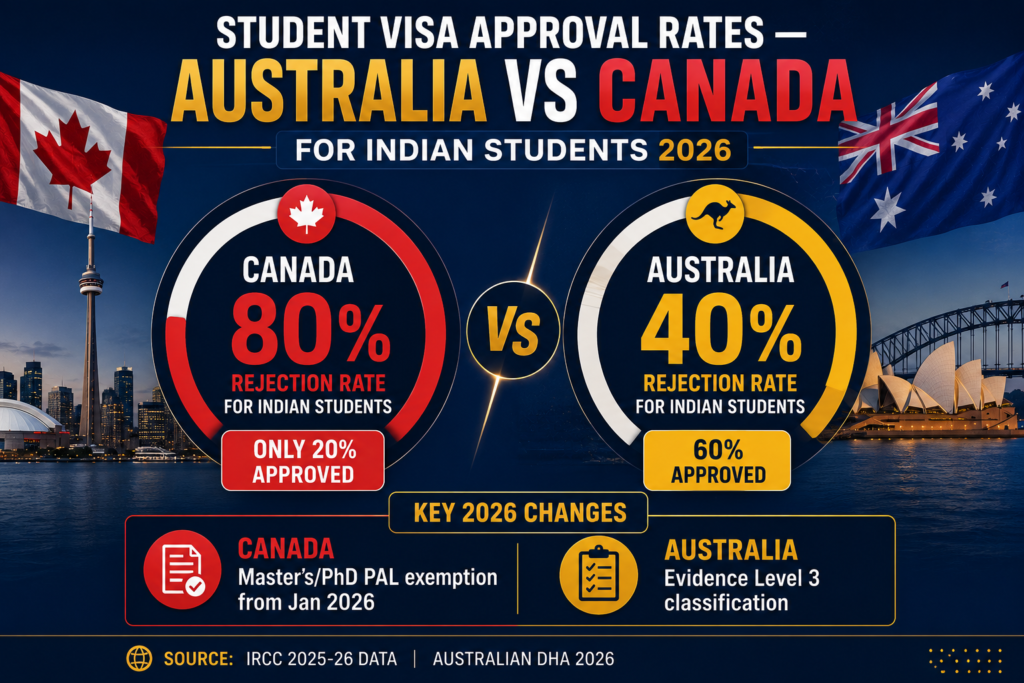
The data tells a clear story: Canada’s study permit rejection rate for Indian students reached 80% in 2025 and remains elevated in 2026, while Australia’s rejection rate for university-level applicants sits at 40% — still challenging, but significantly better. Meanwhile, Australia raised its minimum wage to AUD $24.95 per hour — the highest nationally mandated student wage in the world — while Canada’s PGWP rules for Master’s students became significantly more favourable with the January 2026 PAL exemption.
This guide cuts through the noise and gives Indian students and parents a clean, data-driven answer — covering costs in INR, visa approval reality, part-time earnings, PR pathways, job markets, university rankings, and a final verdict by student profile.
Can’t decide between Australia and Canada? Book a free personalised comparison session with GlobalEd — we compare both options against your specific profile, budget, and career goals.
Section 1: The Quick Verdict — Before We Deep-Dive
🍁 CHOOSE CANADA IF: You want your spouse to work from Day 1 — Canada’s open work permit for PGWP dependants is unmatched You want Canadian citizenship — eligible after just 3 years of PR (one of the world’s fastest timelines) | 🦘 CHOOSE AUSTRALIA IF You are in healthcare, nursing, construction, or civil engineering — Australia’s shortage occupation lists are stronger in these fields You prefer a longer post-study work visa — Australia’s 485 visa offers 2–4 years vs Canada’s PGWP at up to 3 years You are at undergraduate level — Australia’s visa approval rate (40%) is currently better than Canada’s for UG applicants You want a warmer climate and outdoor lifestyle — Australia’s quality of life is consistently ranked in the global top 5 You are targeting research or PhD — Australia’s 485 visa for research Master’s/PhD is up to 4 years |
This verdict is expanded with full data in every section below. Read the complete guide before making your decision — the details matter significantly.
Section 2: Visa Approval Reality in 2026 — The Most Critical Difference
The single biggest practical difference between Australia and Canada for Indian students in 2026 is the visa approval rate. This is the first thing to check before any other comparison.
Visa Metric | Canada 2026 | Australia 2026 |
|---|---|---|
Overall study permit rejection rate | ~64% overall | ~80% for Indian students (2025 data) | ~15-25% overall | ~40% for Indian applicants (university level) |
Indian-specific rejection pattern | Highest-hit cohort — 80% Indian rejection in 2025 | Evidence Level 3 (highest scrutiny tier) — but approval rate still better than Canada |
Master’s/PhD applicants (key change) | PAL exemption from Jan 1, 2026 — NOT counted under 408,000 cap | No separate exemption — all apply under standard Subclass 500 process |
Undergraduate applicants | High risk — PAL required, counted under 408,000 cap | Better odds vs Canada — apply to Group of 8 universities for best results |
Processing time | 8–16 weeks (SDS: 20 days) | 4–8 weeks typically |
Key financial proof required | GIC CAD $20,635 (~₹16.9 lakh) + first year tuition | AUD $29,710 (~₹21.3 lakh) living proof + first year tuition |
Visa application fee | CAD $150 (~₹12,300) | AUD $1,600 (~₹1.15 lakh) — significantly higher |
Subclass 485 / PGWP fee (post-study) | CAD $255 (~₹21,000) for PGWP | AUD $4,600 (~₹3.3 lakh) — major post-graduation cost |
The January 2026 Canada change every Indian Master’s student must know: This is the single most important immigration change for Indian MS/MBA aspirants in 2026. It does not eliminate the high rejection rate — but it removes one of the biggest administrative barriers that was driving rejections for postgraduate applicants. If you are applying for a Master’s or PhD at a public Canadian university, your visa application process is now significantly smoother than it was in 2024-25. This exemption does NOT apply to undergraduate, diploma, or college-level programs. Those applicants still face the cap and PAL requirements — and the 80% rejection rate. |
Australia’s Evidence Level 3 classification — what it means for Indian applicants: This does NOT mean rejection is certain. A well-prepared application with strong Genuine Student (GS) statement, clear financial documentation, and a credible study plan can still achieve an 85-90% approval rate. The key: apply to Group of 8 universities (ANU, Melbourne, Sydney, UNSW, Queensland, Monash, Adelaide, UWA) where approval rates are significantly higher than for private colleges or VET providers. Prepare your GS statement meticulously — it must explain your choice of course, your country selection, your funding plan, and your post-study intentions clearly and specifically. |
Section 3: Cost of Studying — Australia vs Canada for Indian Students 2026 (Full INR Breakdown)
Cost is the second most important factor after visa approval. Here is the complete, honest comparison:
Tuition Fees
Program Level | Canada (CAD) | Canada (INR) | Australia (AUD) | Australia (INR) |
|---|---|---|---|---|
Bachelor’s — Year 1 (Arts/Business) | CAD $18,000–28,000 | ₹14.8–23.0 lakh/yr | AUD $22,000–38,000 | ₹15.8–27.3 lakh/yr |
Bachelor’s — Year 1 (Engineering/CS) | CAD $22,000–35,000 | ₹18.0–28.7 lakh/yr | AUD $28,000–42,000 | ₹20.1–30.2 lakh/yr |
Master’s — Business/MBA | CAD $28,000–55,000 | ₹23.0–45.1 lakh/yr | AUD $32,000–50,000 | ₹23.0–36.0 lakh/yr |
Master’s — CS/Engineering/IT | CAD $24,000–40,000 | ₹19.7–32.8 lakh/yr | AUD $28,000–45,000 | ₹20.1–32.4 lakh/yr |
Master’s — Nursing/Healthcare | CAD $20,000–32,000 | ₹16.4–26.2 lakh/yr | AUD $26,000–40,000 | ₹18.7–28.8 lakh/yr |
PhD | CAD $5,000–12,000 (often funded) | ₹4.1–9.8 lakh/yr | AUD $20,000–35,000 | ₹14.4–25.2 lakh/yr |
Exchange rates: 1 CAD = ₹82 | 1 AUD = ₹71.9 (July 2026). Source: Bank of Canada, Reserve Bank of Australia, individual university fee schedules.
Monthly Living Expenses
Expense | Toronto/Vancouver (CAD) | Toronto (INR) | Sydney/Melbourne (AUD) | Sydney (INR) |
|---|---|---|---|---|
Rent (shared accommodation) | CAD $900–1,400/month | ₹73,800–1,14,800 | AUD $1,000–1,600/month | ₹71,900–1,15,000 |
Food & groceries | CAD $400–600 | ₹32,800–49,200 | AUD $400–600 | ₹28,800–43,100 |
Public transport | CAD $100–160 | ₹8,200–13,100 | AUD $150–200 | ₹10,800–14,400 |
Health insurance | CAD $30–80 (province-dependent) | ₹2,500–6,600 | AUD $0 (OSHC: ~$65/mth) | ₹0 (OSHC ~₹4,700/mth) |
Mobile + internet | CAD $50–80 | ₹4,100–6,600 | AUD $30–60 | ₹2,200–4,300 |
Miscellaneous | CAD $150–250 | ₹12,300–20,500 | AUD $150–250 | ₹10,800–18,000 |
TOTAL (major city) | CAD $1,630–2,570/month | ₹1,33,700–2,10,700 | AUD $1,730–2,710/month | ₹1,24,400–1,94,900 |
TOTAL (smaller cities) | CAD $1,100–1,800/month | ₹90,200–1,47,600 | AUD $1,200–1,900/month | ₹86,300–1,36,600 |
Total All-In Cost Comparison — 2-Year Master’s
Cost Component | Canada (2-yr MS) | Australia (2-yr MS) | Winner |
|---|---|---|---|
Tuition (2 years) | ₹38–65 lakh | ₹40–65 lakh | Draw — comparable |
Living expenses (2 years) | ₹27–42 lakh | ₹25–39 lakh | Australia slightly lower (outside Sydney/Melbourne) |
GIC / Financial proof (one-time) | ₹16.9 lakh (GIC returned after year 1) | ₹21.3 lakh (not returned — proof only) | Canada 🍁 — GIC is refunded; Australia proof is not |
Visa application fee | ₹12,300 | ₹1.15 lakh | Canada 🍁 — 9x cheaper visa fee |
Post-study work visa fee (PGWP/485) | ₹21,000 (PGWP) | ₹3.3 lakh (Subclass 485) | Canada 🍁 — 15x cheaper |
Part-time earnings (2 years, max hours) | ~₹24–28 lakh offset | ~₹30–36 lakh offset | Australia 🦘 — higher wages offset more cost |
NET out-of-pocket (after earnings) | ₹45–79 lakh | ₹36–68 lakh | Australia 🦘 — better net after earnings |
Cost verdict: Canada wins on upfront tuition, visa fees, and GIC structure. Australia wins on part-time earnings, which offset more of the total cost. For a budget-focused student who maximises part-time work, Australia’s net out-of-pocket cost is lower despite the higher headline costs.
Section 4: Part-Time Work — Australia vs Canada 2026 (Real Earnings in INR)
Australia wins this comparison decisively. AUD $24.95 per hour is the world’s highest nationally mandated minimum wage. Canadian minimum wages vary by province — Ontario at CAD $17.20/hour is the highest. This translates to a meaningful earnings difference over 2 years of study.
Work Factor | Australia 2026 | Canada (Ontario) 2026 |
|---|---|---|
Term-time hours | 48 hrs/fortnight (~24 hrs/week) | 24 hrs/week off-campus + unlimited on-campus |
Holiday hours | Unlimited — many students earn full-time | Full-time (40 hrs/week) during breaks |
Minimum wage | AUD $24.95/hour | CAD $17.20/hour (Ontario 2026) |
Casual loading | AUD $31.19/hour (25% casual premium) | No mandatory loading — regular rate applies |
Monthly earnings (term, max hours) | AUD $2,390 (~₹1,71,800/month) | CAD $1,651 (~₹1,35,400/month) |
Monthly earnings (holiday, full-time) | AUD $4,312 (~₹3,10,000/month) | CAD $2,752 (~₹2,25,700/month) |
Annual earnings potential (term + hols) | AUD $36,000–48,000 (~₹25.9–34.5 lakh) | CAD $25,000–35,000 (~₹20.5–28.7 lakh) |
Tax-free threshold | AUD $18,200/year | ~CAD $15,000/year (provincial) |
Spouse work rights | Yes — full work rights immediately | Yes — open work permit for PGWP dependants |
Australia’s part-time earnings advantage — what it means in real life: During university breaks (summer, winter), Australian students can work unlimited hours. A 6-week break working full-time at AUD $24.95/hour adds approximately AUD $6,000 (~₹4.3 lakh) to your annual savings. Canada’s co-op programs are the exception: universities like Waterloo, UBC, and SFU have mandatory paid co-op terms where students earn CAD $20-45/hour — significantly higher than minimum wage. If you are targeting a co-op program, Canada’s earnings advantage becomes competitive with Australia. Over 2 years, the part-time earnings difference between Australia and Canada is approximately ₹5–7 lakh in Australia’s favour — enough to offset the higher visa and financial proof costs. |
Section 5: University Rankings & Top Programs — Australia vs Canada 2026
Ranking Metric | Canada | Australia |
|---|---|---|
Universities in QS World Top 100 (2026) | 3 (McGill 46, Toronto 25, UBC 38) | 7 (Melbourne 13, Monash 37, Sydney 18, UNSW 19, ANU 30, Adelaide 100, Queensland 86) |
Universities in QS World Top 200 | 6 | 10 |
Best for Engineering | Waterloo, UBC, McGill — strong co-op programs | Melbourne, UNSW, Monash, UQ — strong research output |
Best for Computer Science | Toronto (#1 Canada), Waterloo, UBC, McGill | ANU, Melbourne, UNSW, Queensland — strong AI research |
Best for Business/MBA | Rotman (Toronto), Ivey (Western), Desautels (McGill) | Melbourne Business School, AGSM (UNSW), Monash Business |
Best for Healthcare/Nursing | McMaster, Toronto, UBC — excellent med programs | Melbourne, Monash, Sydney — nursing shortage = job guarantee |
Best for Data Science/AI | Waterloo, Toronto, Mila Montreal — world-class AI cluster | UNSW, ANU, Melbourne — growing AI research ecosystem |
Research funding (2025) | CAD $6.8B federal research investment | AUD $12B+ NHMRC and ARC funding — higher per-institution |
Industry connections | Strong Silicon Valley and Toronto tech corridor | Strong ties to mining, healthcare, finance sectors |
Top Universities for Indian Students — Canada
University | Location | QS 2026 | Best Programs | 2-yr MS Tuition (INR) |
|---|---|---|---|---|
University of Toronto | Toronto, ON | #25 | CS, Engineering, Business, Life Sciences | ₹35–48 lakh |
University of British Columbia | Vancouver, BC | #38 | Engineering, CS, Forestry, Business | ₹30–42 lakh |
McGill University | Montreal, QC | #46 | Law, Medicine, Engineering, Business | ₹28–40 lakh |
University of Waterloo | Waterloo, ON | ~#134 | CS, Engineering, Math — best co-op in Canada | ₹26–36 lakh |
University of Alberta | Edmonton, AB | ~#111 | Engineering, Energy, Business, CS | ₹22–32 lakh |
Dalhousie University | Halifax, NS | ~#300-350 | Healthcare, Engineering, Ocean Science | ₹18–26 lakh |
Top Universities for Indian Students — Australia
University | Location | QS 2026 | Best Programs | 2-yr MS Tuition (INR) |
|---|---|---|---|---|
University of Melbourne | Melbourne, VIC | #13 | Business, Law, Engineering, Biosciences | ₹40–58 lakh |
University of Sydney | Sydney, NSW | #18 | Business, Law, Medicine, Engineering | ₹42–60 lakh |
UNSW Sydney | Sydney, NSW | #19 | Engineering, Business, CS, Law | ₹40–58 lakh |
Australian National University (ANU) | Canberra, ACT | #30 | Policy, Sciences, CS, International Relations | ₹36–50 lakh |
Monash University | Melbourne, VIC | #37 | Engineering, Pharmacy, IT, Business | ₹36–52 lakh |
Deakin University | Geelong/Burwood | ~#251 | Business, Healthcare, IT — strong Indian community | ₹24–34 lakh |
Section 6: Post-Study Work Visa — PGWP vs Subclass 485 — A Critical Comparison
Feature | Canada — PGWP | Australia — Subclass 485 |
|---|---|---|
Visa name | Post-Graduation Work Permit (PGWP) | Temporary Graduate Visa (Subclass 485) |
Duration | Up to 3 years (for 2-year Master’s) | 2–3 years (metro) | 3–4 years (regional/STEM) |
Employer restriction | NONE — work for any employer | NONE — work for any employer |
When to apply | Within 180 days of graduation | Within 6 months of graduation |
Application fee | CAD $255 (~₹21,000) | AUD $4,600 (~₹3.3 lakh) — MAJOR cost difference |
Eligibility (Master’s) | All 2-year Master’s from eligible DLI on CIP list | All CRICOS-registered university programs |
Salary expectation | CAD $60,000–80,000/yr (~₹49–65 lakh) | AUD $65,000–90,000/yr (~₹47–65 lakh) |
Regional advantage | No bonus for regional study on PGWP | Regional study = 1–2 extra years on 485 visa |
Spouse work rights | Open work permit for spouse — any employer | Spouse included on 485 visa — full work rights |
PhD/Research Master’s | PGWP up to 3 years | 485 up to 4 years — longer for research students |
Leading to PR | Express Entry — 2–3 years | General Skilled Migration — 3–5 years |
Post-study work visa verdict: Canada’s PGWP costs 15x less in application fees (₹21,000 vs ₹3.3 lakh) and feeds more directly into Express Entry PR. Australia’s 485 is longer for regional and research students, and the higher part-time wages during the visa period generate more savings. For most Master’s students, Canada’s PGWP is the stronger overall package — but Australia’s 485 is better for regional study strategy and research graduates.
Section 7: Permanent Residency Pathway — Canada vs Australia for Indian Students 2026
Canada offers the faster and more structured PR pathway for Indian students. Express Entry’s points-based system is transparent, employer-independent, and has a clear timeline. Australia’s General Skilled Migration is equally valid but takes 1–2 years longer and requires stronger English scores and skills assessments.
PR Factor | Canada | Australia |
|---|---|---|
PR system | Express Entry (CRS points-based) | General Skilled Migration (SkillSelect points-based) |
Minimum timeline (from graduation) | 2–3 years after graduation | 3–5 years after graduation |
Employer required for PR? | No — Express Entry is open work permit | No — points-based, employer-independent |
Minimum points score needed | CRS ~480–510 for STEM category draws | SkillSelect 65+ points minimum; target 75–85 competitively |
Language requirement for PR | IELTS CLB 7+ (already have for admission) | IELTS 7.0 overall (already have) | Superior 8+ adds 10 points |
Skills assessment required? | No for Express Entry (CRS-based) | YES — ACS/Engineers Australia/CPA (takes 3–9 months) |
Regional study PR bonus | Provincial Nomination adds 600 CRS points — guaranteed ITA | Regional study adds 5 points; 491 regional visa adds 15 points |
Spouse PR | Included in same PR application | Included in same PR application |
PR success rate for Indians (est.) | ~90% of eligible PGWP holders who apply | ~70-80% of competitive 485 holders who apply |
PR → Citizenship timeline | 3 years of PR | 4 years of PR |
Best sector for PR odds | STEM, healthcare, finance (TEER 0/1/2) | Healthcare, construction, engineering (shortage occupations) |
Canada PR advantage — the numbers that matter most: A provincial nomination from Ontario, BC, or Saskatchewan adds 600 CRS points — making PR virtually guaranteed regardless of base score. No equivalent exists in Australia’s system. 90% of eligible Indian PGWP holders who enter Express Entry achieve PR within 3 years — compared to 60-70% of Australian 485 holders who reach SkillSelect invitation within 5 years. Canada’s citizenship eligibility after just 3 years of PR is one of the world’s fastest. Australia requires 4 years of PR for citizenship eligibility. |
Section 8: Job Market & Salaries After Graduation — Australia vs Canada 2026
Job Market Factor | Canada | Australia |
|---|---|---|
Overall unemployment rate (2026) | ~6.5% — rising post-COVID correction | ~4.1% — tighter, more competitive |
Tech sector (CS/IT/Data Science) | Strong — Toronto, Vancouver, Montreal AI/tech clusters | IBM, Shopify, Google Canada | Growing — Sydney, Melbourne | Atlassian, Canva, Tech giants expanding |
Average starting salary (MS STEM) | CAD $65,000–85,000/yr (~₹53–70 lakh) | AUD $75,000–100,000/yr (~₹54–72 lakh) |
Nursing/Healthcare | CAD $65,000–80,000/yr — strong demand | AUD $65,000–85,000/yr — critical shortage, immediate hiring |
Engineering (Civil/Mechanical) | CAD $60,000–80,000/yr | AUD $80,000–110,000/yr — mining and infrastructure boom |
Business/Finance | CAD $55,000–75,000/yr | AUD $65,000–90,000/yr — Sydney finance hub |
Data Science/AI | CAD $75,000–110,000/yr | AUD $80,000–115,000/yr |
Co-op work term earnings (Canada only) | CAD $20–45/hr — Waterloo, UBC, SFU programs | Not applicable — no equivalent mandatory co-op |
Indian community size | ~2 million+ in Canada — largest growing diaspora | ~750,000 — well-established, especially Melbourne and Sydney |
Job search language | English only | English only |
Salary verdict: Australia pays 15–20% higher average graduate salaries than Canada, particularly in engineering, construction, and healthcare. However, Canada’s co-op programs at universities like Waterloo give students industry experience and job offers before graduation — which translates to faster employment and higher starting salaries than the Canadian average suggests.
Section 9: Quality of Life, Indian Community & Student Experience
Lifestyle Factor | Canada | Australia |
|---|---|---|
Climate | Cold winters (-20 to -30°C in interior) | Mild on coasts | Warm year-round — Sydney 18-26°C avg | Melbourne 4 seasons |
Indian food & community | Excellent — Brampton, Surrey, Mississauga have large Indian communities; Indian grocery stores everywhere | Very good — Melbourne and Sydney have extensive Indian communities, restaurants, and festivals |
Religious facilities | Strong — temples, mosques, gurudwaras in all major cities | Good — available in Sydney, Melbourne, Brisbane, Perth |
Cost of recreation | Moderate — Canadian winters limit outdoor options 4–5 months | High — beaches, outdoor lifestyle year-round |
Safety | Very safe — ranked consistently in global top 15 | Very safe — ranked consistently in global top 10 |
Public transport | Varies — Toronto and Vancouver excellent; Calgary car-dependent | Varies — Sydney and Melbourne excellent; Brisbane car-dependent |
Campus life quality | Strong — established decades, rich student culture | Strong — established decades, outdoor and sports culture prominent |
Mental health support (students) | Good — university counselling widely available | Good — university counselling widely available |
Time zone advantage (India calls) | IST -10.5 hrs (hard for family calls) | IST -4.5 hrs (Melbourne/Sydney) — much easier |
Section 10: Which Is Better by Field of Study — The Final Sector Breakdown
Field of Study | Better Country | Why |
|---|---|---|
Computer Science / AI / ML | Canada 🍁 | Toronto-Waterloo AI corridor rivals Silicon Valley; MILA Montreal is world-class; stronger co-op pipeline to Google, Microsoft, Shopify |
Data Science / Analytics | Draw | Both strong — Canada for co-op; Australia for mining/finance data roles |
Electrical / Electronic Engineering | Australia 🦘 | Mining sector demand; semiconductor expansion; higher starting salaries |
Civil / Structural Engineering | Australia 🦘 | Infrastructure boom; shortage occupation; AUD $80-110K starting salary; direct PR pathway |
Mechanical / Automotive Engineering | Canada 🍁 | Manufacturing and EV sector growing; Waterloo engineering co-op is world-renowned |
Nursing / Healthcare | Australia 🦘 | Critical nursing shortage; immediate employment; 485 visa; PR priority occupation; AUD $65-85K |
Business / MBA | Canada 🍁 | Rotman, Ivey, and Desautels have stronger global alumni networks; PGWP feeds cleanly into PR |
Finance / Fintech | Draw | Sydney is Asia-Pacific finance hub; Toronto is North American finance hub — depends on target market |
Accounting / CPA | Canada 🍁 | CPA Canada qualification more globally portable; faster PR for accounting NOC TEER 2 |
Pharmacy / Biomedical | Australia 🦘 | NHMRC research funding; pharmaceutical manufacturing sector; healthcare shortage occupations |
Law | Canada 🍁 | Common law system; NCA process for Indian LLB graduates; better path to Canadian legal career |
Architecture | Australia 🦘 | Building boom; AACA registration pathway; higher salaries in construction-heavy economy |
Frequently Asked Questions — Australia vs Canada for Indian Students 2026
1. Is Australia or Canada better for Indian students in 2026?
The answer depends on your specific priorities. Canada is better for permanent residency (2–3 years vs 3–5 years), lower overall costs, and STEM/business careers. Australia is better for higher part-time earnings (AUD $24.95/hr — world’s highest minimum wage), longer post-study work visas for regional and research students, healthcare/nursing careers, and lifestyle. For Indian Master’s students specifically, Canada’s January 2026 PAL exemption has made the visa process significantly more accessible, making Canada the stronger overall choice for postgraduate STEM applicants.
2. Which country has better visa approval rates for Indian students in 2026?
Australia has significantly better visa approval rates for Indian students in 2026. Canada’s study permit rejection rate for Indian students reached approximately 80% in 2025 and remains elevated, while Australia’s rejection rate for Indian university-level applicants is approximately 40%. However, Canada’s January 2026 PAL exemption for Master’s and PhD applicants at public universities has improved the situation for postgraduate Indian applicants specifically. For undergraduate applicants, Australia is currently the safer choice.
3. Is Canada cheaper than Australia for Indian students?
Canada is generally 10–20% cheaper in tuition fees, particularly at master’s level, and has significantly lower visa fees (₹12,300 vs ₹1.15 lakh for student visa; ₹21,000 vs ₹3.3 lakh for post-study work permit). However, Australia’s minimum wage of AUD $24.95 per hour — the highest in the world — means students earn more during their studies, and the net out-of-pocket cost after part-time earnings can be lower in Australia. For budget-sensitive students who plan to maximise part-time work, Australia’s total cost after earnings is comparable to or lower than Canada.
4. Which country gives PR faster — Canada or Australia?
Canada is faster. Canada’s Express Entry PR pathway takes 2–3 years after graduation, while Australia’s General Skilled Migration takes 3–5 years. Canada’s system is also more transparent — the CRS points cutoffs are published before each draw, and a provincial nomination adds 600 points for guaranteed PR regardless of base score. Australia requires a skills assessment (3–9 months additional time for ACS, Engineers Australia etc.) and SkillSelect invitation rounds are periodic rather than guaranteed.
5. Is Canada or Australia better for nursing?
Australia is significantly better for nursing in 2026. Australia has a critical nursing shortage, registered nursing is on the shortage occupation list (priority PR pathway), starting salaries are AUD $65,000–85,000 per year, the 485 post-study work visa provides 2–3 years of open work rights, and nursing is among the fastest-track occupations for Australian PR. Canada also has nursing opportunities, but the Ontario nursing registration process has faced delays, and the supply-demand balance is less favourable than Australia.
6. Which country is better for international students — Canada or Australia?
Both countries rank consistently in the global top 10 for international student experience. Australia has 7 universities in the QS World Top 100 (Canada has 3), a warmer climate, higher wages, and strong lifestyle indicators. Canada has a larger Indian diaspora community, lower overall costs, more predictable PR, and stronger tech-sector employment pipelines. For Indian students specifically, Canada’s community integration is typically smoother due to the larger and more geographically distributed Indian community.
7. Can I bring my family to Canada or Australia as an international student?
Both countries permit spouses and dependent children to accompany international students. In Canada, spouses of Master’s and PhD students at public universities receive an open work permit, allowing them to work for any employer. In Australia, spouses receive a student dependent visa with the right to work (hours restricted to 48 hours per fortnight during term from 2025). Canada’s spousal open work permit is generally considered more flexible and economically valuable for dual-income families.
Authoritative Sources & External References
1. IRCC Canada — Post-Graduation Work Permit & Study Permit 2026 — Official IRCC PGWP eligibility, PAL exemption for Master’s/PhD, and study permit cap data
2. Australian Department of Home Affairs — Subclass 485 Temporary Graduate Visa — Official 485 visa eligibility, duration, financial requirements, and 2026 fee schedule
3. Collegedunia — Indian Student Visa Approval Rates 2026 — Comprehensive 2026 visa rejection rate data for Canada, Australia, USA, and UK for Indian students
4. Fair Work Commission Australia — National Minimum Wage 2026 — Official AUD $24.95/hour national minimum wage order 2025-26
5. GradPilot — Student Visa Refusal Rates by Country 2026 — Consolidated 2024-26 visa rejection rate comparison across 11 major study destinations
6. QS World University Rankings 2026 — Official university ranking reference for Canadian and Australian institutions
Conclusion: Australia vs Canada — The Final Verdict for Indian Students in 2026
Australia vs Canada for Indian students in 2026 does not have a single right answer — but it does have clear answers by profile.
Choose Canada if: permanent residency is your primary goal (Express Entry gives PR in 2–3 years), you are applying for a Master’s or PhD (January 2026 PAL exemption makes the visa more accessible), you are in CS/AI/data science targeting the Toronto-Waterloo tech corridor or Montreal AI ecosystem, or your family needs your spouse to work from Day 1 on an open work permit.
Choose Australia if: maximising part-time earnings during study is important to you (AUD $24.95/hr — world’s highest minimum wage), you are in healthcare/nursing (critical shortage, guaranteed employment, priority PR), civil or structural engineering (mining and infrastructure boom), or you prioritise lifestyle and a warmer climate. Also choose Australia if you are an undergraduate applicant — the visa approval rate is currently significantly better than Canada for UG students.
The single biggest practical difference in 2026 is visa approval rate: Canada’s 80% Indian rejection rate versus Australia’s 40% is a structural factor that should weigh heavily in your decision. For Master’s students, Canada’s PAL exemption has partially addressed this — but for undergraduates, Australia is the more accessible choice right now.
At GlobalEd, we help Indian students make this exact decision — comparing Australia and Canada (and Germany, UK, and New Zealand) based on your specific profile, budget, field of study, and long-term goals. Our comparison counselling is free, personalised, and based on current 2026 data.
→ Book Your Free Australia vs Canada Comparison Session with GlobalEd

